
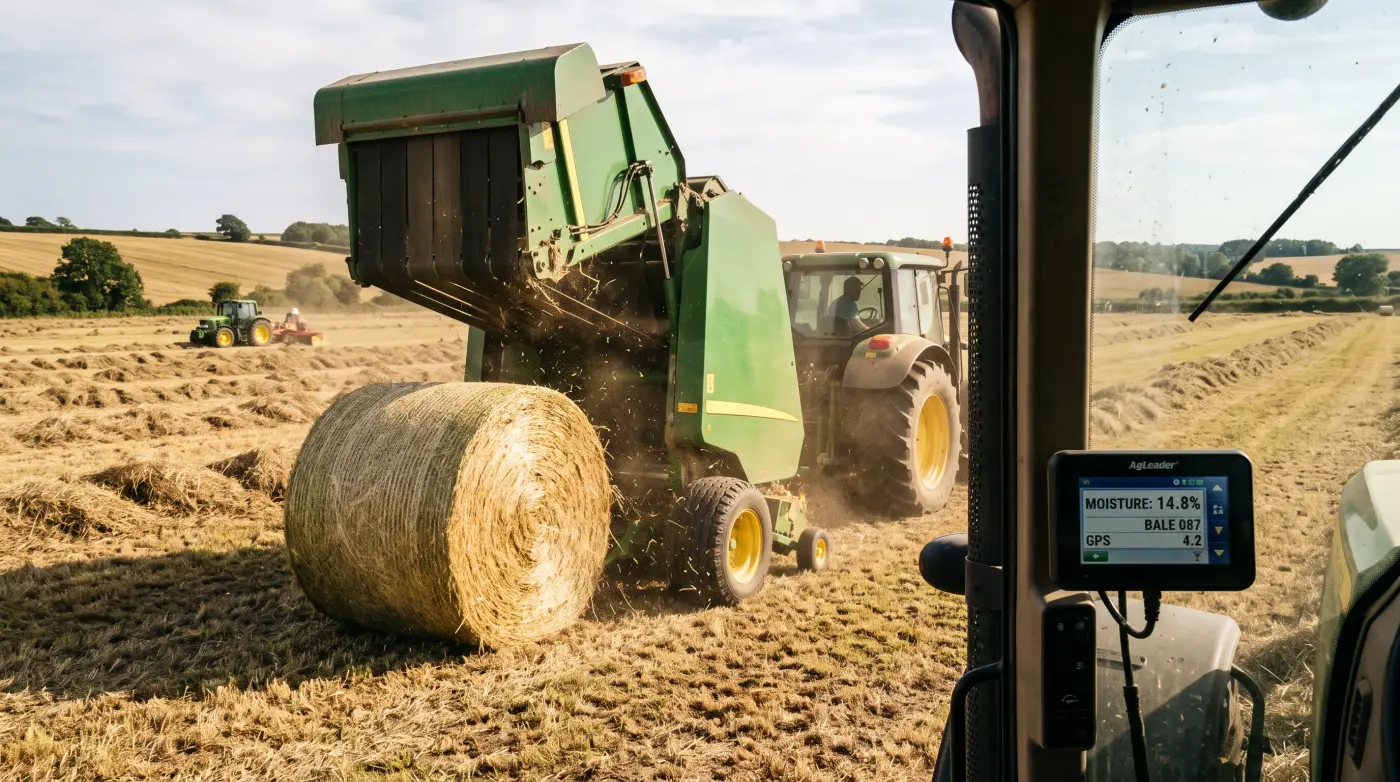
A baler monitor reads hay moisture as the crop feeds into the chamber, and on automated systems it triggers a variable-rate applicator to spray buffered propionic acid whenever the hay runs too wet. Together with per-bale weight sensing, the setup lets you bale nearer the wet edge of the safe window, keep the leaves, and log every bale.
Every hay maker knows the clock. Wait too long and the leaves - about half the weight of an alfalfa plant and roughly 90 percent of its feed value - go brittle and shatter off the stems when the pickup grabs the windrow. Go too early and the bale heats, molds, and in a bad case catches fire in the stack. The window where dry alfalfa bales clean and stores safe is narrow, roughly 14 to 18 percent moisture, and on a lot of afternoons it is open for only a few hours. "Smart baler" gear exists to widen that window and buy you more baling hours without losing the tank. This is a look at what it actually does, what it does not do, and where the honest limits are.
The phrase bundles three separate systems that solve different problems. It helps to keep them straight before you spend a dollar.
The first is on-the-go moisture sensing - a sensor that reads the crop's moisture continuously as it enters the chamber. The second is an automatic preservative applicator, a tank-and-spray rig that the sensor triggers to lay down buffered propionic acid when the hay is running wet. The third is bale weight sensing plus baler automation, which weighs each bale, pairs it with moisture, and can take over the tedious mechanics of stopping to tie and steering for a uniform bale.
None of these is the same purchase, and you do not need all three. Moisture sensing is the foundation everything else hangs on. The applicator is the one that changes what moisture you can safely bale at. Weight and automation are labor and record-keeping tools that ride along.
Most systems read moisture through electrical resistance. Water conducts and dry hay insulates, so wetter hay shows lower resistance and drier hay shows higher. A chamber sensor reads that continuously as the crop flows past.
The baler-mounted version people know best is the star-wheel sensor: two conductivity star wheels ride the forming bale and read moisture side to side, measuring resistance through the stem rather than just skimming the surface. They self-calibrate as bale density changes, and the working range runs roughly 8 to 70 percent, which covers everything from bone-dry to baleage-wet.
Here is the part the brochure underplays, and it is the most important thing to understand: the number on the monitor is a moving, local reading, not the true moisture of the whole bale. Hay can gain or lose 3 to 5 points of moisture in an hour as the dew burns off or comes back, and a single windrow can vary as much as 10 points end to end. The star wheel reads a thin slice of a forming bale, not its core. So the sensor is genuinely useful for guiding the applicator and telling you when to start and stop, but it does not replace a handheld probe and your own judgment. Cross-check it. If you already run a probe and want the counterpart discipline, see the companion piece on hay moisture testing.
Buffered propionic acid, sold as ammonium propionate, is the standard hay preservative. It inhibits the mold and bacteria that drive heating in slightly-too-wet hay, which is what lets you push the safe baling edge from around 18 percent up toward the mid-20s. The word buffered matters: unbuffered propionic acid is caustic to equipment and to skin, and buffered formulations were developed specifically to cut that corrosion. Buy buffered. There is no good reason to run the raw acid.
The rate scales with how wet the hay is. The numbers most extension services publish look like this:
| Hay moisture | Active ingredient | Roughly per ton |
|---|---|---|
| 20 to 25 percent | about 0.5 percent | about 10 lb |
| 25 to 30 percent | about 1.0 percent | about 20 lb |
Effectiveness drops off above 25 percent, and the product can be cut to a 50 percent solution with water for better coverage at the higher rates. On the hardware side, adding a spray system to a baler starts around $1,000 and climbs from there. The tanks and nozzles mount on the baler, the nozzles are spaced to cover the forage evenly as it enters the chamber, and the whole thing has to be calibrated to your bale-formation speed and spray volume or the rate on the label means nothing.
One thing not to spend on: microbial or bacterial inoculants marketed for dry hay. Extension trials show little consistent value from them on dry hay, though they do no harm. Do not confuse them with silage inoculants, which are a legitimate and different tool for wet-wrapped forage.
The manual version of an applicator sprays at a fixed rate you set by hand. The automatic version closes the loop: the moisture sensor feeds the rate. As the hay gets wetter across a field or through the afternoon, the system pushes more acid; as it dries, it backs off. On the reference systems, that adjustment happens on a tight cadence and targets a rate for the current hay condition, all shown on the baler's ISOBUS display or a tablet reading out moisture, baling speed, and how much preservative is going down. Harvest Tec's 700 series is the common name here, with AGCO selling the equivalent under the Hay Boss brand, and versions exist for large square, round, and small square balers. Treat the tightest accuracy and cadence figures as vendor claims rather than gospel, but the concept is sound: variable-rate spraying tied to a live moisture read is a real improvement over a fixed setting on a field that is anything but uniform.
This is where you want the honest neighbor and not the salesman, because the answer is: it depends heavily on the bale, and round bales are the weak case.
In large square bales, propionic acid works well. In one study, high-moisture hay baled at 27.4 percent and treated accumulated only about 30 percent of the heating degree days of untreated hay. Since digestibility and total digestible nutrients each fall roughly half a point per 100 heating degree days, cutting that heat directly protects feed value. Dense square bales hold the acid against the forage and it does its job.
In large round bales, the results disappoint. The best case in the same body of work was only about 121 fewer heating degree days, in hay baled near 20 percent, and hay baled above roughly 28 percent actually heated more when treated than when left alone. The takeaway to state plainly: preservative is far more reliable in dense square bales than in round bales, and it is not a rescue for genuinely wet hay. Either way the effect is temporary, holding dry-matter losses down mainly in the first four weeks of storage and then dissipating.
There is a line, and crossing it without knowing changes what you are doing entirely. Below roughly 30 percent moisture you are preserving dry hay - widening the window at the margins with acid. Above about 30 percent you are no longer making dry hay at all. That is baleage, and it needs a different system: wrap the bale to exclude oxygen and let it ferment, ideally with a silage inoculant. Spraying acid on 35 percent hay and stacking it dry is not a shortcut to baleage. It is a fire waiting for a warm week. If your hay is running that wet by design, commit to the wrapped-and-fermented path and monitor it the way you would any ensiled forage. The companion piece on silage quality monitoring covers what that looks like.
Modern round balers can weigh each bale in near real time and pair the weight with its moisture, then push both to a farm data account for after-harvest analysis: inventory, total tonnage, and a moisture map of what you put up. John Deere's Bale Doc on the 1 Series is the familiar example, sending per-bale weight and moisture to the Operations Center.
The number to keep honest is scale accuracy. Load-cell bale weighing is thrown off on slopes, because on a hillside the forces no longer line up with the load-cell axis and the system underestimates weight unless it corrects for slope, bale size, and shape. Published targets land around a pound or two of accuracy, but read those as design targets, not a guaranteed field number on rolling ground. Where this data really earns its keep is not the individual bale but the season-long picture, and that only pays off if it lands somewhere you actually use. A farm record-keeping system that ingests per-bale weight and moisture turns a pile of readings into a tonnage and quality record you can market against.
Separate from any of the sensing, baler automation takes over mechanics that used to be all operator. Speed or stop-tie automation halts the tractor at the exact moment the bale reaches full size, so every bale comes out the same size, shape, and weight instead of varying with how fast your foot was that pass. Weave automation steers the baler side to side to spread the crop evenly across the chamber for a denser, more uniform bale.
Be clear about what this is: a consistency and fatigue play, not a hay-quality play. It will not save a wet bale or a shattered leaf. What it does is take the strain out of a long day and make your bales uniform enough that everything downstream - stacking, hauling, feeding, selling - gets easier. If your operation runs long baling days with tired hands on the throttle, that is worth something real. It just is not the same something the moisture and preservative gear gives you.
Right at the center, because it is the reason the wet wall of the window exists. Heating happens in all hay above about 15 percent moisture, and it normally peaks at 125 to 130 degrees within three to seven days with little risk. Above about 130 degrees a chemical reaction starts producing flammable gases, and by around 150 degrees spontaneous combustion is imminent. Most hay fires start within six weeks of baling.
The thing to sit with: preservative reduces the risk but does not erase it. Treated wet hay can still heat, especially in round bales, so the safety habit does not change. Put a thermometer probe into your higher-moisture stacks and check bale temperatures through that first six-week window. The sensor and the acid keep you off both walls of the window. Your own temperature checks are the backstop when they do not.
On-the-go moisture sensing plus a buffered-acid applicator widens the baling window and saves leaves at the margins. That is a genuine gain: more baling hours a day, less shatter loss, fewer nights spent watching a forecast. What it is not is a license to bale wet hay. The acid is strong in square bales and shaky in round ones, it fades after a month, and above 30 percent moisture you are in baleage territory and should treat it that way. The sensor guides but still lies by a few points, so keep the probe in the truck. Buy the tool for what it actually does, calibrate it, and keep checking bale temperatures for six weeks. Do that and this gear pays for itself the first afternoon it lets you start an hour early and finish an hour late with the leaves still on.
If you are wiring up sensors and want the moisture-and-heat picture on the storage side too, the guides on grain bin monitoring systems and yield monitor calibration cover the same calibrate-or-it-lies discipline for the rest of the operation.
Dry alfalfa bales best at roughly 14 to 18 percent moisture. Below about 13 percent the leaves shatter and you lose feed value; above the window the bale molds and can heat or catch fire. Safe moisture also depends on bale size: small squares around 20 percent or less, large rounds near 18 percent, and dense large squares closer to 15 to 16 percent.
Rate scales with moisture. Hay in the 20 to 25 percent range typically takes about 0.5 percent active ingredient, roughly 10 pounds per ton. Hay in the 25 to 30 percent range takes about 1.0 percent, roughly 20 pounds per ton. Effectiveness drops off above 25 percent, and at higher rates the product is often cut to a 50 percent solution with water for better coverage. Use buffered acid.
Not reliably. Propionic acid protects dense large square bales well, cutting heating substantially at moistures near 27 percent. In large round bales the benefit is small, and hay baled above roughly 28 percent can actually heat more when treated than untreated. Preservative is best thought of as a square-bale tool and never as a rescue for genuinely wet hay in any package.
Useful for guidance, not precise enough to trust alone. Hay moisture can swing 3 to 5 points in an hour, and a single windrow can vary up to 10 points end to end. A star-wheel sensor reads a thin slice of a forming bale, not its core. Use the reading to trigger the applicator and time your baling, but confirm with a handheld probe before making marketing decisions.
Hay above about 15 percent moisture heats naturally, usually peaking at 125 to 130 degrees within a week with little risk. Above 130 degrees it begins producing flammable gases, and near 150 degrees spontaneous combustion becomes imminent. Most hay fires occur within six weeks of baling, so check bale temperatures through that window even when the hay was treated with preservative.
Join our list for practical guides on farm tech, precision agriculture, and tools that work.