
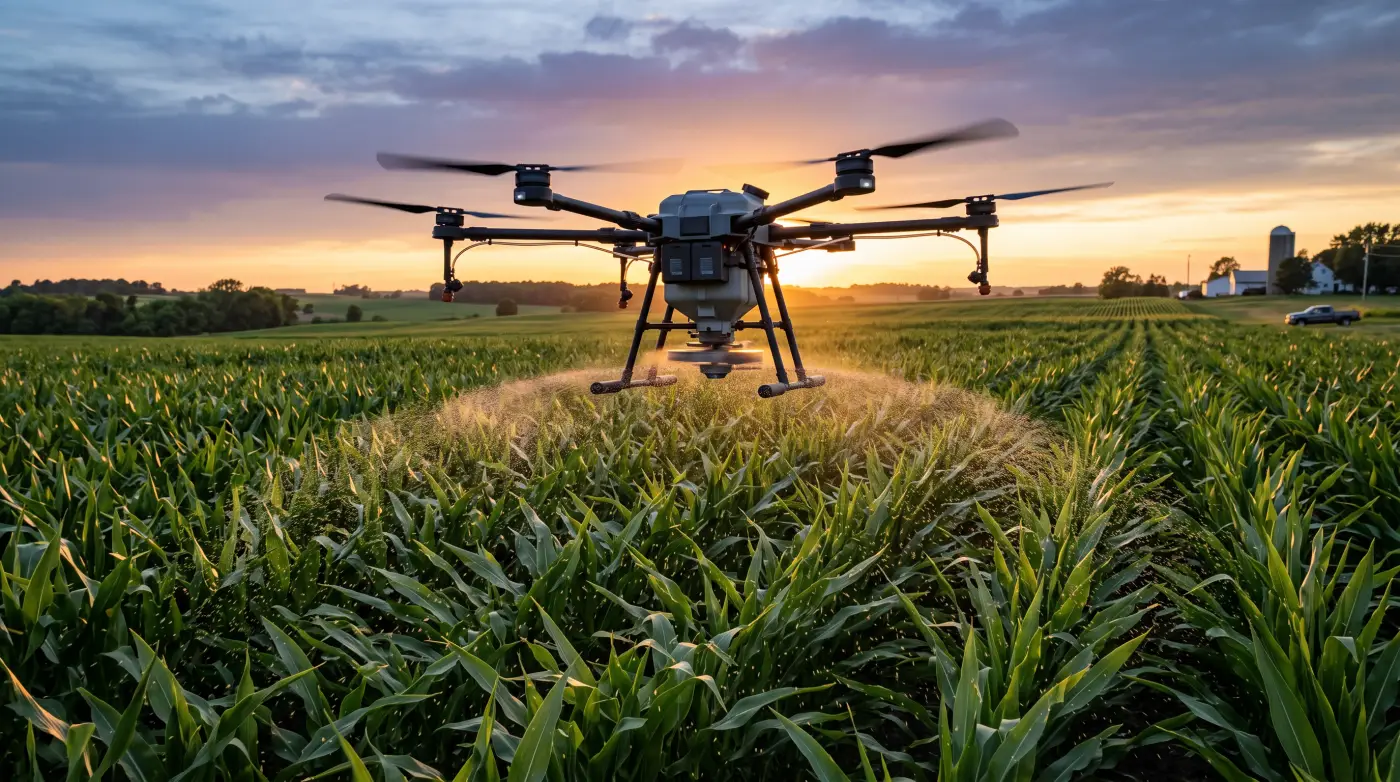
Drone cover crop seeding broadcasts seed from the air onto a standing corn or soybean crop, weeks before harvest. Its one real advantage over a post-harvest drill is timing - the seed gets an earlier start on fall growth. Establishment is less uniform and depends on rain, so that head start is what you pay for.
That is the whole honest case for flying seed on, and it is worth sitting with before you write a check. Most of what you will read about ag drones is written by people selling ag drones. The stand you get from a drone is not better than a drill. It is earlier. Whether earlier is worth the trade depends entirely on your calendar and your ground.
You take a heavy-lift agricultural drone, bolt a granular spreader onto it in place of the spray tank, load it with cover crop seed, and fly a grid over a field that still has a cash crop standing in it. The seed falls through the canopy and lands on the soil surface and the residue. Nothing incorporates it. There is no furrow, no press wheel, no depth control. It is broadcasting, done from fifteen feet up instead of off the back of a spinner buggy.
The machine doing most of this work is a DJI Agras T50 class drone with a spreading attachment. Vendor specs put dry payload around 90 to 110 pounds and quote coverage up to roughly 50 acres per hour in ideal conditions. Treat that throughput number as a showroom figure. Between battery swaps, refills, and ferrying back and forth to the tender, real cover crop output on a working day is a good deal lower. A single drone realistically covers a few hundred acres in a day, not a few thousand.
The reason this practice is spreading is not that farmers are buying dedicated seeding drones. It is that the same drone a grower or co-op already flies for spraying now takes a spreader as a standard accessory. The seeding is a second job for a machine that was already justified on herbicide and fungicide. That changes the math, and it is why aerial cover crop seeding has gone from novelty to a real line item in a few short seasons.
Here is the problem drone seeding solves, and it is a calendar problem, not a technology problem.
In the Corn Belt, a cover crop drilled after grain harvest often runs out of season. By the time the combine is out of the corn or the full-season beans, you are into mid or late October. There is not enough heat and daylight left for the cover to put on meaningful fall growth. You get a thin, tentative stand that limps into winter having done very little for your soil.
Flying the seed on while the cash crop is still standing moves that seeding date up by weeks. The window runs roughly from early August through early October, depending on the crop and your latitude. Penn State's guidance for soybeans is to seed at the very start of leaf yellowing, which in Pennsylvania lands in the last week of September or the first week of October. Those extra weeks are the product. That is what the drone is selling you, and it is the only thing a drill physically cannot do, because a drill cannot get into a field that still has a crop in it.
So the first question is not "is the drone good?" It is "will I actually cash in the extra time?" If you terminate early the following spring, right around cash crop planting, a lot of that head start evaporates. The payoff shows up when you let the cover run - late termination into late May or June, or planting green into a living cover. If that is not your system, the timing advantage has nowhere to go, and a reliable post-harvest drill is the better tool.
This is where the honest version departs from the sales version, and it is worth being specific because the data is unusually good here.
Penn State ran a five-year study, from 2020 through 2024, funded by the Pennsylvania Soybean Board, testing nine cover crop species broadcast by drone into standing soybeans against the same species drilled after harvest. The results are not a clean win for either method. They are a lesson in timing.
In the fall of 2022, broadcast beat drill at some sites and lost at others. At one Berks County site the drone-seeded cover produced 409 pounds per acre of biomass at termination while the drilled plot produced zero, because the drill had to wait for a late harvest and never got established. At a Franklin County site it went the other way, with drilled cereal rye at 589 pounds against 211 for broadcast. Mixed, site by site.
The following year told a cleaner story. At cooperator sites in the fall of 2023, a late-September drone seeding hit 3,794 pounds per acre against 3,462 for the drill. At the research station, broadcast plots seeded September 27 and October 4 produced 2,731 and 2,558 pounds against just 1,686 for the post-harvest drill. When the broadcast went on early and bought real weeks, it won, and it won because the drill was stuck waiting on the combine.
The researchers' own blunt summary is the line to remember: there is no benefit to broadcasting cereal rye into standing soybeans if you do it within one month of soybean harvest. In other words, the drone only pays when it buys genuine extra time and you have a late termination to spend that time on. Fly it on three weeks before you would have drilled anyway, terminate early, and you have spent money to get a slightly worse stand.
Two things make broadcast-on-surface less dependable than a drill, and neither is a secret.
The first is uniformity. Ohio State measured the spread uniformity of drone cover crop seeding and found a coefficient of variation running from 18 percent up to 31 percent. A grain drill places every seed at a controlled depth and spacing, near perfectly. A drone throws seed across a swath, and how evenly it throws depends on the seed. Dense, round seed like cereal rye spreads evenly. Light, fluffy, or mixed seed spreads less evenly, and the effective swath width shifts with it. That variability is the price of doing the job from the air, and it is worth planning your rate and species around rather than pretending it away.
The second, and the bigger one, is seed-to-soil contact. Broadcast seed sits on top of the residue with nothing pressing it into the ground. It needs a rain within a few days to wash it into contact and get it germinating. A dry spell right after seeding is the classic failure mode, and it is the single most common way a drone cover crop job disappoints. The standing canopy actually helps here, shading and humidifying the soil surface, and later the falling leaves mulch the seed. But none of that substitutes for a timely rain. If you fly seed on into a dry forecast with no moisture in sight, you are gambling.
This is exactly the kind of window worth watching closely. A tool like the free Spray Window Planner or the streamflow and precipitation watch on the Manley Farms tools page will not put the seed in the ground for you, but they will tell you whether the rain you are counting on is actually coming before you commit the drone and the seed.
Species selection is where a lot of the reliability is won or lost, and Penn State was direct about it.
Cover crops with vigorous surface germination handle broadcast conditions. Cereal rye is the workhorse, followed by winter wheat, annual ryegrass, and the brassicas like rapeseed and forage radish. These establish from surface contact and shrug off imperfect placement better than the alternatives.
The alternatives to avoid are the small, hard-seeded legumes. Penn State's research found clovers underperform when broadcast on top, and their recommendation is plain: skip clover species for this practice. Crimson clover, red clover, Balansa clover, hairy vetch - these want soil contact the broadcast method cannot reliably give them. If you want a legume in the mix badly enough, that is an argument for drilling, not for flying. Match the species to the method, and the method here rewards the tough, aggressive grasses and brassicas.
Because you are giving up placement, you buy some of it back with seed.
Penn State's drone-seeded cereal rye went on at about 80 pounds per acre in their trials, while their drilled comparison ran 120. But the general rule for broadcast and aerial work runs the other direction from that particular comparison: because establishment percentage is lower when seed sits on the surface, you raise the broadcast rate above what you would drill, commonly by 20 to 50 percent, to land the same final plant stand. You are paying in seed for the placement you did not get. That extra seed cost is real and belongs in your budget next to the application fee, not buried under it.
If you are running the numbers on how much seed a given field actually needs at a bumped rate, the Field Boundary and Input Calculator will handle the acreage and the seed math off a drawn boundary, which beats guessing off an old FSA map.
The drone is not the only way to get seed on early, and it is not always the best one. Here is the honest comparison.
| Method | Cost per acre | Daily coverage | Best fit |
|---|---|---|---|
| Drone broadcast | ~$12-20 application only | ~200-400 acres | Small, irregular, or tree-lined fields; no acreage minimum |
| Airplane broadcast | ~$12-18 application only | 500-2,000+ acres | Big, open acreage |
| Post-harvest drill | Varies, often lowest | Field-dependent | Anywhere reliability matters more than early timing |
Read those cost figures as ranges from custom operators, not quotes. Application only runs roughly $12 to $20 per acre for a drone, and seed sits on top of that. Aerial overseeding all-in with seed is often described around $20 to $30 per acre. Keep those two numbers separate in your head so you do not understate the real cost.
The airplane and the drone land in nearly the same cost neighborhood per acre, so price is not the deciding factor. Coverage and field shape are. A plane covers enormous ground fast but will not fly small jobs - typical minimums are 40 acres, sometimes 80 - and it needs open approaches. The drone has no minimum and threads into small, odd, tree-lined fields a plane cannot service, but a single machine is battery-limited on big tracts. Big open ground favors the plane. Small and awkward ground favors the drone. And if you are harvesting early enough that a post-harvest drill still gives the cover a fair fall, the drill remains the most reliable and often the cheapest of the three.
Broadcasting seed from a drone is a regulated agricultural aircraft operation, and this is the part farmers most often overlook.
Federal aviation rules, 14 CFR Part 137, govern aircraft that dispense substances for the propagation of plant life, and that explicitly includes seeding. A drone under 55 pounds operates under Part 107 but still needs the relevant exemptions. A T50 class drone fully loaded is over 55 pounds, which pushes it into Part 91 and Part 137 territory, requiring Part 137 certification plus exemptions. The FAA has been streamlining the certification path for drone operators, and as of early 2026 it eased some of the front-end paperwork, but the core requirement has not gone away.
The practical implication is simple. Most farmers do not certify themselves to seed a few hundred acres of cover crop. They hire a Part 137 certified custom operator who already holds the paperwork and flies the missions for a living. That is the normal path, and it is the one to plan around unless drone application is going to be a real part of your operation. If you want the deeper version of the regulatory picture, that is its own subject worth reading up on before you commit either way.
Run this short checklist before you book an operator.
If most of those point yes, drone seeding earns its place in your rotation. If they point no, you are better served by a drill.
The drone is not planting your cover crop better. It is planting it sooner, and sooner is the only thing you are paying for. When your calendar can actually spend that head start, it is money well spent. When it cannot, the honest answer is to keep the seed in the drill.
Manley Farms builds free tools for exactly these decisions - weather windows, streamflow and rainfall watch, soil lookups, and field input math, all pulling from public government data with no login and no cost. If planning around timing and moisture is the hard part of a call like this, start with the tools, and sign up for updates if you want new ones as they ship.
Custom drone cover crop seeding runs roughly $12 to $20 per acre for application only, with seed cost on top of that. All-in with seed, aerial overseeding is often described in the $20 to $30 per acre range. Treat these as operator ranges rather than firm quotes, since public pricing data is thin and varies by region, field size, and seed choice.
Fly the seed on while the cash crop is still standing but nearing maturity, roughly early August through early October in the Corn Belt. Penn State's target for soybeans is the onset of leaf yellowing, often the last week of September or first week of October. The goal is to buy weeks of fall growth the cover would never get if you waited for harvest.
Yes. Dispensing seed from a drone falls under FAA Part 137 agricultural aircraft rules, and heavy-lift drones over 55 pounds require Part 137 certification plus exemptions. Because that certification is involved, most farmers hire a Part 137 certified custom operator rather than certifying themselves for a handful of missions each fall.
Cereal rye, winter wheat, annual ryegrass, and brassicas like rapeseed and forage radish broadcast well because they germinate vigorously from surface contact. Avoid clovers and small hard-seeded legumes - Penn State research found they underperform when broadcast on top without soil incorporation. If a legume is essential, drilling suits it far better than aerial seeding.
Not for stand quality. A drill places seed more uniformly and reliably, with measured broadcast spread variability running 18 to 31 percent. The drone's only structural advantage is earlier timing, since it seeds before harvest. It wins when your harvest is late and you terminate the cover late enough to use the extra growth. Otherwise a post-harvest drill is the safer choice.
Join our list for practical guides on farm tech, precision agriculture, and tools that work.