
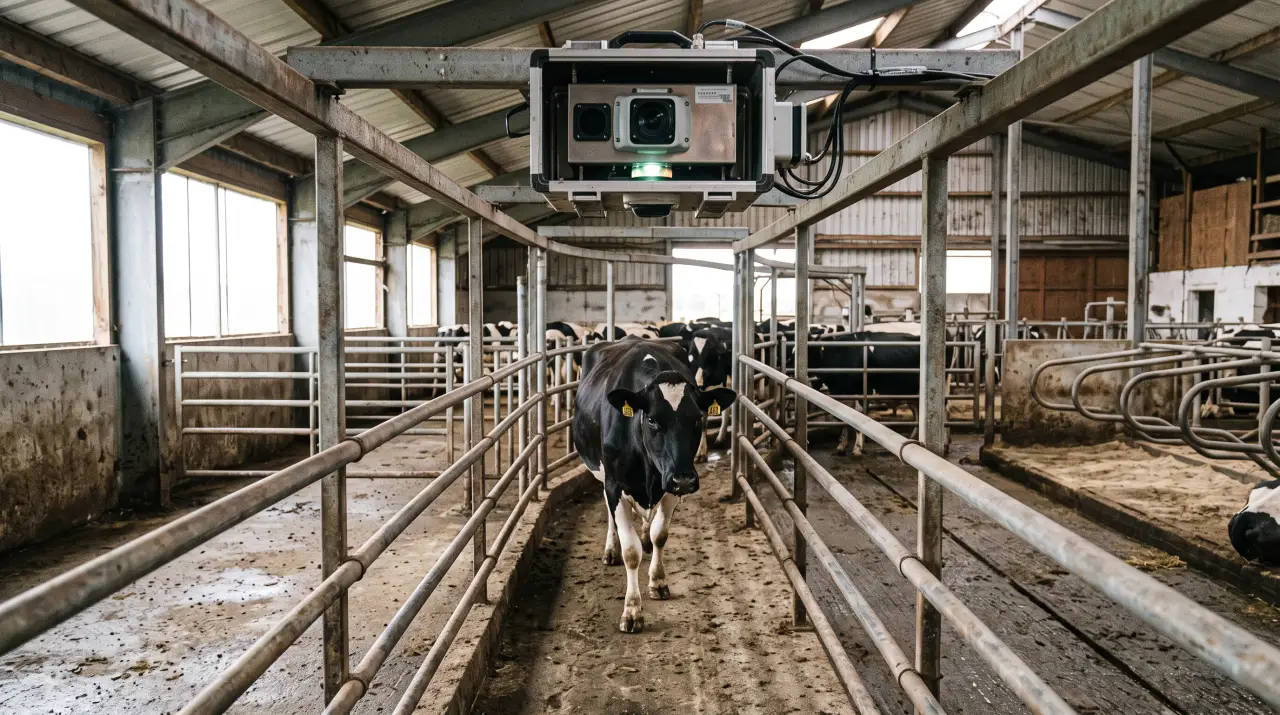
Machine vision body condition scoring uses a fixed camera over the milking parlor exit to read the same landmarks a trained scorer checks - hooks, pins, tailhead - and log a BCS for every cow, every day. It is accurate in the middle range, weaker at the thin and fat extremes, and it remains a dairy tool, not a beef-on-pasture one.
That last sentence is the whole story, and most of the marketing around these systems buries it. So before you price a camera, it is worth being clear about what the technology genuinely does well, where it quietly lies to you, and whether your operation even has the one thing that makes it work.
Body condition score is the fat-cover number every producer already knows. Dairy runs a 1-to-5 scale in quarter-point steps; beef runs 1-to-9. Either way you are estimating how much subcutaneous fat a cow is carrying by looking at and feeling the same spots: the hooks and pins, the tailhead ligaments, the short ribs, the line of the spine.
Nobody argues about whether BCS matters. It is the number sitting behind fertility, transition-cow health, and feed efficiency. A cow that calves down too fat is a candidate for ketosis and milk fever and going off feed. A cow that milks herself too thin does not settle back in calf on time. In beef, the thin cows in a fall run breed back late and cost you a whole calving cycle. The score is a leading indicator, which is exactly why catching a change early is worth something.
The problem was never that BCS is unknown. The problem is that scoring by eye and hand is subjective, it drifts between people and even for the same person over a season, and because it takes real labor, most operations score the whole herd a handful of times a year at best. You end up acting on a number that is three months stale and a quarter-point soft. That gap - not the concept - is what a camera is built to close.
A camera body condition scoring system mounts over a place the cows already walk single-file: the exit lane of the milking parlor, or the sort gate on a robotic milker. It looks down at the cow's back as she passes. The software finds the anatomical landmarks - pin bones, hook bones, thurl, the tailhead and sacral ligaments, the short ribs - measures the geometry of that back and rump, computes a score, and logs it against her ID in the herd-management software.
The parlor exit is the entire trick. Cows file under it, already identified, at every single milking. So the system re-scores the whole herd twice a day with no extra labor, no chute work, no one standing in the alley with a clipboard. That is why dairy got this technology first and beef did not, and it is the fact that should shape how you think about the rest of it.
There are two hardware routes. The traditional one is a 3D depth camera, which captures the actual contour of the back and has long been the accurate approach. The newer one is an ordinary 2D camera running a well-trained algorithm, which recent work has pushed to comparable accuracy. That 2D result is what makes a cheap retrofit possible - you may be able to point an existing overhead camera at the problem instead of buying a proprietary 3D unit.
Two names come up.
DeLaval BCS is marketed as the first commercially available automatic body condition scoring system. It is a 3D camera mounted on a DeLaval sort gate or VMS robot, taking a 3D image of the cow's lower back at every pass and logging the score in DelPro Farm Manager, where you can see individual cows, groups, and whole-herd trend graphs.
CattleEye takes the 2D route. It runs on a single ordinary camera over the parlor exit, scores both locomotion (lameness) and body condition, and is pitched as retrofittable to cameras you may already have and compatible with a range of parlor and herd-software brands. GEA licensed the technology and launched it as GEA's AI Body Condition Scoring on November 28, 2024. CattleEye's own figures claim lameness flagged up to 23 days before it is visible to the eye and up to a 75 percent reduction in severely lame cows on some farms. Read those as vendor numbers, because that is what they are - useful for knowing what the company promises, not the same as independent proof.
This is not a buyer's guide, and the systems will keep changing. The point is that the category is real and shipping, on both the expensive-3D and cheap-retrofit-2D ends.
Here is the part worth slowing down for, because it is where the sales sheet and the science part ways.
The strongest independent check is a University of Kentucky validation of the DeLaval system, run on a working 3,200-cow Holstein-Friesian dairy in Greensburg, Indiana, with 343 cows scored. The automated scores correlated with careful manual scoring at r = 0.78, which is a strong correlation, with a mean error of about -0.1 BCS. Inside the 3.0 to 3.75 range that covers most of a healthy milking herd, the camera landed within the 0.25-point error that separates good human scorers from each other. In that middle band, the machine is genuinely as good as a trained eye.
Then the honest caveat. In that same study, the system over-estimated 44 percent of the cows that manually scored below 3.0, and under-estimated 92 percent of the cows above 3.75. In plain terms, it is least reliable at exactly the two ends of the scale - the thin cows and the fat cows - which are the animals you most want it to flag. A separate machine-learning model, reported to underlie the commercial DeLaval system, put 74 percent of its scores within 0.25 of the true value, 91 percent within 0.5, and 100 percent within 1.0. Good numbers, but the extremes weakness rides along with them, and it shows up across systems and papers, 2D and 3D alike. It is not one vendor's flaw. It is the current state of the art, and the fix - more training data at the extremes - is the same everywhere.
So if you were expecting a camera that reliably rings the bell the moment a cow slides to a 2.5, adjust that expectation. On the single reading, at the single moment, at the extreme, it is soft.
The extremes weakness sounds fatal until you remember what you are actually buying, which is not one perfect reading. It is a reading every day, on every cow, without anyone doing the work.
A cow does not drop from a 3.25 to a 2.25 in a morning. She drifts. And a system that scores her at every milking will show that drift - a line bending down over two or three weeks - long before a quarterly hand-score would have caught it, even if the absolute number at the bottom of the slide is a quarter-point off. You are not trusting the camera to nail her thin score. You are trusting it to show you she is heading there while there is still time to change her ration or her group. That is a real thing a clipboard four times a year cannot do, and it is the honest case for the technology. Sell yourself on the trend line, not the number.
This is the same logic we laid out for rumen bolus sensors: the value of continuous monitoring is not any one heroic reading, it is catching the direction of travel early.
Prepare to be annoyed here. The only public figure worth quoting is Farmers Weekly citing DeLaval "from £1 a cow a day, including software support charges." Take that at face value and it is roughly £365 per cow per year, which for a 200-cow herd would be an enormous number - almost certainly why it is a headline "from" figure that bundles the camera, the sort-gate hardware, and the DelPro subscription rather than a standalone camera price.
Treat it as one reported data point, not a quote. Real pricing is quote-only and swings hard on a single question: do you already run the vendor's parlor and sort gate? If yes, you are adding a camera and a subscription to a system that is already there. If no, you are buying infrastructure, and the math is a different animal. The retrofit 2D route (an ordinary camera plus a software subscription) is structurally cheaper, but no verified price for it turned up, and we are not going to invent one. Get a current quote for your specific setup and do not let a "from" number stand in for a total cost of ownership.
One more honest note on the benefit side. One Scottish dairyman, Grant Smith at Kelton Hill Farm, reported his calving interval fell from 415 to 390 days while running the DeLaval camera, and credits keeping cows in better condition. Twenty-five days is a meaningful swing, but it is one farm with no control group, and the camera did not manage those cows - it gave him better data and he made better calls. That is the right way to read every case like it: the tool informs management, it does not do the managing.
Short answer: this is a dairy technology, and for beef it mostly does not exist yet in the form that matters.
The reason is structural, not a lack of trying. Beef has no parlor. There is no place every animal walks single-file, identified, twice a day, so there is no free daily imaging choke point to hang a camera over. Strip that away and the whole model falls apart. What is actually available today for beef is two things.
First, smartphone apps. You photograph the cow, the app scores her, some compare against reference images and geo-tag the record. These do remove the subjectivity and standardize your records, which is worth something. What they do not remove is the labor - you still have to get within camera range of each animal, which on open ground is the entire cost.
Second, research. A 2026 model called EdgeBCS-YOLO scored beef cattle from an alley or chute view, built from 7,904 images of 494 cattle across three commercial farms, running in real time on a small edge device, with reported precision around 90 percent. Notably its dataset only covered BCS 3 through 7 - the extremes were missing again, the same gap as in dairy. It is a proof of concept, not a product you can buy, and the researchers were blunt about why beef is hard: motion blur, animals blocking each other in the pen, manure on the coat, changing outdoor light, and low-contrast fat texture on the tailhead in an unstructured setting. The clean single-file parlor pass hands the dairy algorithm an easy photo. The pasture hands the beef algorithm a mess.
The realistic beef path is the chute or the single-file working alley. If you already run cattle through a chute regularly to work, weigh, or sort them, a fixed camera over that alley is the plausible near-future version of this technology, and it is worth watching. On open grass, for now, it is a scoring app and your own two eyes. If you are already using ear tags or collars to keep tabs on the herd, our writeup on cattle GPS ear tags and virtual fencing covers where that automation genuinely pays and where it does not, which is the same kind of honest filter this technology needs.
The decision rule is clean.
If you run a parlor or robotic dairy, you are already on the vendor's herd software, and you want objective condition trends on the whole herd without adding labor, this is worth pricing. Ask for a quote that reflects whether you already have the sort gate, and buy the daily trend, not the promise of a perfect thin-cow alarm.
If you run beef on pasture, this is not your tool yet. Use a scoring app to kill the subjectivity in the records you already keep, keep working cattle through the chute, and watch the alley-camera research. Do not let anyone sell you a parlor technology for a pasture problem.
Either way, a camera is only as useful as the records you act on. If you are still scoring by hand and the numbers live on scattered notes and a whiteboard in the barn, the first upgrade is not a camera at all - it is a place to keep the history so a trend is even visible. That is exactly why we built Homestead OS, a simple record-keeping system for small operations, and if you want to eyeball where cattle and feed prices are sitting while you plan, our free USDA Market Price Snapshot pulls the latest reports. The technology will keep getting better. The habit of writing the number down and watching where it goes is what pays now.
In the middle of the scale it is. Independent testing of the DeLaval system on a 3,200-cow dairy found automated scores correlated with manual scoring at r = 0.78 and landed within the accepted 0.25-point error in the 3.0 to 3.75 range. It is much less reliable at the thin and fat extremes, so its real value is the daily trend across the herd, not one exact reading.
A camera mounts over the milking parlor exit or robot sort gate and looks down at each cow's back as she passes. Software locates the same landmarks a human scorer uses - hook and pin bones, the tailhead and sacral ligaments, the short ribs - measures the geometry of the rump, computes a BCS, and logs it against the cow's ID in the herd-management software, every milking.
Not yet as a fixed camera, because beef has no parlor where every animal walks under a camera daily. Today the honest beef tools are smartphone apps, which standardize records but do not remove the labor of reaching each animal, and research models scored from a chute or alley. If you already run cattle through a chute, an alley camera is the plausible near-future path.
Real pricing is quote-only. The one public figure is DeLaval "from £1 a cow a day," which almost certainly bundles the camera, sort-gate hardware, and software subscription rather than a standalone price. Cost depends heavily on whether you already run the vendor's parlor and sort gate. The 2D retrofit route is structurally cheaper but has no verified public price, so get a current quote for your setup.
3D depth cameras have traditionally been the accurate approach because they capture the actual contour of the cow's back. Recent work has pushed well-trained 2D algorithms to comparable accuracy, which matters because a 2D system can retrofit an ordinary overhead camera you may already own instead of requiring a proprietary 3D unit. For a farm choosing today, 2D lowers the hardware barrier considerably.
Join our list for practical guides on farm tech, precision agriculture, and tools that work.