
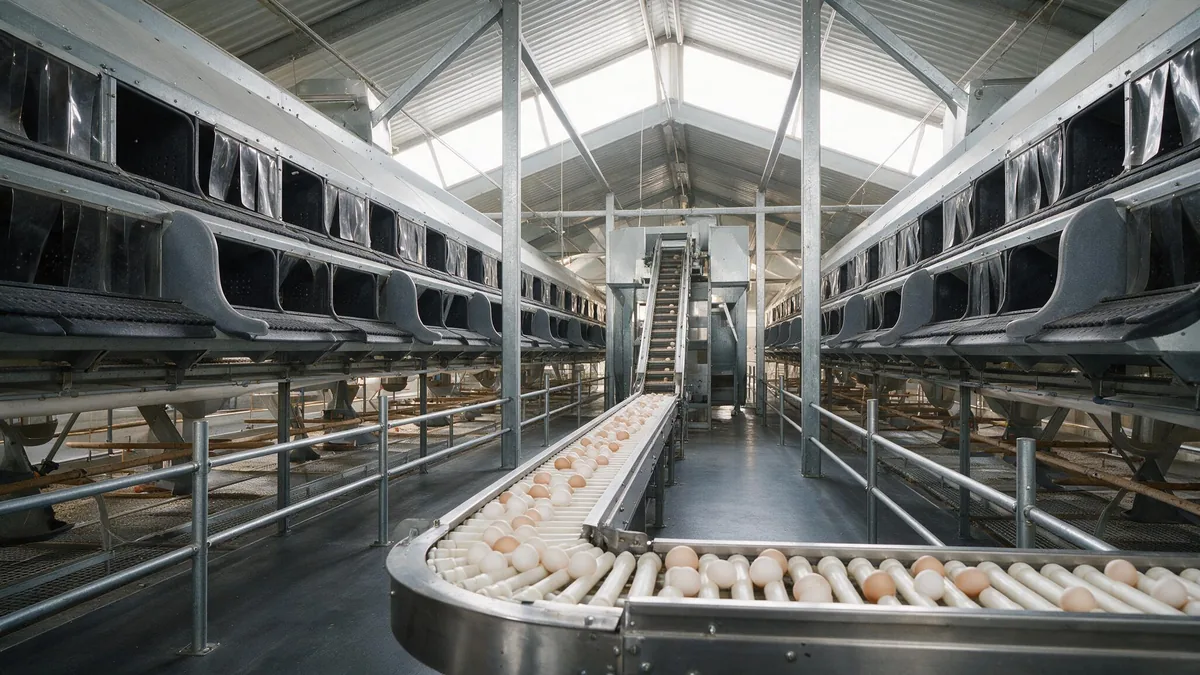
Robotic egg collection today means three different technologies at three different stages of readiness. Belt-and-grader systems already gather and inspect nest eggs hands-free and have for decades. Robots that pick eggs off the floor are still research prototypes. And the one barn robot you can actually buy does not collect eggs at all - it herds hens away from the floor.
That gap between the headline and the hardware is where producers lose money. A layer barn full of belts and cameras is not "robotic" in the way the trade-show video implies, and the machine in that video usually does not ship. If you are converting to cage-free and trying to figure out what to automate - alongside the barn's climate and ventilation controls that keep the flock alive - the honest starting point is knowing which of these three things you are actually buying.
Because the cage-free transition handed producers back a problem the battery cage had quietly solved: the floor egg.
A conventional cage collected every egg automatically because the hen never touched the floor. She laid, the egg rolled to a belt, and it left the house without a human hand on it. Cage-free and aviary systems gave hens the run of the barn, and a percentage of them now lay wherever they please - in a dark corner, under a feed line, on the litter.
This is not a niche concern anymore. As of August 1, 2025, the USDA estimated the non-organic cage-free flock at 116.3 million hens, or 39.2 percent of the U.S. table-egg flock, up 12 percent year over year. State laws and retailer pledges keep pushing that number up. Every house that converts inherits the floor egg, and that single problem is what the word "robotic" is chasing.
Not with a robot. With a belt.
The workhorse of automated egg collection is a tilting nest floor. The nest is engineered on a slight slope so that once a hen leaves, the egg rolls off the nest pad onto a central egg belt running down the row. That belt feeds a cross conveyor, which feeds an elevator that lifts eggs to the packing level or straight into an in-line grader. No one touches the egg between the nest and the pack.
Good system design here is quieter than it sounds. Vendors keep the roll-off distance short on purpose, because every centimeter an egg drops or rolls is a chance for a hairline crack, and cracks are graded out as loss. The better nests also tip their floors between lays to shed manure and feathers so the belt stays clean and the eggs stay sellable. This is mature equipment sold by Big Dutchman, Vencomatic, Chore-Time and others, and it is what "automated egg gathering system" means in practice on the vast majority of farms. It collects the eggs that land in the nest, which is most of them, and it does it well.
The important limit: a belt can only move what rolls onto it. It has no answer for the egg laid on the floor three feet away.
This is the second proven layer, and it is genuinely hands-free.
Once eggs reach the packing end, an in-line grader inspects and sorts them faster than any crew could. Modern graders candle each egg for cracks, dirt, blood spots and leakers, weigh it, and route it to the right pack. The inspection is increasingly camera-based rather than mechanical. Category leaders like Moba run contactless, machine-vision crack detection and AI-assisted weighing on inline systems, and independent peer-reviewed work confirms that computer-vision egg grading and defect detection is a real, working approach, not a marketing claim.
Two things are worth keeping straight. First, this "egg grading conveyor" stage is where the hands-free chain genuinely ends - collection and grading together move an egg from nest to carton with no human contact. Second, the throughput and accuracy numbers you see on a grader spec sheet are vendor figures. The technology is real and commercial. The specific "eggs per hour" and "percent caught" claims are the manufacturer's, so treat them the way you would any vendor number.
Sort of. In a lab. Not on your farm yet.
This is the part of the topic that gets oversold, so here is the plain version. Researchers have built machines that hunt for floor eggs and pick them up. Wageningen University's PoultryBot, a rover a little over a meter long, collected 46 percent of 300 test eggs in trials. A Mississippi State team built an autonomous robotic car with an arm and real-time image processing to gather floor eggs, and their published write-up gives no success rate at all.
Read those numbers honestly. Forty-six percent means the best-documented floor-egg robot misses more than half the eggs in a controlled test. On a real barn floor - litter, dust, moving birds, dropped feathers, uneven light - that rate goes down, not up. A poultry egg handling robot that autonomously finds and picks floor eggs is a technology to watch, not a product to buy. Anyone selling you one as a finished tool is ahead of the evidence.
A hen herder, not an egg collector.
The one commercial barn robot in this niche is Tibot's Spoutnic, now sold in an updated generation called T-Moov. It is a roughly 20-pound, four-wheel-drive autonomous rover that patrols the house in randomized patterns, emitting light and sound so hens keep moving and do not settle down to lay on the floor in the first place. It also nudges birds toward feed and water. It is closer in spirit to a robotic feed pusher - a single-chore barn robot that does one proven job well - than to the egg-picking machine the headlines imagine.
Notice what it does and does not do. It reduces floor-laying behavior. It never collects an egg. Any impressive percentage attached to this robot is floor-egg reduction, not collection, and Tibot's figures for extra bird weight and lower mortality are internal vendor studies. That does not make them worthless, but it does mean you weigh them as a manufacturer's claim, not an independent result. If you buy this machine expecting it to gather eggs, you bought the wrong thing.
Fix the barn first. It is cheaper, better proven, and it attacks the cause instead of the symptom.
Floor eggs are a behavior problem before they are a robotics problem. Hens seek dark, sheltered spots to lay, and most floor eggs get laid at first light. The proven levers are all management, not machinery:
Run the honest math on that. Lighting and nest management can cut the floor-egg problem up to 80 percent with no capital robot at all. A producer whose real issue is a dark corner under a feed line does not need a picking robot. They need a light and one fewer shadow. Layering a robot onto a badly managed house just automates a mess.
Buy in the order the evidence supports, not the order the marketing suggests.
There is a quieter version of automation worth naming here too: knowing your own numbers. Before you spend on hardware, it helps to have a clean record of daily production, floor-egg counts, and where the problem zones sit, so you can tell whether a fix worked. Our free farm tools at manleyfarms.com are built for exactly that kind of no-nonsense, own-your-data tracking, and they cost nothing to try. Automation earns its keep only when you can measure what it changed.
Robotic egg collection is not one thing arriving all at once. The belt and the grader already gather and inspect your nest eggs hands-free, and they are the part worth buying. Floor eggs, the problem cage-free reintroduced, are best solved with light and nest management long before a robot enters the conversation. The picking robots are a technology to watch. The buyable robot herds hens. Get those categories straight and you will spend on the automation that works instead of the automation that photographs well.
Not the picking robot people picture. What collects eggs hands-free on commercial farms is a belt system - a tilting nest floor that rolls each egg onto a conveyor to an in-line grader. Autonomous robots that find and pick eggs off the floor are still research prototypes, and the best-documented one collected only about 46 percent of test eggs. Treat floor-egg picking robots as technology to watch, not buy.
Because cage-free housing gave hens access to the floor, and hens naturally seek dark, sheltered spots to lay. In cage-free houses, floor eggs can run as high as about 10 percent of daily production. They must be gathered by hand every day, and because they sit in litter and manure they carry a higher contamination risk and get downgraded. A belt cannot reach them, which is the entire reason floor eggs drive the automation conversation.
Lighting and nest management, not machinery. Raising light intensity under the aviary from roughly 5 lux to 20 to 50 lux has cut floor eggs in that area by up to about 80 percent. Adding nest space, removing dark corners and obstructions, managing litter depth, and delaying morning floor access all help because most floor eggs are laid at first light. Fix the cause before you consider any robot.
It deters floor-laying, it does not collect eggs. The Spoutnic and its newer T-Moov generation are roughly 20-pound autonomous rovers that patrol the house emitting light and sound so hens keep moving and settle less on the floor. Any performance figures, including bird-weight and mortality claims, come from the manufacturer's own studies, so weigh them as vendor numbers rather than independent results.
No, and keeping them separate matters. Grading is the in-line stage after collection, where a conveyor candles each egg for cracks, dirt, blood and leakers, weighs it, and sorts it, increasingly using machine vision. Both belt collection and inline grading are mature and hands-free. The "robotic" hype is aimed at a different job entirely - the floor egg the belt cannot reach - which grading does not touch.
Join our list for practical guides on farm tech, precision agriculture, and tools that work.