
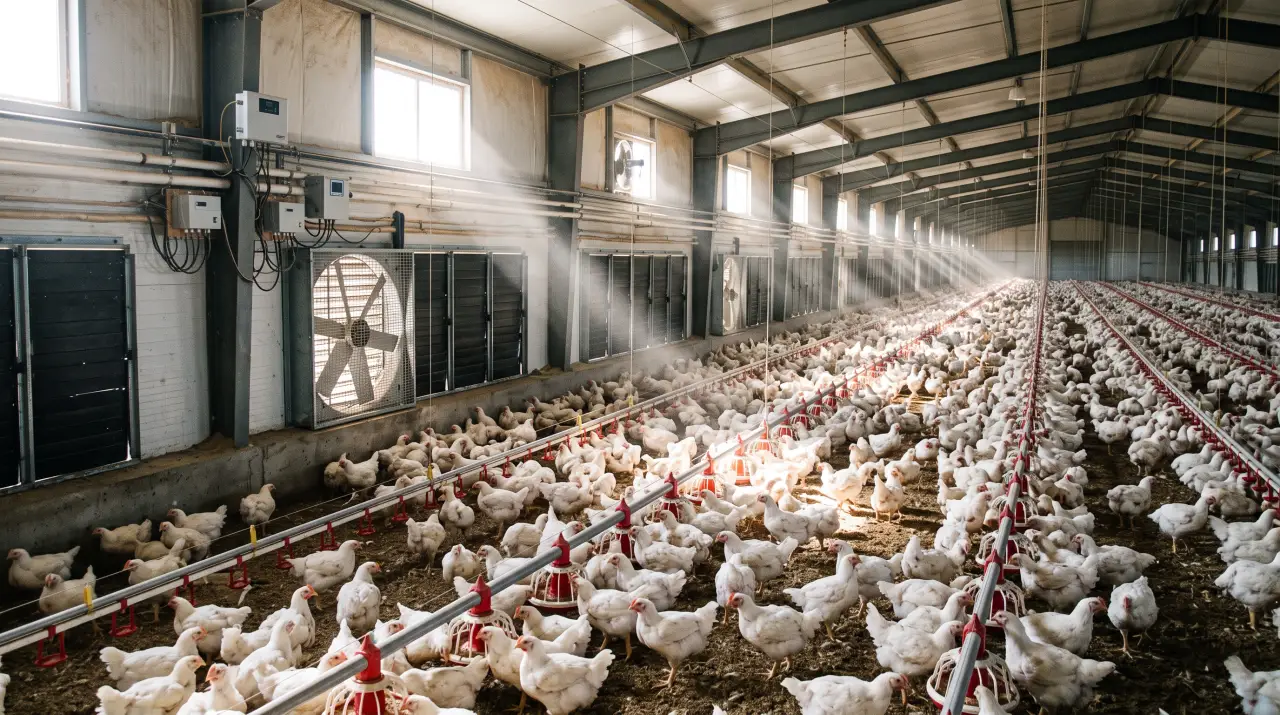
In an enclosed poultry house, automated climate control is the flock's life support, not a comfort upgrade. One environmental controller runs four jobs: it holds temperature, exchanges air to keep ammonia down, cools the house with tunnel airflow and evaporative pads, and triggers alarms and backup power when something fails. Get that last job wrong and a hot summer outage can kill a full house in minutes.
Picture the day every poultry producer quietly dreads. It is July, the house is packed with market-age birds, and a storm drops the power. The fans coast to a stop. In a sealed tunnel house there is no breeze to fall back on, no window to crack that will save you. Heat and gases start climbing right away, the biggest birds go first, and the clock that matters is measured in minutes, not hours. Auburn's poultry engineers put the number bluntly: on a hot day, fifteen minutes of dead power is all it takes to lose an entire house.
That scenario is the honest frame for this whole topic. Everything a modern controller does day to day, all the elegant staging of heaters and fans and pads, sits on top of one non-negotiable requirement: the system cannot be allowed to fail silently. So before we talk about the automation, understand what it is really for. The climate system keeps thousands of birds alive inside a building that has no natural airflow, and its most important feature is the one you hope never fires.
Here is how the four jobs actually work, in the order they matter to the bird.
Strip away the branding and a poultry house climate system is one controller wired to a set of sensors and a set of machines. The sensors read temperature, humidity, and static pressure at several points down the length of the house. The controller compares those readings against a target curve that changes as the birds age, then stages equipment in and out to hold the target: heaters and minimum-ventilation fans in the cold, tunnel fans and evaporative pads in the heat, and inlet machines that meter fresh air the whole time.
The major controllers come from a short list of suppliers. Munters Rotem (the Platinum and Trio lines), Chore-Time, and Cumberland (both AGCO/GSI) are the names you will meet on most build sheets, and large integrators tend to standardize on one so their growers all run the same brain. Modern units log data and tie into a phone app, so a producer can check the house from the truck or the kitchen table.
That remote-monitoring layer is genuinely useful, and it is worth being clear-eyed about it. Checking a house from your phone is convenience layered on top of the local system. It is not a substitute for a local alarm and a generator, and it now makes the house depend on rural internet and turns the controller into a networked device. That is a real trade worth one honest sentence: convenience up front, a connectivity and security dependency behind it. If you run controllers on your network, the same discipline you would apply to any connected farm equipment applies here too.
Day-old chicks cannot regulate their own body temperature. That single fact drives the entire brooding phase. At placement the house is held high, roughly 90 to 95 degrees F, with floor temperature around 90 degrees F so the birds are warm from the litter up. From there the target steps down about 5 degrees F per week as the birds feather out and start generating real body heat of their own.
The controller runs that whole descent for you. Early on it leans on the heaters and a trickle of minimum ventilation. As the birds grow and the weather shifts, it hands off from heating to cooling, staging fans in as the house warms. The point is not any single setpoint. The point is that the target is a moving curve tied to bird age, and the controller's job is to hold the curve without you standing over it. If you have ever run a farm weather station, think of the controller as its bigger, bossier cousin: it does not just read temperature, it acts on it.
This is the unglamorous job, the one that quietly separates good houses from bad ones, and it runs hardest in the cold. Even in January the house has to keep exchanging air, because a house full of birds is constantly producing three things you have to get rid of: moisture, carbon dioxide, and ammonia.
Ammonia is the one to watch. Keep it well under 25 ppm and aim below 10. That is not a comfort target, it is a production and welfare one. Extension work has measured the cost of letting it climb: broilers raised in 25 to 50 ppm ammonia came out roughly half a pound lighter at seven weeks than birds kept below 25 ppm, on top of the respiratory and eye damage the gas causes. Twenty-five is the ceiling you never want to touch, not a number that is fine.
The tool for all of this is minimum ventilation, and it runs on a timer or controller cycle rather than being switched off to save fuel. A common target is on the order of 1 cfm per square foot of floor. The classic winter mistake is throttling that back to save propane, which feels thrifty right up until the litter goes wet and the ammonia spikes. You do not save money there. You just move the cost from the propane bill to the birds.
Here is the piece that separates producers who understand their houses from those who just push buttons. In cold weather the inlets are not controlled by temperature, they are controlled by static pressure, and static pressure is the single most important number on the panel in winter.
Static pressure is the small vacuum the fans pull inside the sealed house, measured in inches of water column (in wc). It decides how fast air enters through the perimeter inlets and how far that incoming jet throws across the ceiling before it drops. A practical starting point is roughly a 2-inch inlet opening at about 0.10 in wc. At that 2-inch opening, the throw runs about 9 feet at 0.05 in wc and stretches to about 15 feet at 0.15 in wc. You want the cold incoming air to hug the ceiling, mix, and warm before it falls on the birds, never to dump straight down cold.
Lower the pressure setpoint and the inlets open wider and the air slows down. Raise it and the inlets narrow and the air speeds up. That is the whole control logic. One red flag is worth memorizing: static pressure that climbs above about 0.15 in wc usually means roughly half your incoming air is sneaking in through cracks and gaps instead of the inlets. When that happens your careful distribution is gone, and the house is telling you it is not sealed. A tight building is the foundation the entire winter ventilation strategy stands on. These are reference numbers, not gospel. Your house length, bird age, seal, and controller will set your real targets, so use them, not a blog figure.
Summer is the dramatic, visible mode, and it stacks two different mechanisms that people often confuse.
The first is tunnel ventilation. The controller stages in banks of big fans at one end of the house and pulls air end to end at high velocity, commonly somewhere from a minimum around 350 to 500 ft/min up to 600 to 700 ft/min in a long house. That moving air does not lower the air temperature. It lowers the temperature the bird feels, by wind chill, and for market-age birds that effect can be worth roughly 10 to 12 degrees F. The key nuance: wind chill is an effect on the bird, not a drop in the thermometer, and it largely fades once outside air climbs above about 90 degrees F.
That fade is exactly why the second mechanism exists: evaporative cooling pads. Water runs down porous pads at the air inlet, the incoming tunnel air evaporates some of it, and evaporation pulls real heat out of the air. Under hot, dry conditions pads can drop the incoming air temperature by about 12 degrees F. The physics is fixed and worth knowing: lowering the air about 1 degree F takes evaporating roughly 0.125 gallon of water per hour for every 1,000 cubic feet of air you move. Pads earn their keep in dry heat and give back less in high humidity, and the controller only stages them in once the house is genuinely hot, since there is little benefit below about 82 to 85 degrees F with larger birds.
Put together, the two stack. The pad lowers the actual air temperature, and the tunnel airspeed lowers the effective temperature the bird feels on top of that. Understanding they are different tools, doing different work, is what lets you troubleshoot a hot house instead of just turning everything to maximum and hoping.
Now back to the fifteen-minute problem, because this is the section that actually protects the flock, and it is the one most worth your money and attention.
Start with sensing air quality honestly. Temperature and static pressure are sensed reliably. Gas is not. Continuous ammonia sensing is the least mature leg of the whole system: inline sensors drift and need maintenance, and plenty of houses still lean on cheap detector tubes or a handheld meter to spot-check. Extension services publish guides on detecting ammonia with inexpensive instruments precisely because you cannot assume the controller "knows" the ammonia level unless a maintained sensor is feeding it. Trust your temperature and pressure readings. Verify your air quality.
Then build the safety net in layers.
Alarms that reach you. The controller should be wired to an alarm system that dials or texts your phone on high temperature, low temperature, power loss, and high static pressure. A "chicken house temperature alarm" is not a nicety, it is the thing that gets you out of bed in time to act. Manufacturers are explicit that the controller itself can fail, so you also want a fully independent backup alarm that can operate the critical systems even if the main controller is dead. Test both on a set schedule, weekly at least.
Backup power that beats the clock. The core answer to the fifteen-minute problem is a permanently mounted standby generator on an automatic transfer switch (ATS). The ATS has to sense the outage, start the generator, and transfer the load in under a minute, and it must carry the full tunnel-fan load, not just the lights. There is a timing detail that people miss and it matters enormously: the generator has to come on before the automatic curtain-drop timer operates, which is often around 2 to 3 minutes after power loss. Once the house has dropped its curtains and switched to non-powered natural ventilation, there are simply too many birds packed inside for that fallback to save. The generator's whole job is to make sure the house never has to find out.
A generator you have actually tested. A generator that fails to start is the same as no generator at all. Standby units need scheduled maintenance and, critically, load testing under real load, not just a monthly idle. This is the same predictive-maintenance discipline that keeps the rest of your iron running, and it is covered well in our piece on predictive maintenance for farm machinery. Put generator testing on the same calendar.
Extra eyes. Cameras and remote monitoring pair naturally with the alarm layer. An alarm tells you something is wrong. A camera lets you see the house before you drive out, which can be the difference between a five-minute phone check and a two a.m. panic. If you already run remote livestock monitoring cameras elsewhere on the farm, the poultry house is an obvious place to extend them.
No, and this is the honest counter-case that makes everything above credible. Automation removes the need to be present. It does not remove the need to check.
Every failure mode in a "automated" house is a management failure, not a technology failure. A temperature sensor drifts a few degrees and the whole curve shifts with it. A static-pressure setpoint gets left on a summer number through the first cold snap. Minimum ventilation gets turned down in November to save propane and never gets turned back up. An alarm dialer sits with a dead backup battery. A generator that nobody load-tested since spring refuses to start on the one night it is needed. None of those are the controller's fault. All of them kill birds or grow them poorly, and all of them are prevented by the same two habits: a daily walk through the house and a written test schedule for the alarms and the generator.
That is the buy-and-manage takeaway. A poultry environmental controller is a genuine force multiplier, but it multiplies whatever you feed it. Pair it with good management and it runs a tight, efficient house with less labor. Pair it with set-and-forget and it multiplies your neglect just as faithfully. The controller earns its keep only when the alarm and generator behind it are proven, and the whole system is only ever as good as the last time you walked the house and tested the backup.
When you are ready to spec a system, take these figures to your integrator as a starting point, not a purchase order. Ask for house-specific fan capacities, pad sizing, controller model, and a real generator and ATS quote sized to your tunnel load. The reference numbers here get you a smart conversation. Your integrator's numbers get you a house that holds.
Manley Farms builds free, browser-based tools for on-farm decisions like this one, from spray-window planning to soil and market data, and we publish practical guides the same way we would want them written: no hype, real numbers, and the honest caveats included. If that is useful, the email list is where new tools and guides land first.
It is an environmental controller wired to sensors and equipment that keeps a flock alive inside a sealed house. The controller reads temperature, humidity, and static pressure, then stages heaters, ventilation fans, tunnel fans, inlets, and evaporative pads to hold a target that shifts as birds age. It also triggers alarms and backup power when something fails.
Day-old chicks cannot regulate their body temperature, so the house is held around 90 to 95 degrees F at placement, with floor temperature near 90 degrees F. The target then steps down roughly 5 degrees F per week as the birds feather out and start producing their own body heat. The controller manages that descent automatically against a curve set by bird age.
Keep ammonia well under 25 ppm and aim below 10 ppm. Twenty-five is a ceiling, not a comfort zone. Birds raised in 25 to 50 ppm have come out roughly half a pound lighter at seven weeks than birds kept below 25 ppm, along with respiratory and eye damage. Minimum ventilation, run on a timer even in cold weather, is how you hold the number down.
A sealed tunnel house has no natural airflow, so when fans stop, heat and gases build in minutes and larger birds die first. On a hot day, roughly fifteen minutes of lost power can kill a full house. A standby generator on an automatic transfer switch restores fan power in under a minute, and it must start before the automatic curtain-drop timer, typically 2 to 3 minutes, takes over.
Static pressure is the small vacuum the fans pull inside a sealed house, measured in inches of water column. It controls how fast air enters the inlets and how far it throws across the ceiling. A common starting point is a 2-inch inlet at about 0.10 in wc. Readings above roughly 0.15 in wc usually mean air is leaking through cracks instead of the inlets, so the house needs sealing.
Join our list for practical guides on farm tech, precision agriculture, and tools that work.