
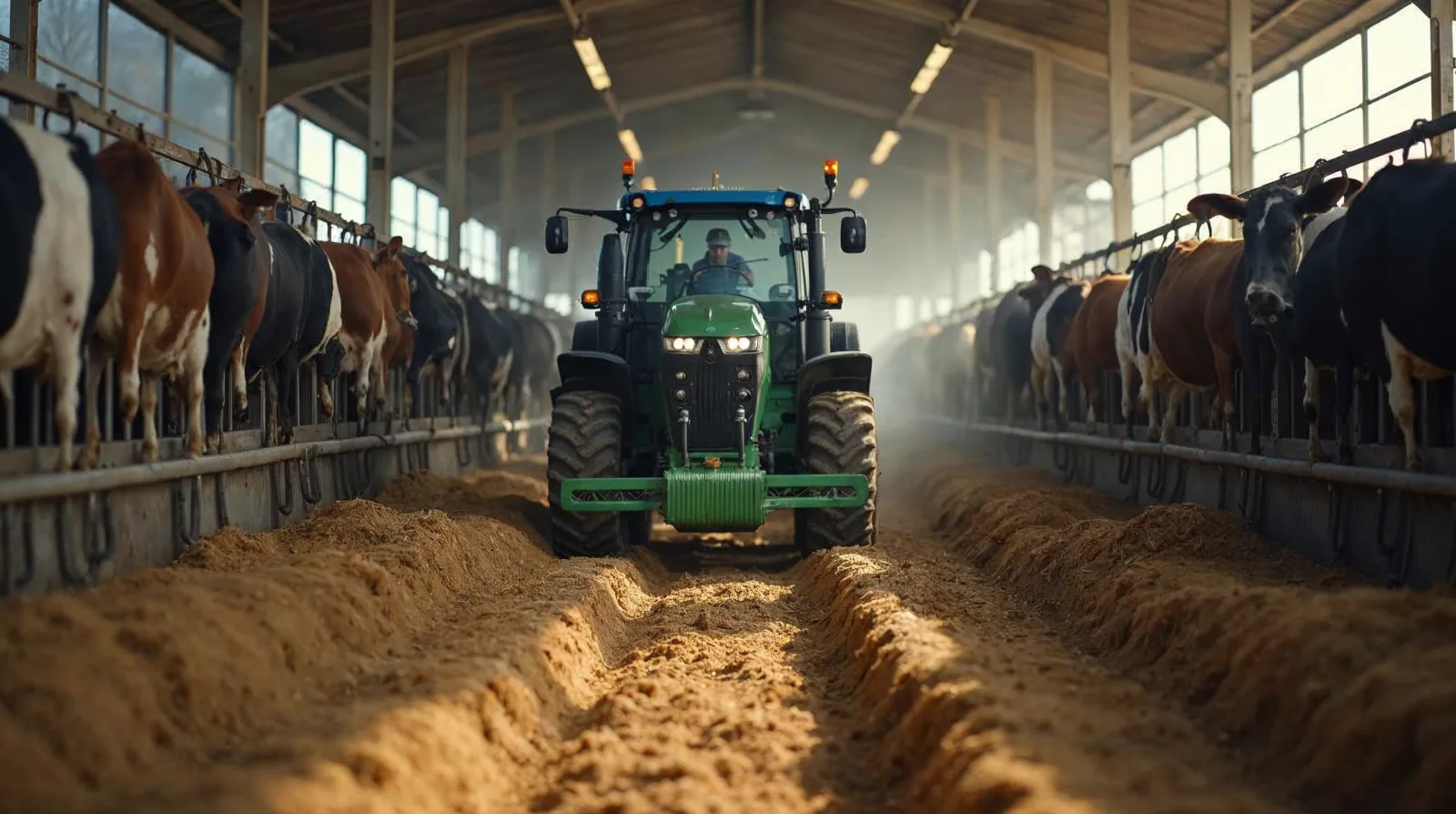
A robotic feed pusher is a battery-powered machine that patrols the feed alley on its own, nosing feed back within reach of the cows day and night. It keeps feed constantly available so cows eat smaller, more frequent meals. Expect roughly $30,000 installed and a two to three year payback, driven mostly by reclaimed labor.
Every dairy has the same quiet problem. You mix and drop a good ration, the cows dig in, and within a couple of hours they have shoved half of it out of tongue reach. It just sits there. Uneaten. It stays there until someone climbs on the skidloader and pushes it back, and nobody is doing that at 2 a.m. A robotic feed pusher exists to close that gap, and it does it the same way every ninety minutes, all night, without a paycheck. Whether that is worth $30,000 to your operation is a real question with a real answer, and the answer depends almost entirely on how you feed today.
The job is narrow and it is boring, which is exactly why a machine is good at it. A pusher travels the feed fence on a fixed route, following either a steel strip set into the floor or an induction wire buried in the alley, and it sweeps feed back toward the cows as it goes. Some units, like the Lely Juno, are a simple weighted cone that noses the pile back to the bunk. Others, like the DeLaval OptiDuo, use an auger that turns against the direction of travel so it remixes and fluffs the ration while it pushes, instead of just shoving a packed-down wall of feed forward.
That distinction matters more than the brochures let on. A plain pusher moves feed. A remixer moves feed and loosens it, which pulls the fines and the tasty bits back up and cuts the sorting that leaves the least palatable forage behind. If your total mixed ration is dry and loose, a plain pusher is fine. If it is wet, heavy, or long-fibered and it packs down into a mat, the auger style earns its premium.
Cows are built to eat in small, frequent meals. When feed is always within reach, they get up, take a few bites, lie back down, and ruminate on a steady schedule. When feed is only reachable for the first two hours after each drop, they slug-feed instead - big meals when the feed is fresh, then nothing, which swings rumen pH and invites sorting and off-feed days.
Frequent push-up smooths that curve out. The cow that can reach feed at midnight eats a little at midnight. Vendor data from Lely reports around a 3.5 percent lift in dry matter intake, concentrated in the overnight hours, and on robotic-milking dairies a bump in voluntary robot visits because a fuller bunk pulls cows past the milking unit more often. Treat those exact numbers as directional rather than gospel - they come from the company selling the machine, not an independent trial. The mechanism itself is not in dispute. More reachable hours means more eating events, steadier rumination, and less sorted-out forage in the alley.
Here is the part the sales visit tends to skip. Sometimes it will, and sometimes it plainly will not, and the difference is your current push frequency.
A University of Wisconsin-Platteville trial at the Pioneer Farm ran a Lely Juno against a skidloader for about four months and found no significant change in milk production and only a slight change in dry matter intake. The behavioral wins still showed up - the cows ate smaller and more frequent meals, spent more time lying and ruminating, and sorted less. Those things just did not translate into more milk in the tank.
The reason is the whole story. That farm was already pushing feed at least six times a day with the skidloader. When your baseline is that good, the robot has almost no headroom left to add, because the cows already had feed in front of them most of the time. The machine simply took over a job that was already being done well.
So be honest with yourself about your own routine. If you push feed once or twice a day, or you rely on the cows to reach whatever they can, a pusher has real room to lift intake and it may show up at the bulk tank. If you are already running the skidloader down the alley five or six times a day, buy the robot to get those labor hours and that diesel back, not to chase a yield bump that the research says may never arrive. Both are good reasons to buy. Only one of them is honest for a farm that already feeds well.
Most operations settle on a pass every ninety minutes to two hours, which lands somewhere between six and fourteen passes a day depending on how you program the overnight window. The exact count matters less than where the passes fall. Daytime pushing partly overlaps with work you or a hired hand were doing anyway. The overnight passes are the ones you could never realistically cover, and they are where the machine does its most valuable work, quietly, while the barn is dark and empty.
There is a ceiling worth knowing. Pushing more often stops helping once feed is essentially always reachable, and running the machine harder than that just burns battery and wears parts for no return. Start moderate, watch how clean the alley stays between passes, and add passes only where you see feed sitting out of reach.
Three names cover most of the conversations, and they are not really competing for the same job.
| System | What it is | Best for |
|---|---|---|
| Lely Juno | Standalone cone pusher, follows a steel floor strip, around eleven hours of daily autonomy on a 12V battery, seldom needs barn modifications | The common entry point. Labor savings and around-the-clock feed availability on a dry, loose ration |
| DeLaval OptiDuo | Auger that remixes while it pushes, induction wire plus transponders, handles up to about a five percent alley slope | Rations that pack down or sort. When fluffing the feed matters as much as moving it |
| Lely Vector | A full automatic feeding system with a feed kitchen and grab, not just a pusher - it mixes and delivers fresh feed on demand | Farms trying to automate the entire feeding job, not just push-up. A different budget class entirely |
GEA, Wasserbauer, Rovibec, Schuitemaker, JOZ, and Hetwin also sell into this market, and availability comes down to your dealer network. For a machine that runs unattended in a wet, dusty, corrosive barn, the closest dealer with parts on the shelf often beats a slightly better spec sheet.
The clean way to think about it: a pusher for labor and feed availability, a remixer if your ration sorts or packs, and a Vector-class system only if you are genuinely ready to hand off feeding itself. Do not let a Vector quote talk you out of the $30,000 problem you actually have.
Budget around $30,000 installed for a feed pusher, with a typical two to three year payback. Treat both numbers as ranges, because your barn, your alley layout, and your dealer all move them. The payback math has three real line items:
Do not confuse a pusher with a full automatic feeding system. A turnkey single-unit feeding robot runs roughly $150,000 to $275,000, and multi-robot setups can top a million dollars. The pusher is the cheap, low-risk way to put your first robot in the barn. That is its honest positioning: small ticket, narrow job, quick payback if your labor situation is tight.
Run this list before you sign anything.
A pusher is rarely the whole story. It works best as the first, cheapest piece of a barn that is slowly taking labor off your plate. It pairs naturally with the systems that already run themselves overnight, and the same logic that justifies it - reclaim the hours nobody wants to work - is exactly the logic behind robotic milking on small dairies, automated calf feeders, and the precision feed bunk management tools that tell you whether all that pushed-up feed is actually being eaten. Start with the pusher, measure what it buys you, and let the numbers decide the next machine.
If you want the plain-English breakdowns before you talk to a dealer, our newsletter sends one practical ag-tech guide at a time - no hype, no vendor spin, just what works on a working farm. It is a good way to keep the honest counter-case in your back pocket when the sales visit gets optimistic.
Sometimes, and it depends on how you feed now. On farms that push feed only once or twice a day, keeping feed constantly reachable can lift intake and milk. On farms already pushing five or six times daily, a University of Wisconsin-Platteville trial found no significant milk change - the machine mostly replaced labor. Buy it for the yield lift only if your baseline pushing is poor.
Budget around $30,000 installed for a feed pusher, with a typical two to three year payback driven mainly by reclaimed labor and reduced skidloader use. Treat that as a range, since barn layout and dealer quotes move it. Do not confuse it with a full automatic feeding system, which runs roughly $150,000 to $275,000 for a single unit and far more for multi-robot setups.
Most farms program a pass every ninety minutes to two hours, landing between six and fourteen passes a day. The overnight passes matter most, since no one is running a skidloader at 2 a.m. Pushing more often stops helping once feed is always within reach, so start moderate and add passes only where you see feed sitting out of the cows' reach.
Usually not for a floor-strip unit like the Lely Juno, which follows a steel strip and seldom needs barn changes. An induction-wire unit like the DeLaval OptiDuo needs a wire laid in the alley, which is a small install job. Either way, check that your alleys are reasonably level, clean, and a consistent width, and confirm the machine's slope limit.
Choose a plain pusher like the Juno if your ration is dry and loose and you mainly want labor savings and around-the-clock availability. Choose a remixing auger like the OptiDuo if your ration packs down or the cows sort it. Choose a Vector-class automatic feeding system only if you are ready to automate mixing and delivery, not just push-up - it is a much larger investment.
Join our list for practical guides on farm tech, precision agriculture, and tools that work.