
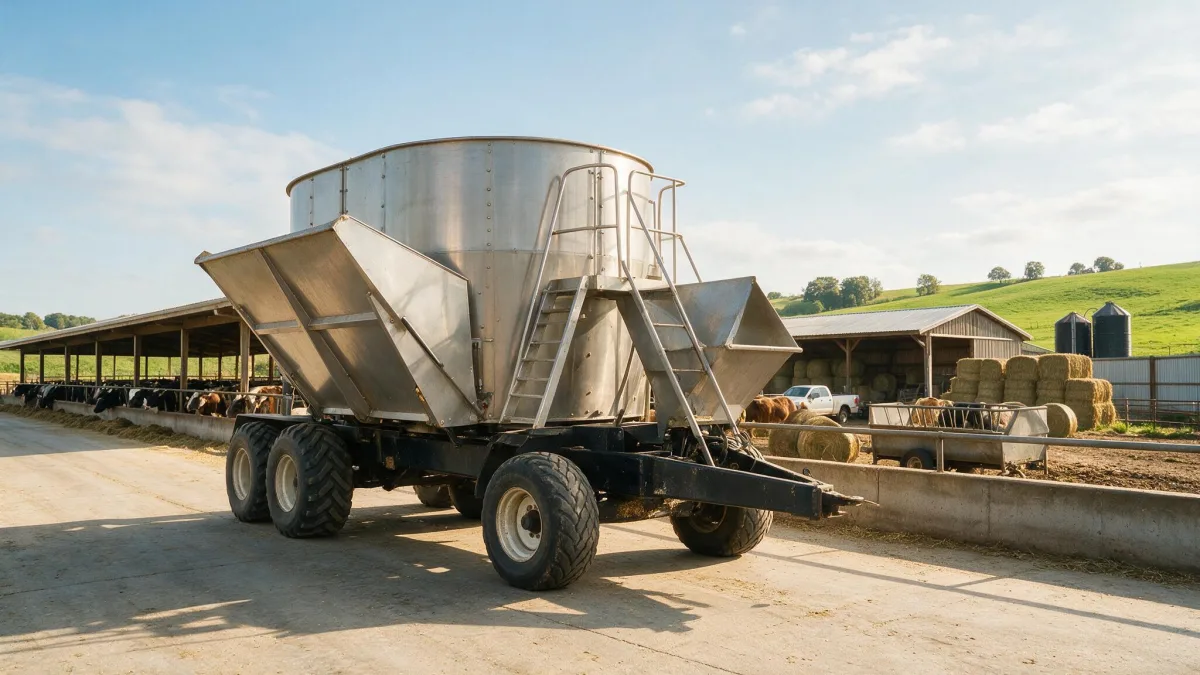
The scale head on a total mixed ration mixer hits ration targets by weighing every ingredient as it loads, but accuracy comes from the operator loading to the real target instead of the tolerance edge. Load cells and feed software do not make feeding accurate on their own. They expose whether your loading process already is, one logged load at a time.
That distinction is the whole point of this article. A TMR mixer with load cells and a feed-management platform is often sold as a precision tool that fixes feeding accuracy. It does not fix anything. It measures. What the measurement reveals, on farm after farm, is that the expensive part of the ration is the part most likely to be wrong, and that the fix costs nothing but a change in habit and a menu setting.
A total mixed ration blends every ingredient a group of animals needs - forage, grain, protein, minerals, additives - into one uniform feed so every bite carries the same nutrient profile. The reason to mix at all is consistency. If the ration a cow eats at 6 a.m. differs from the one she eats at noon, or the feed at the head of the bunk differs from the feed at the tail, her rumen never settles into a stable fermentation and production suffers.
Consistency is not something you can eyeball. A skid of mineral looks like a skid of mineral whether the loader put in 480 pounds or 520. The only way to know you loaded what the nutritionist formulated is to weigh it, and the only practical place to weigh it is on the mixer itself, ingredient by ingredient, as each one goes in. That is what the scale is for. It turns feeding from a memory-and-eyeball job into a measured, logged process.
Most TMR mixers carry three or four load cells mounted under the frame. As the mixer fills, the combined weight registers on a scale indicator in the cab, and the operator watches the readout climb toward each ingredient's target before switching to the next. That is the hardware layer, and it has been mature and affordable for years.
The software layer sits on top. A feed-management platform holds the rations the nutritionist built, breaks each one into a load sequence for a specific pen and mixer, and pushes those instructions to the indicator. As the operator loads, the system records the actual weight of every ingredient against its target. The output is not just a mixed batch. It is a per-load record showing exactly how close the operator got, every ingredient, every load, every shift. Feed the pen, and the loop closes: formulation goes out, actuals come back.
The most useful field data on this comes from a 2021 study in Translational Animal Science (Arce-Cordero and colleagues), which measured weighing accuracy, precision, and shrink of mineral supplement across five commercial Western U.S. dairies. The findings are specific and slightly counterintuitive.
The bulk forages loaded reasonably well. Silage deviated from target by roughly 0.82 percent and grain by about 0.91 percent. The small, expensive ingredients were where the error lived. Mineral supplement was loaded less accurately than the bulk feeds, and hay and wet byproducts ran worse still, around 6 to 7 percent off target. Average shrink on the mineral supplement came to 2.0 percent, ranging from 0.37 to 3.25 percent across farms.
The number that should get a manager's attention is the spread between farms. Mean deviation from the targeted mineral amount was 1.54 percent on average, but per-farm results ran from a tight 0.3 percent on the best dairy to 2.8 percent on the worst. Same equipment class, same instrument, very different discipline. The scale did not decide who was accurate. The people running it did.
The practical read: buy the scale for the minerals and the micros, not the corn silage. The corn silage was never your problem.
Here is the failure mode that costs the most and shows up the least. Feed software lets you set a tolerance band around each ingredient target, a window the operator can land in and still be counted "on." TMR audits have repeatedly found that a large share of ingredients carry tolerance settings loose enough to allow more than 2 percent deviation, and that operators quietly aim for the tolerance edge rather than the target.
Think about what that does. The readout turns green the moment the weight enters the acceptable band. A person loading fast, all day, stops when the light says stop. On a heavy, cheap ingredient a slightly early stop costs little. On a mineral pack or a feed additive, stopping at the low edge of a loose tolerance means systematically under-delivering the most expensive and most concentrated part of the ration, load after load, without anyone deciding to.
The fix is free. Tighten the tolerance bands in the software so the green light cannot appear until the operator is genuinely near target. You change a menu setting, not a machine. It is the highest-return five minutes available on most feeding operations, and it costs nothing.
A perfectly weighed load can still reach the cow wrong, and this is the nuance that separates a credible operator from a salesman. Weighing accuracy and feeding accuracy are two different things.
Mixing is the first place a good load goes bad. Typical guidance puts total mix time around 7 to 9 minutes for most mixers - long enough to blend evenly, short enough to leave the fiber intact. Push well past that, and physically effective fiber starts dropping while fines climb, which raises the risk of sub-acute ruminal acidosis. Under-mix, and the ration is different at the head of the bunk than at the tail. Treat these numbers as a starting window, not a rule, because the right mix time depends on your mixer type, load size, and forage.
Because the scale cannot see any of this, verify the mix with tools that can. The Penn State Particle Separator is the field check for particle size and mix uniformity; shake it consistently and compare pens and days. Fecal starch is a downstream outcome check that tells you whether the ration is actually being digested. Neither one measures your load cells. Both tell you whether the accurately weighed load did its job by the time it reached the animal.
If a basic scale and tight discipline get you most of the way, what does a full feed-management platform buy? Mainly control and memory. Named platforms in this space include TMR Tracker (now under Topcon, formerly Digi-Star), EZfeed from Amelicor, and Feed Supervisor, among others like FeedWatch. Describing what the category does is fair; repeating any vendor's accuracy or ROI claims is not, so treat marketing numbers as unverified.
What the software genuinely adds:
Read those load logs weekly as a management report, not a green light. The value is not the weighing. It is spotting the shift, the operator, or the ingredient that drifts, before it shows up in the tank.
The scale is only as honest as its upkeep. Load cells drift, and a mixer that never gets a calibration check will confidently report the wrong number. Run a periodic check against a known weight and correct as needed. Just as important, a neglected mixer weighs and mixes worse: dull or worn knives lengthen mix time and chop unevenly, and skipped grease and oil shorten the machine's life. Calibration and maintenance are not separate from accuracy. They are accuracy.
The full software stack fits dairies and larger beef or backgrounding operations where multiple pens, mixers, and shifts make coordination and logging worth the cost. A smaller herd captures most of the benefit earlier and cheaper. A basic on-mixer scale plus real discipline - loading to target, tightening tolerances, watching mix time, verifying with a particle separator - delivers the majority of the gain before you ever license a platform. Match the tool to the scale of the problem. The behavior is what pays; the software makes the behavior harder to skip.
None of this requires new equipment for most operations. It requires treating the number on the readout as a report you are accountable to, not a light that tells you to stop.
If you want more no-hype breakdowns of farm technology like this, and free planning tools for inputs, spray windows, and market prices, the resources on Manley Farms are built for exactly that kind of working-farm decision. Start with what you already own, tighten what you can measure, and let the scale tell you the truth.
For the downstream side of the bunk, see our guides on precision feed bunk management and robotic feed pushers in dairy barns. The pusher keeps feed in front of the cow. The mixer scale decides whether what is in front of her is the ration your nutritionist actually formulated.
On-mixer load cells can weigh bulk forages within roughly 1 percent of target on well-run farms, but real accuracy is limited by the operator, not the hardware. Field studies show minerals and additives loaded far less accurately than silage or grain, and the same equipment produced tight results on disciplined farms and loose results on careless ones.
They are small, concentrated, and easy to stop early on. A slight under-load barely registers as a percentage of a heavy silage target but is a large error on a small mineral target. Loose tolerance settings make it worse by turning the readout green before the operator reaches the real number, so the most expensive ingredients get shorted.
A tolerance is the window around each ingredient target that still counts as acceptable. Audits find many farms run tolerances loose enough to allow over 2 percent deviation, and operators aim for the edge. Tighten the bands so the readout cannot signal done until the operator is genuinely near target. It is a free accuracy gain that costs one menu change.
Typical guidance is around 7 to 9 minutes of total mix time, long enough to blend evenly without pulverizing fiber. Over-mixing past that window drops physically effective fiber and raises acidosis risk; under-mixing leaves the ration uneven along the bunk. Treat it as a starting point and verify with a particle separator, since ideal time varies by mixer, load size, and forage.
Smaller operations get most of the benefit from a basic on-mixer scale plus disciplined loading. Software adds locked tolerances, per-load logging, out-of-spec alerts, multi-mixer coordination, and nutritionist data exchange, which earn their cost on larger operations with multiple pens and shifts. The behavior drives accuracy; software mainly makes that behavior harder to skip.
Join our list for practical guides on farm tech, precision agriculture, and tools that work.