
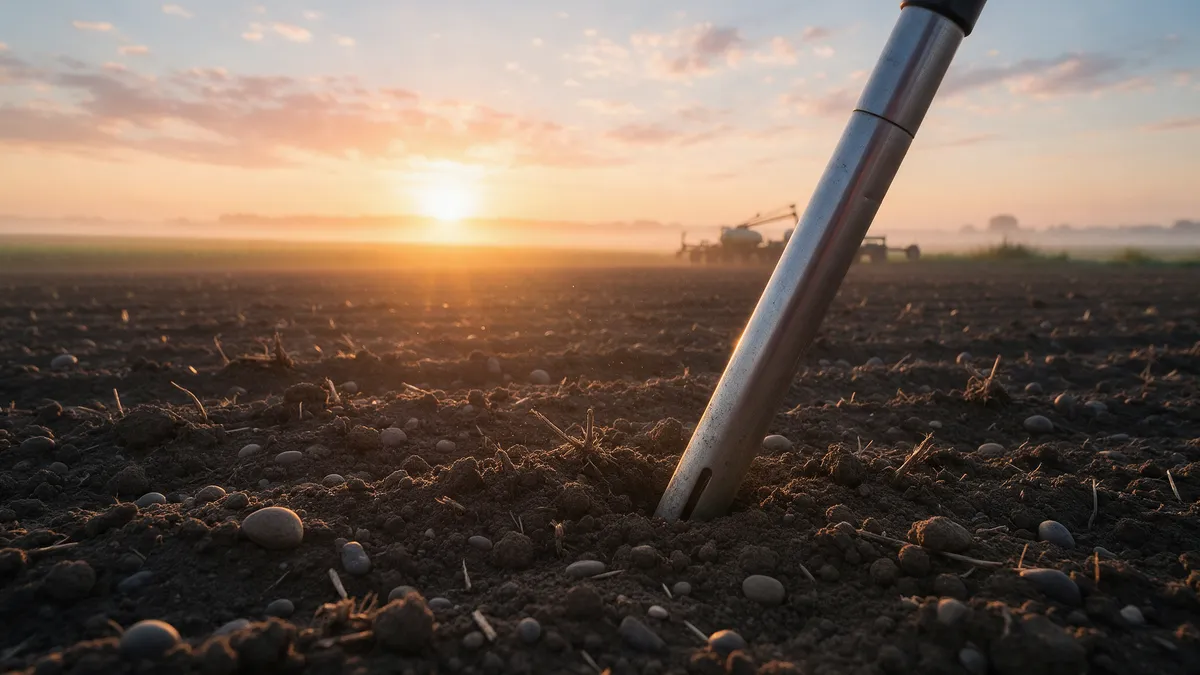
Plant corn and soybeans when soil at seed depth holds 50°F or warmer at dawn for three mornings running, and the next 48 hours bring no cold rain or sharp cool-down. Grain sorghum wants 55 to 60°F, cotton and peanuts about 65°F at 4 inches, and spring wheat about 40°F.
That is the answer, and it has three parts. Most soil temperature charts only give you the first one: the number. A reading you can trust is the second. The third is the forecast for the day or two after the seed goes in, because that is the window when cold water does its damage. Get all three right and the planter can roll. Skip one and you are guessing.
Here is the field crop side, with the depth and time of day the extension sources actually use. Ranges are where the sources disagree by region.
| Crop | Plant when soil is | Depth and timing used | Source |
|---|---|---|---|
| Corn | 50°F or warmer, not expected to drop much below 50°F for 48 hours | 4 in (state maps); seed depth in Nebraska field logging | Iowa State, 2026 |
| Soybeans | 50°F minimum; 50 to 60°F works but emergence is slow | 2 in | Penn State, 2026 |
| Grain sorghum | 55 to 60°F (Nebraska); 60 to 65°F (Wisconsin) | - | Nebraska CropWatch, 2025 |
| Cotton | About 65°F at 8 a.m., ideally three days running, with a decent 5-day forecast | 4 in | LSU AgCenter |
| Peanuts | 65°F with no cold front coming; UGA has called 68°F ideal | 4 in | UGA |
| Spring wheat, barley | About 40°F | - | UMN Crop News |
| Oats | About 45°F | - | Montana State Extension |
If you plant soybeans at the cool end of that range, Kentucky's soybean specialists suggest bumping the seeding rate and using treated seed, because cool, wet soil slows emergence and gives disease and insects more time to work. Our seeding rate and plant population guide walks through the math if you want to adjust.
For cotton growers, the Southern rule of thumb adds a heat check: DD60 = ((high + low) / 2) - 60. Guidance commonly wants 25 or more DD60s in the 5-day forecast after planting, and yield potential can suffer when fewer than 10 build up. NC State runs a free cotton planting conditions calculator built around exactly that.
Vegetable charts disagree with each other, and the reason is worth knowing. Some list the absolute floor where a seed will germinate at all. Others list the temperature where planting makes practical sense. We use the University of Wisconsin-Madison Extension's "plant now" minimums below, and pair them with the classic UC Davis germination data (Harrington, carried in the UC Master Gardener tables) to show what happens if you go early.
| Crop | UW plant-now minimum | Days to emerge (UC Davis data) |
|---|---|---|
| Lettuce | 45°F | 7.0 at 50°F; 2.6 at 68°F |
| Peas | 50°F | - |
| Sweet corn | 55°F | 21.6 at 50°F; 12.4 at 59°F; 6.9 at 68°F |
| Onion | 60°F | - |
| Pepper | 65°F | none at 50°F; 25.0 at 59°F; 12.5 at 68°F |
| Tomato | 70°F | 42.9 at 50°F; 13.6 at 59°F; 8.2 at 68°F |
| Snap beans | 72°F | little or none at 50°F; 16.1 at 59°F; 8.1 at 77°F |
Read the right column slowly. A tomato seed sown into 50°F soil takes about six weeks to come up. At 68°F it takes about eight days. That is the real cost of going early - not that the seed fails outright, but that it sits in cold, wet ground for weeks while rot and seedcorn maggot get first crack at it. Lettuce, on the other hand, comes up in a week even at 50°F, so cool-season crops really do not need to wait.
One note so the numbers do not look like a mistake: field corn guidance is 50°F, and UW lists sweet corn at 55°F. Sweet corn, and the supersweet types in particular, is fussier about cold soil than field corn, so the higher number is deliberate.
Because that is when the seed drinks. The term is imbibition: the dry seed soaking up water to start germination. Corn does most of it in the first 24 to 48 hours in moist soil. Penn State puts soybeans at about 24 hours.
If that water is cold, roughly below 50°F, the seed can be injured as it swells. Purdue's corn team describes the result: the root and shoot start to push out of the seed and then stall. Nebraska researchers describe cell membranes that turn leaky and lose sugars, which slows growth and cuts emergence. This is called imbibitional chilling, and once it happens there is no rescue treatment. Penn State says it plainly: after the seed is in the ground, there is really nothing that can be done except scout for emergence problems.
That leads to the most useful rule in this whole article. The worst time to plant is right before a cold rain. Purdue notes that planting just ahead of a cold snap is far riskier than planting a few days before one, that 40°F is worse than 50°F, and that several cold days are worse than one. Nebraska's 2018 guidance boils it down to a two-day window: corn seed needs about 48 hours when soil at planting depth does not drop much below 50°F. Iowa State's 2026 update goes a step further and suggests looking for a 3- to 7-day forecast with a warming trend.
The flip side matters too, so you do not lose sleep over every cool night. Once the seed has taken up its water, a dip below 50°F mostly slows emergence. Nebraska's 2025 summary notes research showing corn can tolerate soil as low as 40°F without injury past that stage. The danger is concentrated in those first hours, not spread across the whole spring.
You need an inexpensive probe thermometer, a screwdriver and two minutes. Nebraska's agronomists said it best: check in-field soil temperatures just after dawn, even with a cheap meat thermometer, and schedule planting on those readings and the 48-hour forecast. The details that make the reading worth something:
Depth. Match the depth to the decision. Most state networks and field crop guidance use 4 inches. Garden guidance uses about 2 inches for seeds and 4 to 6 inches for transplants. If you can, read at your actual seed depth, and compare against 4-inch numbers when you use public data.
Time of day. Here the sources seem to disagree, and they are both right. Nebraska, the cotton rules and the peanut rules all say early morning, around 7 to 8 a.m. UW-Madison says mid-day, between 10 a.m. and noon, for garden planting. Shallow soil swings a lot over a day. The dawn reading is close to the daily low, which is the one that matters for chilling injury. The late-morning reading is closer to the daily average. For corn, soybeans and anything where cold injury is the worry, read early. Whichever time you choose, use the same time every day so the readings compare.
Repeat it. Three mornings in a row, minimum. One warm afternoon proves nothing. Nebraska's 2025 field logging is the cautionary tale: their sensor first hit 50°F on April 9, then dropped back below 50°F several more times before mid-May. Corn planted in that stretch took 12 to 23 days to emerge, and soybeans 13 to 25.
Technique. In firm ground, open a pilot hole with a screwdriver so the probe does not bend. Make sure the probe is in full contact with soil with no air pocket around it, and give it 30 to 60 seconds to settle before you read.
Location. Read the spots that warm last, not the ones that warm first. Your stand is limited by the coldest part of the field.
Two fields on the same road can sit several degrees apart on the same morning. The usual reasons:
Iowa State adds one more check that has nothing to do with the thermometer: the soil should fracture, not smear. Warm, wet ground is still the wrong ground to plant.
You do not have to probe every field every day. Public networks give you the regional picture:
Treat all of these as the trend line, not your answer. They are readings at a fixed station, often under sod or bare ground, not in your residue on your soil. Use them to see whether the region is getting close, then probe your own ground before you commit.
This is the half a probe cannot give you. The thermometer tells you where the soil is this morning. It cannot tell you whether a cold rain arrives tomorrow night, and that is the thing most likely to cost you a stand.
We built the free Farm Weather Station to put the forecast pieces of this check on one screen for your location, using National Weather Service data:
Be clear about that last one. The tool labels it an estimated proxy, and says so in its own words: the Weather Service does not measure your field's soil, and real soil temperature depends on moisture, texture, tillage and residue. Use a probe for the planting decision. The proxy is useful for one thing: telling you whether the next several days lean warmer or colder. That is the warming-trend question Iowa State tells you to ask.
So the division of labor is simple. The probe gives you today. The forecast gives you the next 48 hours. You need both. If you are thinking about putting real soil sensors on your own ground, our farm weather stations guide covers hardware with probes at 2, 4 and 8 inches.
This is a hypothetical example, not a real field.
You probe a residue-heavy corn-on-corn field at 7 a.m. three days running and read 51°F, 52°F and 53°F at 2 inches. The number clears. You pull up the forecast:
Same probe readings, opposite calls. The forecast made the decision.
One honest limit: soil temperature is a go or no-go gate, not a yield strategy. Iowa and Nebraska planting-date research shows a fairly wide optimal planting window. Inside that window, the temperature check keeps you from planting into a bad 48 hours. It does not, by itself, make a high-yield planting date. And none of the sources say seed treatments make 45°F planting safe - they reduce risk, they do not remove it.
For the air-temperature and frost-date side of spring planting, see when it is actually safe to plant.
Plant corn when soil at 2 to 4 inches reads 50°F or warmer in the early morning for several days running, and the forecast shows no big drop below 50°F for the next 48 hours. The seed takes up water in its first day or two, and cold water at that stage can injure it. After that, a cool night mostly just slows emergence.
Measure at the depth you plant whenever you can, since that is where the seed sits. Most state soil networks and field crop guidance report 4 inches, so take a 4-inch reading too if you plan to compare against public data. Shallow soil swings more over a day than deeper soil, so a 2-inch reading will run colder at dawn and warmer by afternoon.
For field crops, check just after dawn. Shallow soil is near its daily low then, and the low is what matters for cold injury to germinating seed. Some garden guidance uses late morning, which is closer to the daily average. Whichever you pick, read at the same time for at least three days in a row so the numbers compare.
It is a risk. Extension guidance sets 50°F as the soybean minimum, and soybeans take up water within about 24 hours of planting, so cold soil plus a cold rain in that first day is the worst case. If the forecast is warming and dry, a reading just under 50°F is less dangerous. Use treated seed and consider a higher seeding rate.
Only roughly. Soil warms more slowly than air in spring and swings less day to night, and residue, moisture, texture and drainage all change how fast a field warms. A forecast-based estimate can show whether soil is trending warmer or cooler over the next few days, but only a probe in your own field tells you the actual temperature at seed depth.
Join our list for practical guides on farm tech, precision agriculture, and tools that work.