
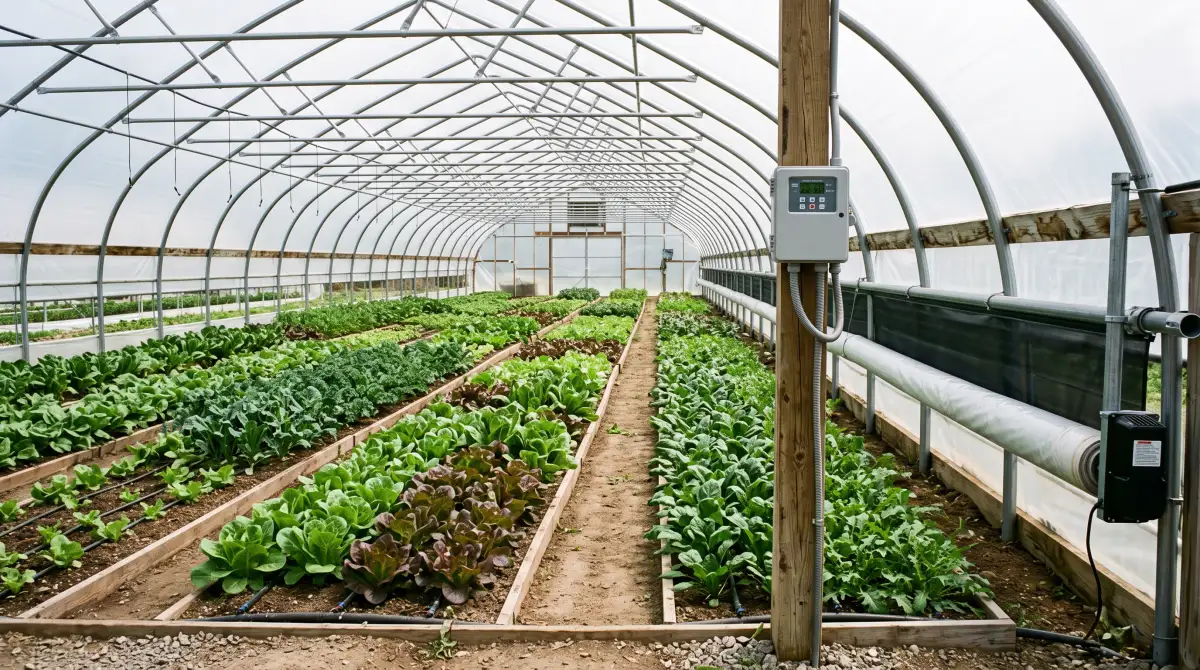
Greenhouse and high tunnel automation is not one product but a three-rung ladder: a passive wax vent opener for light vents, a thermostat driving motorized roll-up sides for a working tunnel, and a staged climate controller for a heated greenhouse. Match the rung to your structure, not the spec sheet.
On a bright, cold February morning, a closed high tunnel is a machine for making temperature swings. The sun climbs, the poly traps the heat, and the inside air can run 30 to 40 degrees warmer than the frosty air outside. By late morning the tunnel is hot enough to stress the crop. By dawn the next day it has fallen back toward freezing. Right now, on most tunnels, the thing standing between the crop and that swing is a person: you, at 9 a.m. to crank the sides open, and back at 6 p.m. to close them, every single day. That is the job automation takes over. It does not turn your passive tunnel into a heated greenhouse. It removes a human from a decision that has to be made correctly many times a day, or the crop cooks by noon or freezes by dark.
The enemy is the daily temperature swing, and the reason it is so punishing is that a high tunnel is a passive structure. By definition, and by the rules of the federal cost-share program that funds most of them, a high tunnel is an unheated, poly-covered steel hoop house that relies on passive solar heating to buy four to six weeks on each end of the season. There is no thermostat calling for heat and no compressor pulling it back down. The only levers are the sides, the vents, and the fans, and those levers do nothing until somebody moves them.
That is the difference between a tunnel and a greenhouse. A greenhouse is an actively climate-controlled box that adds heat and mechanical cooling to hold a target. A high tunnel manages a passive climate. Automation is the bridge between the two: it works the passive levers on a schedule the weather sets, not the one your morning allows.
Extension guidance is blunt about the manual version of this job. Internal temperatures should be checked several times a day and the sides adjusted accordingly, which is why so many growers retrofit thermostatically controlled sides, vents, and fans specifically to stop having to babysit the number. Open the sides an hour too early and you drop the tunnel below its growth zone. Open them too late and you overheat the crop, and it is hard to pull a hot tunnel back down once the day has warmed. Two ways to lose, one narrow window to get it right, several times a day. That is the labor automation is really buying back.
The first rung uses no electricity at all. A wax-cylinder vent opener is a sealed tube of a special wax that expands as the air warms, pushing a piston that lifts a vent. As the air cools, the wax contracts and a spring pulls the vent closed. No wiring, no batteries, no controller - it runs on thermal expansion alone. Most openers start cracking a vent around 62 to 77 F, adjustable with a collar, and reach full lift near 86 F, raising a light vent roughly a foot and a half.
Here is the part the catalog photo does not tell you: a wax opener produces very little force. It will lift a light roof vent, a casement window, or a hobby greenhouse louver. It will not raise the heavy roll-up side curtain on a working tunnel, and it gives you no data, no remote control, and no staged response. It is the honest entry point for a small hobby greenhouse or a light peak vent, and a genuinely good buy at that scale for the money. It is the wrong tool for a commercial tunnel's sidewalls. If your automation problem is a heavy curtain, skip straight to rung two.
For most working tunnels, this is the rung that earns its keep. A single-zone thermostatic controller switches a tube motor or gearmotor to open the roll-up sides incrementally, a few inches at a time, holding the crop in its growth zone as long as the day allows instead of the all-or-nothing of a manual crank. That incremental behavior is the whole point. A hand crank is a blunt instrument. A motor on a thermostat is a dimmer switch.
Sizing the motor is mostly a question of side length. Manufacturers pair roughly a 60 Nm tube motor with roll-up sides up to about 100 feet, and step up to a 100 Nm motor for sides longer than that. Auto-temperature openers in this class are typically set to begin opening somewhere between about 60 and 77 F. Treat those numbers as starting points from the vendor, not engineering law, and get a real quote for your exact side length rather than eyeballing it off a chart.
This is the retrofit that takes the daily crank off your calendar without pretending your tunnel is something it is not. It manages the passive climate faithfully, and it pairs naturally with the outdoor data you should already be watching. A farm weather station that tells you a cold, clear, high-swing day is coming is exactly the input that makes an automated side worth having, because those are the days the manual version is most likely to burn you.
The top rung is greenhouse-grade, and the core idea a grower has to understand is staging. A good controller does not run equipment on and off. It ventilates in stages on rising temperature: closed, then one-quarter open, then half, then full, and when it is tied to an electronic environment controller it can run as many as eight stages, sequencing the vents first, then the circulation and exhaust fans, then the heat, each on its own setpoint. The result is a smooth climb instead of a lurch.
Mechanically, a gearmotor turns a shaft with pinion gears, and the gearbox ratio is large enough that a small motor in the 1/20 to 1/4 horsepower range can move vents as long as 450 feet from a single unit, mounted at one end for a short house or the center of a long one. Simple systems run off a thermostat. Electronic controls use thermistor-type sensors, and once you add a humidistat or a thin-film humidity sensor you can start steering on moisture as well as heat. This is where controlled environment agriculture sensors genuinely belong, and it is the rung where remote monitoring and alarms start to pay for themselves. It is also the rung a passive high tunnel does not need. Do not buy greenhouse-grade sensing for a structure whose humidity just tracks the outdoor air.
The cheapest mistake in this whole business wrecks the most expensive automation: putting the sensor in the wrong place. A ventilation sensor belongs in the center of the growing area, at plant height, next to the heating sensor, and shaded or aspirated so it reads air temperature and not sunlight. A sensor sitting in direct sun reads hot and over-vents, chilling the crop. A sensor against a cold wall reads low and under-vents, cooking it. The controller is only ever as smart as the number the sensor hands it.
Two other distinctions keep growers honest. First, ventilation and circulation are not the same job. Ventilation exchanges inside air for outside air through the roll-up sides, ridge vents, and exhaust fans. Circulation mixes the air already inside with horizontal air-flow fans, sized to move about a quarter of the tunnel's air volume per minute and spaced every 20 to 50 feet. You need both, and one does not substitute for the other. Second, size active ventilation to the season. UVM Extension puts it at about 8 CFM per square foot of growing space in hot weather and 2 CFM in cool weather, with active systems typically kicking on above about 85 F. A 30 by 96 foot tunnel, near 2,900 square feet, works out to roughly 23,000 CFM on a hot day. If measuring before you automate is new territory, the same discipline behind soil sensors and IoT farming applies here: put the probe in the right spot, or the data lies to you.
This is the section that earns trust, because the honest answer is: plenty. Sides jam. Motors fail. Power dies, and a motorized side with no electricity is just a stuck side you cannot even crank. A sensor drifts or gets bumped into the sun. And the failure mode people forget is weather. In high wind, the sides should be down and secured, because a rolled-up side curtain is a sail that can tear the cover or rack the frame. A dumb automation that faithfully rolls the sides up into a windstorm because the tunnel got warm is worse than no automation at all.
So anything worth buying needs a manual override, high and low temperature alarms, and ideally a way to force the sides closed ahead of a storm. Automation removes the routine daily labor. It does not remove the judgment call before a weather event, and it does not remove the habit of still walking the tunnel. Power loss deserves its own plan, because it turns every motorized rung into a liability at once - the same reasoning that makes backup power for the farm worth thinking through before you wire a single motor.
One more wrinkle if your tunnel was cost-shared. The federal program funds the passive structure, and automating vents and sides is passive climate management that fits fine. But adding supplemental heat or grow lights can change how the structure is classified. Rules vary by state and change year to year, so check with your local NRCS office before you add active heating rather than assuming.
Here is the honest version of the yield story. A 2024 University of Vermont survey of 48 tunnel tomato growers, written up in HortTechnology in 2025, found that the top-yielding tunnels averaged about 3.5 pounds of tomatoes per square foot against roughly 1.8 for the rest, and that about 70 percent of the top tunnels used automated side ventilation against roughly 10 percent of the others. That is a striking split, and it is real. It is also correlation from a small survey, not a controlled trial. The same top growers also ran the long-term soil test, added more drip lines per bed, and improved airflow with gable vents and circulation fans. Automation traveled with the whole package of good practice. It was not proven to be the lever that doubled the yield by itself.
So do not buy automation because a vendor promises a yield multiplier. Buy it because it protects the crop from the swing and buys back your mornings. The best operations automate, and they also do five other things right. The reclaimed labor and the crop you did not lose on the one hot Tuesday you were away are the ROI you can actually count on.
A hobby greenhouse or a light peak vent wants a passive wax opener - cheap, wiring-free, and honest about only lifting a light vent. A working high tunnel with heavy roll-up sides wants a thermostat driving a properly sized tube or gearmotor, opening the sides a few inches at a time. A heated or year-round greenhouse wants a staged controller sequencing vents, fans, and heat, with sensors placed correctly and humidity or VPD control if you are that serious. And whatever rung you land on, buy the failsafes: the manual override, the high and low alarms, and the discipline to drop the sides before a storm.
If planning around the weather swings and moisture is the hard part of a call like this, Manley Farms builds free tools for exactly those decisions - weather windows, streamflow and rainfall watch, and soil lookups, all pulling from public government data with no login and no cost. The Spray Window Planner will not open your sides for you, but it will tell you what the day is going to do before you commit to it. Sign up for the email list if you want the next plain-spoken breakdown like this one in your inbox.
Start by matching the tool to your structure. A working tunnel with heavy roll-up sides needs a thermostat driving a tube or gearmotor sized to the side length, which opens the sides incrementally on rising temperature. A hobby greenhouse with light vents can use a passive wax opener. Add a manual override and high and low temperature alarms whatever you choose.
No. Wax-cylinder openers run on thermal expansion and produce very little force, so they only lift light roof vents, casement windows, or hobby greenhouse louvers. They cannot raise the heavy roll-up side curtain on a commercial tunnel. For sidewalls you need a powered tube motor or gearmotor on a thermostat, which is a different rung of the automation ladder entirely.
Sizing goes by side length. Manufacturers commonly pair a 60 Nm tube motor with roll-up sides up to about 100 feet and a 100 Nm motor with sides longer than that. Those are vendor guidelines, not fixed rules, so confirm against your exact side length and structure with a quote rather than assuming a number off a chart.
Automation is linked to higher yields, but it is not a proven yield multiplier on its own. In a 2024 University of Vermont survey, top tomato tunnels yielded far more and were far more likely to automate their sides, but those growers also soil-tested, added drip lines, and improved airflow. Automation's dependable payoff is protecting the crop from temperature swings and reclaiming your daily labor.
Place it in the center of the growing area, at plant height, next to the heating sensor, and shaded or aspirated so it reads air temperature rather than direct sun. A sensor in the sun reads too hot and over-vents, chilling the crop; one against a cold wall reads too low and under-vents, overheating it. Correct placement is what makes good automation behave.
Join our list for practical guides on farm tech, precision agriculture, and tools that work.