
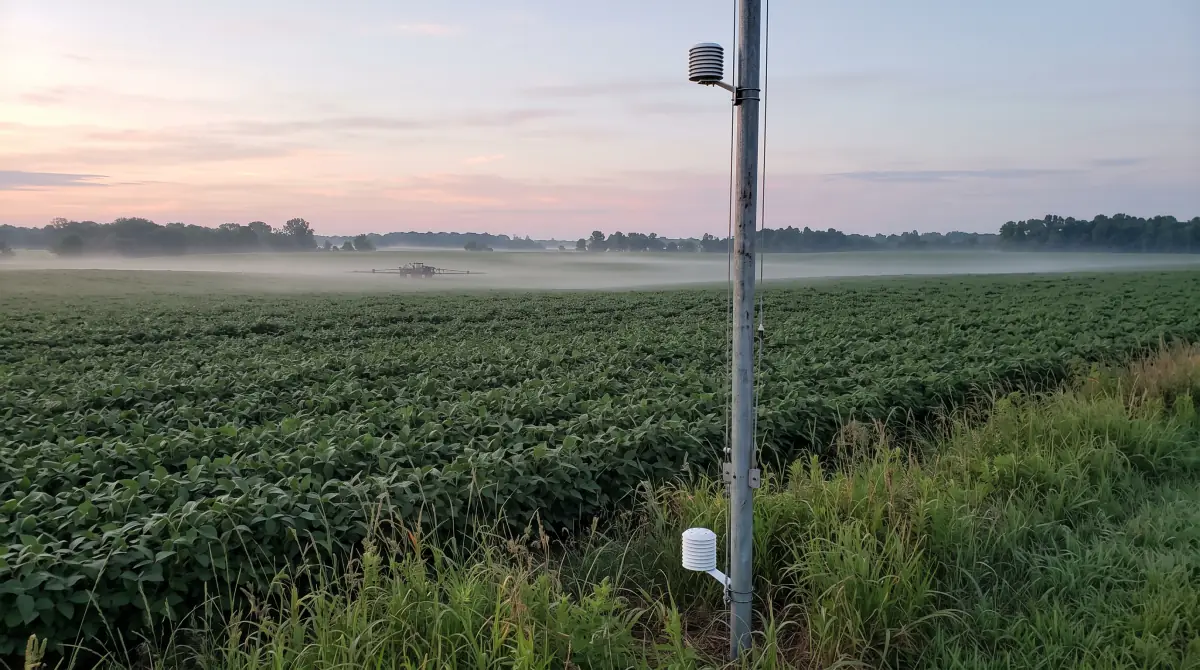
To check for a temperature inversion before spraying, measure shaded air temperature about 1 foot and about 10 feet above the ground or canopy at the field. If the higher reading is warmer, an inversion is present and you wait. Steady wind under about 5 mph, clear skies and the hours around sunset and sunrise make one likely.
If you're spraying over-the-top dicamba in 2026, the clock decides before the thermometer does. The label bars application in the first hour after sunrise and from two hours before sunset onward, and it bars application during an inversion at any hour. The label wins over any reading in this article.
The forecast sees the region's wind. It doesn't see the cold air that has pooled in your bottom field under closed soybeans. Our wind speed field check covers what an inversion is and the 3 to 10 mph band, and our spray window apps guide covers the mesonets that measure inversions for you. This guide covers the part neither one can do: proving, at the field you're about to spray, that an inversion isn't there.
In normal daytime air, the ground warms the air above it, the warm air rises, and that mixing carries fine droplets up and spreads them out. An inversion shuts the mixing off. North Dakota State University's drift publication, AE1876, puts numbers on what happens next. Droplets of 200 microns and smaller can fall as little as a few inches per second, so they hang. Small droplets "readily can move thousands of feet," and vaporized pesticide "can move miles." Wind direction inside an inversion "can vary, sometimes 180 degrees." That breaks the habit of checking that the breeze is blowing away from the neighbor's beans.
You don't need to test every time you hook up the sprayer. Test when these line up:
The wind line deserves a second look. EPA's 2026 dicamba release describes the 3 to 10 mph band as "strong enough to prevent inversions." NDSU's data says a steady 4 mph can still sit on top of one. Treat the 3 mph floor as the legal minimum, not proof that the air is mixing.
Clouds help but don't settle it. NDSU says more cloud cover means slower cooling and weaker inversions, and partly cloudy skies make an inversion's length and strength hard to predict. Overcast lowers the risk. It doesn't rule an inversion out.
This is the check three extension services agree on. NDSU's instruction is short: "Measure the air temperature 1 foot above the soil surface or a closed crop canopy, and at 10 feet above. If the temperature is coolest at the surface, a temperature inversion exists. The greater the temperature difference, the more intense the inversion."
Getting a reading you can trust takes some care, because OMAFA warns that "accurate measurements are difficult to manage with conventional thermometers."
What you need: - Two identical thermometers or temperature loggers. NDSU names cellphone-linked loggers such as the Kestrel DROP D1 and the HOBO Bluetooth temperature and humidity logger as examples. Two of the same model is the point. - Something to get one sensor 10 feet up: a pole, a tall stake, a fence post with an extension, or the sprayer boom folded up. - Shade for both sensors: a small radiation shield, a cup or a folded card.
The protocol:
| What you read | What it means | What to do |
|---|---|---|
| Higher sensor warmer than the lower one | Inversion | Don't spray. Retest later. |
| Readings equal, within your measured offset | Unclear | Treat it as an inversion if it's calm, clear or near sunset or sunrise. Run the smoke test. |
| Lower sensor warmer than the higher one | Air is mixing at this spot | Inversion unlikely here. Move on to the wind check and the label. |
How big a difference counts? Here the sources disagree, and you should know it. NDSU's 2022 publication counts any reading cooler at the surface as an inversion, stronger as the gap grows. The often-repeated 3 degree number comes from Thostenson in that 2015 DTN piece, who said "a 1 to 2 degree difference is usually safe, but anything at 3 degrees or above should be considered an inversion and applicators should cease spraying." Use the publication as your rule and the 3 degree F mark as the point where there's nothing left to argue about. Don't treat 1 to 2 degrees as a pass on its own, especially on a calm, clear evening. The dicamba label says no application during an inversion and gives no degree threshold at all.
When you don't have matched sensors, smoke is the backup. Corteva's guidance is to "release a smoke bomb or wind chalk into the air" and watch it. In mixing air, the smoke or chalk "should move naturally with the breeze and mix into the air as it rises." If it gathers at one height and slides sideways in a layer, you're looking at an inversion.
Smoke shows which way the air is actually moving, which under an inversion may not match the wind at the field edge. But it gives you no number to write down, so use it as the tiebreaker on a borderline thermometer reading. Mind burn bans and dry stubble.
Corteva adds a line worth remembering: "Just because you don't see ground fog does not necessarily mean that an inversion is not happening."
This is the part forecasts and apps can't see, and it's why the test belongs at the field. NDSU's AE1876 lays out how the ground itself changes when and how hard an inversion forms:
That's how good operators get caught. The reading at a bare, high yard says no inversion, while the bottom field, under a closed canopy next to a tree line, has been in one since before supper. Measure where you're spraying, and check the low end first. If you run your own weather station, our guide to farm weather stations covers where to site it, and that placement matters here for the same reason.
Fog is the cue everyone knows, and it shows up last. OMAFA is blunt: "inversion conditions can exist long before fog forms, so fog is not a good indicator for the beginning of an inversion - you're already in one." Its list of signs reads "dew or frost (fog may be too late)."
So read the cues in order. Dew on the boom or the windshield at dusk is your early warning, and the moment to run the two-height test. Fog in the low spots means the inversion has been there a while and the cold air has had time to drain. If you see fog, you're not deciding whether to stop. You should have stopped already.
OMAFA says most inversions have dissipated two hours after sunrise. The apps guide covers NDSU's timing data in more detail. "Most" is the key word, and partly cloudy mornings are the hardest to call.
Don't take the clock's word for it. Retest. The inversion is breaking when the lower sensor starts reading warmer than the upper one, and when smoke starts rising and mixing instead of sliding along at one height. Under the 2026 dicamba label, the earliest legal start is one hour after sunrise. That doesn't mean the inversion is gone by then. Clearing the clock and clearing the air are two separate checks, and you need both.
On February 5, 2026, EPA announced the terms for over-the-top dicamba on dicamba-tolerant soybeans and cotton for the 2026 and 2027 seasons. Applications may not be made:
Wind must be between 3 and 10 mph, and there are temperature limits tied to the forecast high. Each rule stands on its own. Wind in the band doesn't cancel the inversion ban, and neither does a time inside the legal window.
The registration is also under legal challenge. A suit was filed in the Ninth Circuit on February 20, 2026, asking the court to vacate it. We found no ruling as of November 2026. Some states add their own cutoff dates or temperature limits on top of the federal label. Check with your state department of agriculture before the season, every season.
Enlist One and Enlist Duo labels also prohibit application during a temperature inversion. Read the label you're actually using.
Finally, write your two temperature readings, the time and the location into your spray record. If anyone questions the application later, it shows you checked. Our guide to restricted use pesticide records covers what else belongs on it.
For step one, our free Spray Window Planner shows the hours where forecast wind, temperature, humidity and rain fit the limits you set from your label. What it doesn't do is test the air at your field. A calm, clear hour near sunrise can still come up green, and those are exactly the hours to treat as suspect. Use the planner to find the window, then take two thermometers to the low end of the field before you fill the tank.
Measure shaded air temperature at the field you plan to spray, once about 1 foot above the soil or crop canopy and once about 10 feet up. If the upper reading is warmer, an inversion is present, and NDSU says the bigger the gap, the stronger it is. Use two matched thermometers or loggers, shade both from the sun, and check the lowest part of the field first.
NDSU's extension guidance treats any reading that is warmer 10 feet up than 1 foot up as an inversion. A widely quoted rule of thumb from an NDSU specialist calls 3 degrees F or more a firm stop and 1 to 2 degrees usually safe, but that comes from a single 2015 interview. Small gaps can sit inside thermometer error, so match your instruments first. The dicamba label sets no threshold.
Ontario's agriculture ministry says most inversions have dissipated within two hours after sunrise, and early mornings around sunrise carry nearly the same risk as evenings. Partly cloudy mornings are harder to predict. Rather than trusting the clock, retest: the inversion is gone when the ground-level reading is warmer than the 10-foot reading and smoke rises and mixes instead of drifting sideways in a layer.
Release a smoke bomb or wind chalk and watch it. In mixing air it moves with the breeze and spreads out as it rises. If it gathers at one height and slides sideways in a flat layer, you are in an inversion. Dew or frost forming, sounds carrying unusually far and fog in low spots are also signs, though fog means the inversion has already been there a while.
No. EPA's 2026 terms for over-the-top dicamba on tolerant soybeans and cotton prohibit application during a temperature inversion as a separate rule from the 3 to 10 mph wind requirement. Application is also barred within one hour after sunrise and from two hours before sunset onward. The registration faces a court challenge, and states can add limits, so confirm current rules locally.
Join our list for practical guides on farm tech, precision agriculture, and tools that work.