
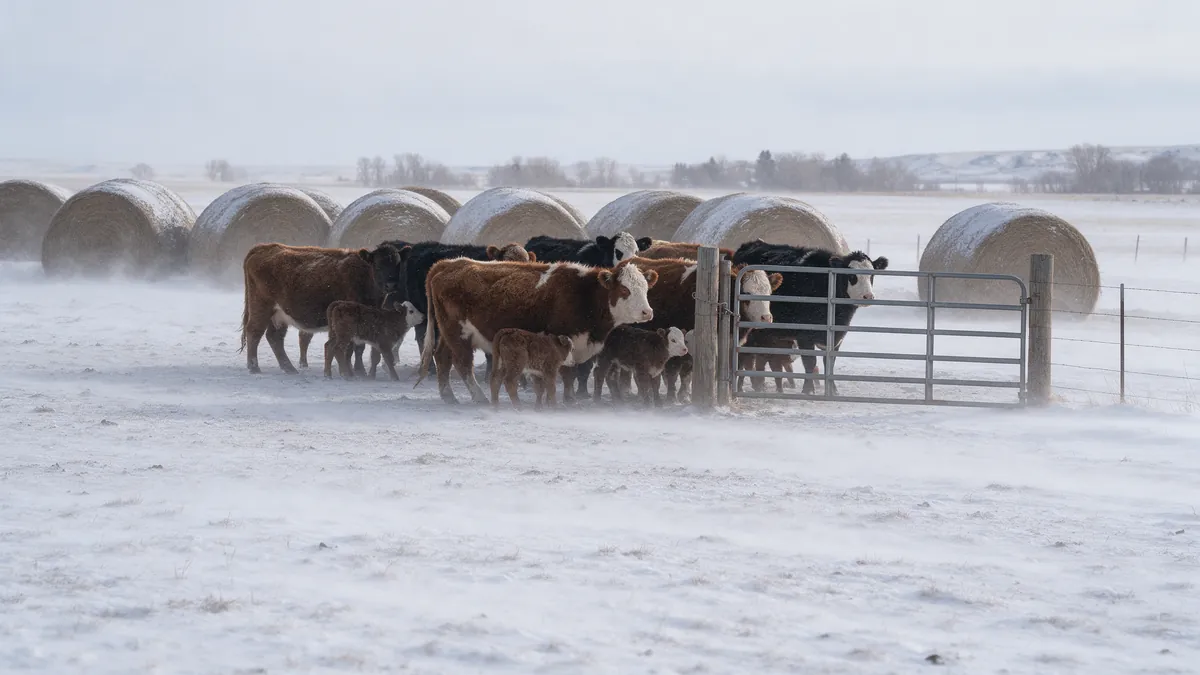
Before you turn cattle out, run three numbers: the effective temperature (air temperature adjusted for wind, from a cattle wind chill chart), the lower critical temperature for those animals (59°F wet, 32°F dry winter coat, 18°F heavy coat), and the gap between them. Each degree below that line raises energy needs about 1 percent dry, 2 percent wet.
The barn thermometer says 10°F, which sounds fine for cows in a good winter coat. But a 15 mph north wind makes it about -5°F to a cow, and if a cold rain soaked her before the front, she needs far more feed than the thermometer suggests. Most winter days the answer to "can they go out?" is yes, with a bit more feed. This guide is for the other days: a cattle cold stress check you can run in a few minutes, a worked example, and a clear line between "feed more" and "keep the newborn pairs in."
The lower critical temperature (LCT) is the point where a cow starts burning extra energy just to stay warm. Above it, her normal ration covers maintenance. Below it, every degree costs feed. It depends mostly on the coat. The standard table comes from D.R. Ames at Kansas State, and Penn State, South Dakota State, the University of Idaho and K-State still use it:
| Coat condition | Lower critical temperature |
|---|---|
| Summer coat, or any coat that is wet | 59°F |
| Fall coat (dry) | 45°F |
| Winter coat (dry) | 32°F |
| Heavy winter coat (dry) | 18°F |
Plan on 18°F for mature cows in a heavy, dry coat. North Dakota State's winter guide (citing NRC 2016) notes that adapted cows in good condition can get by down to about -6°F when it is dry and calm, but treat that as the best case, not the plan.
Three things push LCT up from the table:
Look at the table again. The same cow has an LCT of 18°F with a dry heavy coat and 59°F when that coat is wet. That is a 41-degree swing from one change, and no wind chill reading will show it to you.
A wet coat lies flat and stops trapping air. That's why a 35°F day with sleet can be harder on cattle than a dry, still 5°F morning, and why the first question in the check below is "wet or dry?" and not "how cold?"
It matters in the South too. Most of this research comes from the Northern Plains and Intermountain West, but further south the risk is rarely extreme cold. It is cold rain and wind on cattle that never grew a full winter coat. A cow in a fall coat (45°F LCT) or a wet one (59°F) can be cold stressed at temperatures a Dakota cow would ignore.
This is where most cold-weather advice goes wrong. Three wind chill charts are in circulation, and they don't agree:
Here is how the first two compare:
| Air temp | Sustained wind | NWS 2001 "feels like" (human) | Cattle chart, dry winter coat (U of Idaho) |
|---|---|---|---|
| 20°F | 10 mph | 9°F | 8°F |
| 20°F | 20 mph | 4°F | 0°F |
| 10°F | 15 mph | -7°F | -5°F |
| 0°F | 10 mph | -16°F | -11°F |
| 0°F | 20 mph | -22°F | -20°F |
| 0°F | 30 mph | -26°F | -36°F |
| 30°F | 30 mph | 15°F | -6°F |
In light wind the two are close. At 25 to 30 mph the cattle chart runs up to about 20 degrees colder. The "feels like" on your phone is a fine first look, but in a hard wind it understates what your cattle feel. Use the cattle chart for the check, and never mix charts in one calculation. When someone quotes a cattle wind chill without naming the chart, it could be any of the three.
Two more rules for the inputs:
You don't need a dedicated cattle cold stress index calculator. You need five steps and a pencil.
Step 1: Pull the numbers. Current temperature, tonight's low, sustained wind speed and direction, gusts, and the chance of rain or snow in the next 48 hours. Our free Farm Weather Station shows all of them on one screen for any U.S. location: National Weather Service observations, wind with gust and heading, 48-hour rain chance and forecast rainfall, a 48-hour frost and freeze flag, and a 7-day outlook of highs and lows. Two caveats. Its "feels like" is the human NWS wind chill, so in strong wind read it as "at least this bad." And it is NWS station and grid data, not a sensor in your pasture; a sheltered draw and an open hilltop can feel very different in a north wind.
Step 2: Wet or dry? If rain, sleet or wet snow is likely before or during the cold, use the wet LCT of 59°F. This question changes the answer more often than any other.
Step 3: Pick the LCT for these animals. Use the coat table, and move it up for heifers, thin cows (below BCS 5) and anything just out of a barn. Newborns get their own rules below.
Step 4: Find the effective temperature on the cattle chart, not the human "feels like."
Step 5: Find the gap. LCT minus effective temperature is degrees of cold stress. Multiply by about 1 percent for a dry coat or 2 percent for a wet one. That is roughly how much more energy the animals need.
Then run the pasture go/no-go list further down.
A 1,200-pound cow in a dry winter coat (LCT 32°F). The forecast is 10°F with a sustained 15 mph wind.
A 10-degree day can be a nearly 40 percent feed day. If a cold rain soaked her ahead of that front, South Dakota State's method puts her LCT at 59°F, the gap at 64 degrees, and her extra energy need at roughly two-thirds. Hay alone won't cover that.
The 1 and 2 percent figures are rules of thumb, and K-State states them for cows at BCS 5 or better. Ames' detailed numbers, reprinted by Idaho, show the rate shifting with coat, from about 2 percent per degree wet down to 0.6 to 0.7 for a heavy winter coat. Use the simple version to plan and your hay test to build the ration.
Cold stress raises energy needs only. K-State is clear that protein, mineral and vitamin requirements don't rise with the cold. In a cold snap, cows need calories, not a different mineral tub.
In pounds:
Back to the worked example. If 30 pounds of your hay just covers that 1,200-pound cow on a mild day, 37 percent more energy from the same hay is about 11 more pounds, or 41 total. That's right at Penn State's 3.5 percent ceiling and past what Idaho says most cows will eat.
Skip the extra energy and you pay in weight: 0.5 to 1 pound a day in normal cold and 1.5 to 2 pounds a day in extreme conditions, per Idaho. That condition has to come back before breeding.
One turnout catch. NDSU notes intake rises in moderate cold, but at wind chills around -20°F or lower it can fall, because cattle won't leave shelter to eat. Cattle on open range can eat less right when they need more, so on severe days put the feed where they'll stand to eat it.
Newborns are the strict case. Everything above was written for cows.
The University of Idaho puts a newborn calf's LCT near 60°F. Calf losses climb steeply below 50°F, and rain or snow pushes the calf's effective LCT toward 70°F. Idaho's reading of a 20-year U.S. Meat Animal Research Center study (Azzam and others, 1993, more than 83,000 calving records) is that as little as 0.1 inch of rain on the day of birth can raise calf losses 2 to 4 percent. The study also found calves from 2-year-old dams more vulnerable to bad weather, rain more damaging as temperature fell, and calves from hard pulls about five times as likely to die.
The hold-back list:
A normal newborn runs about 101.5 to 102.5°F, and a calf below 101°F needs help, per Oklahoma State guidance reported by DTN. Idaho notes a cold-stressed calf can get 2 quarts of warm colostrum by esophageal feeder. For a chilled calf that is down, call your vet. For night checks, our guide to thermal drones for cattle checks and calving season covers finding a calf that has wandered off in the dark.
The feed math assumes cattle can get out of the wind and reach water. Check the pasture, not just the forecast.
Yes. The research-grade version is the Comprehensive Climate Index (CCI), published by Mader, Johnson and Gaughan in the Journal of Animal Science in 2010. It adjusts air temperature for humidity, wind and solar radiation to give livestock an apparent temperature. Its cold categories, converted from the paper's Celsius:
| Category | Acclimated adult cattle outdoors | Newborns, non-acclimated or recently housed |
|---|---|---|
| No stress | Above 32°F (0°C) | Above 41°F (5°C) |
| Mild | 32 to 14°F (0 to -10°C) | 41 to 32°F (5 to 0°C) |
| Moderate | 14 to -4°F (-10 to -20°C) | 32 to 23°F (0 to -5°C) |
| Severe | -4 to -22°F (-20 to -30°C) | 23 to 14°F (-5 to -10°C) |
| Extreme | -22 to -40°F (-30 to -40°C) | 14 to 5°F (-10 to -15°C) |
| Extreme danger | Below -40°F (-40°C) | Below 5°F (-15°C) |
The authors call these thresholds arbitrary and say they shift with age, adaptation, genetics, coat, fat and feed intake. Read them as a severity scale, not a hard line.
Some state mesonets compute CCI for you. South Dakota State's SD Mesonet Livestock Stress Tool gives 48 to 72-hour forecasts, and Montana has a Livestock Risk Index. If one covers you, check it. If not, pull the numbers from the Farm Weather Station and run the five steps above. For readings from your own pasture, our guide to on-farm weather stations covers what to buy and where to mount it.
Cattle are tough, and most winter days a cow in a dry, heavy coat just needs a little more feed. The check earns its few minutes on wet and windy days, on days newborn pairs or heifers go out, and when there are thin cows in the bunch. On those days the thermometer misleads you. The gap between effective temperature and LCT does not.
Before the next front, open the Farm Weather Station, note the low, the sustained wind and its heading, and the 48-hour rain chance, then run the gap. It takes less time than chipping ice out of a tank.
Find the effective temperature by taking air temperature and sustained wind to a cattle wind chill chart. Subtract it from the lower critical temperature for your animals: 59°F if wet, 32°F in a dry winter coat, 18°F in a heavy dry coat. Multiply the gap by about 1 percent for a dry coat or 2 percent for a wet one to estimate the extra energy needed.
There is no single cutoff, because a cow's coat sets her limit. A mature cow in a dry, heavy winter coat starts needing extra feed at about 18°F effective temperature, and adapted cows in good condition can tolerate colder on dry, calm days. Wet cattle start feeling cold at 59°F. Newborn calves are the strictest case, with a lower critical temperature near 60°F.
Not quite. The "feels like" number most weather apps show is the 2001 National Weather Service formula, built for a human face. A cattle-specific chart for cows in a dry winter coat runs close to it in light wind but much colder in strong wind. At 30°F with a 30 mph wind, the human number is 15°F while the cattle chart reads about -6°F.
University of Idaho guidance puts it at roughly 3 to 4 extra pounds of hay per cow per day in normal January cold, and 7 to 8 pounds in extreme cold or wet weather. Most cows cannot physically eat 8 more pounds of average hay, so in severe weather part of the increase should come from grain or distillers grains, about 4 to 5 pounds.
Once the calf is strong and nursing, usually 1 to 2 days after birth, according to University of Idaho Extension. Hold pairs in when it is wet and below about 50°F, when a calf has not nursed, or after a hard pull. Newborns have a lower critical temperature near 60°F, and rain on the day of birth raises calf losses.
Join our list for practical guides on farm tech, precision agriculture, and tools that work.