
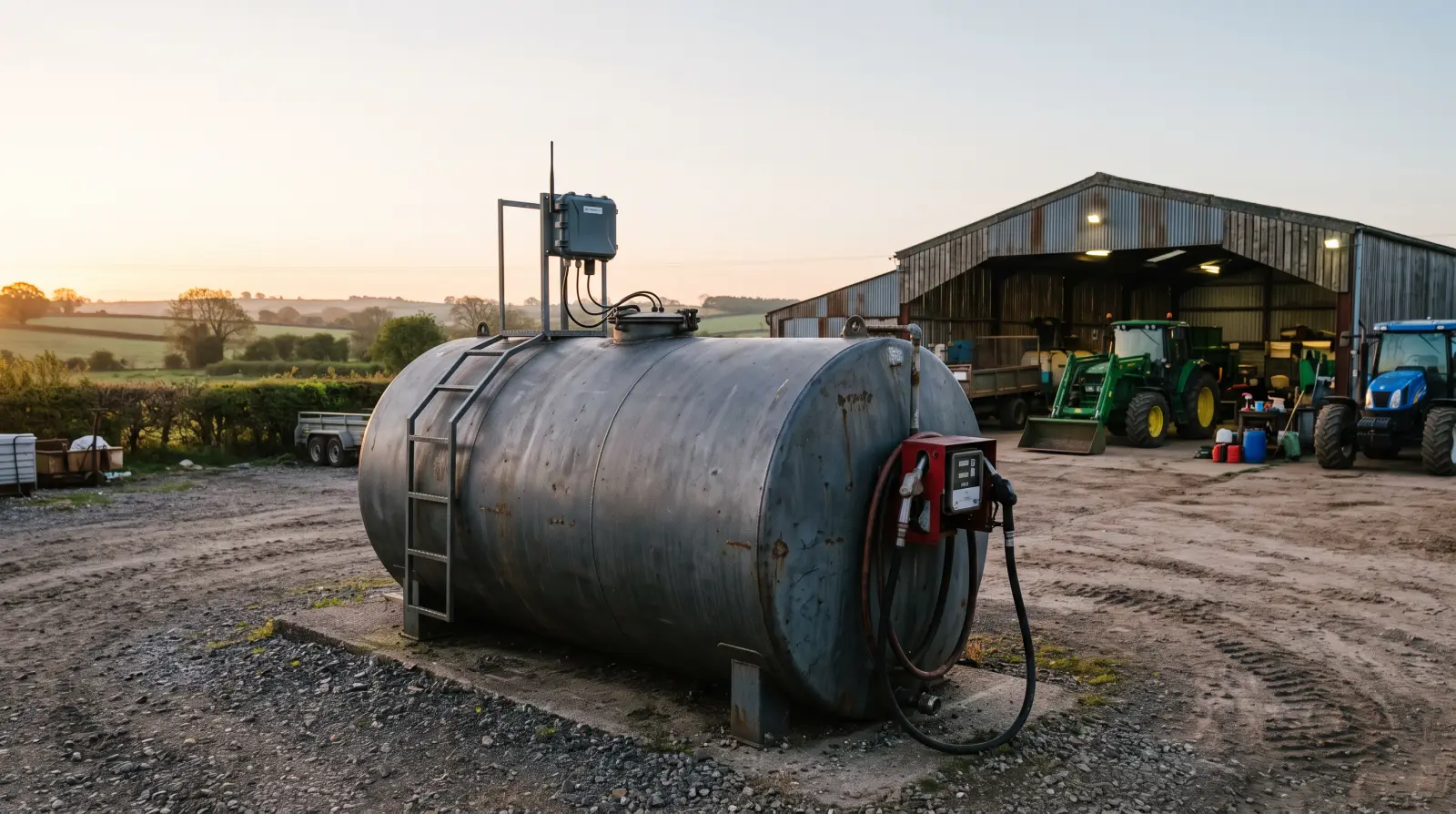
Farm fuel monitoring is three separate systems working together: a level sensor on the bulk tank that reports gallons on hand, a dispenser controller that logs who pumped how much into which machine, and machine telematics that reads burn rate off the tractor's own data. Reconciling all three is what catches fuel you are losing.
Most vendor pages blur those three into one box and imply their product "manages your fuel." It does not, because no single layer closes the loop. A tank gauge tells you fuel is gone, not where it went, and the gap between those two facts is the entire reason to instrument a tank. This guide keeps the three layers separate, shows what each one can and cannot see, and explains why the payoff lives in the space between them.
When a salesperson says "fuel monitoring," they usually mean one of three unrelated products. Layer one is bulk tank monitoring: a sensor on your storage tank that reads the fluid level and reports gallons on hand to your phone. Layer two is dispenser tracking: a controller on the pump that gates fuel behind a PIN and logs each draw against an operator and a machine. Layer three is machine telematics: the tractor's own onboard system reporting gallons per hour, idle time, and consumption per job straight off its data bus.
They answer different questions. The tank knows how much is left but not who took it. The pump knows who pumped and into what, but not how many gallons remain in storage. The machine knows how hard it burned in the field but never sees the storage tank at all. Buy one and call it "fuel management" and you have instrumented a single blind spot. The value is in drawing the lines between the three and then connecting them.
Because fuel is the biggest controllable energy cost on the farm, and diesel is most of it. USDA's Farm Production Expenditures data put total U.S. farm fuel expense at 15.4 billion dollars in 2024, and diesel alone accounted for 9.9 billion of that, roughly 64 percent of the fuel bill. Diesel spend actually fell about 9 percent year over year on lower prices, but the price is the one variable you do not control. What you can control is shrinkage, idle waste, and running the wrong machine on the wrong job.
Fuel cost is also a moving target heading into 2026. Forecasts earlier in the cycle called for fuel expense to ease, then mid-2025 oil moves put that in doubt, and analysts flagged renewed pressure on margins. The takeaway is not a prediction. It is that a line item this large, moving this much, deserves better than a dipstick and a paper log. Monitoring is margin defense in a year the price could go either way.
A tank monitor is a level sensor plus a cellular or satellite gateway that pushes the reading to a dashboard. It sees three things well: how many gallons you have right now, when to trigger a delivery before you run dry mid-season, and an overnight level drop that should not happen. That last one is the alert that matters. If the tank loses 40 gallons at 2 a.m. with no machine running, you want to know at breakfast, not at the next fill.
What it cannot see is who or why. A level drop alone cannot tell theft from a slow leak from a legitimate fill you forgot to log. This is the same sensor class covered in our guide on wireless tank level sensors, applied to fuel instead of water or fertilizer, and the same limit applies: a level is a number, not an explanation. The tank monitor is necessary and it is not sufficient. It tells you something changed. The next two layers tell you what.
This is the accountability layer, and it is a genuinely different product. A pump controller sits between your dispenser and the nozzle and refuses to pump until an operator enters a PIN. Then it logs the gallons dispensed, which employee pulled them, which vehicle or piece of equipment received them, and often the hours or mileage at that moment, uploading it all to a cloud account you can pull reports from.
Vendors in this space (link2pump, FuelCloud, and others) pitch fast installs and "cardlock-level control" without the cardlock price, and they market it hard as theft protection. Grade those as vendor claims, because they are, but the underlying capability is real and it is the piece the tank sensor lacks. Once every draw is tied to an operator and a machine, you have an equipment-level fuel log. That log is what makes reconciliation possible, and, as you will see below, it happens to be the exact record the IRS already expects you to keep on off-road diesel.
The third layer needs no add-on tank hardware at all, because the tractor already generates the data. Machine telematics like John Deere's JDLink use an onboard gateway to stream engine data into a management dashboard, where you can see fuel consumption, idle time, and hours per job across a mixed fleet. Aftermarket and mixed-color systems (Verizon Connect, Razor Tracking, and others) do the same for a yard that is not all green. This is the parent topic of our tractor telematics and fleet guide, and fuel is one of the sharpest reasons to turn it on.
Idle is the classic pitch here, and it deserves an honest asterisk. The figures you see quoted, like a heavy truck burning about 0.8 gallons an hour at idle and idling wasting up to 8 percent of annual fuel, are over-the-road trucking numbers from Department of Energy sources, not field tractors. A tractor's idle burn and duty cycle are different, and no clean independent tractor number exists to quote. Use idle tracking to find your own baseline and your own worst offenders. Do not trust a trucking figure as if it were your tractor's.
Not with a single sensor, despite what the marketing says. A level drop is ambiguous by itself. The thing that actually catches shrinkage is reconciliation across the three layers: gallons delivered (invoice and tank rise) minus gallons dispensed (pump log) should net to the tank's measured change. When it does not, the persistent gap is your shrinkage number, and now you have something to investigate instead of a hunch.
That is a method, not a product feature, and it is worth teaching because no vendor sells it as a box. Delivered in, dispensed out, and burned by the machines should roughly balance over a month. A steady unexplained gap points at theft or a leak. A one-time gap that lines up with a forgotten fill is a recordkeeping miss, not a crime. Our guide on farm diesel theft prevention tech goes deeper on the hardware side, but the honest mechanism is the loop, and the loop only exists once you have all three layers feeding it.
It generates most of them for free. Farms burning dyed off-road diesel, and those claiming the federal credit on clear diesel used off-highway through Form 4136 or Form 8849 Schedule 1, are expected to keep multi-year records: purchase invoices, delivery receipts, monthly inventory logs, and equipment fuel logs tying each fueling event to a specific machine by ID, operator, date, and gallons. That is precisely what a dispenser tracker and a tank monitor produce as a byproduct.
In other words, the compliance paperwork you dread is the same data the pump controller already logs. Pair that with proper farm record keeping software and the annual scramble gets a lot shorter. One caveat, stated plainly: this is not tax advice, and the specifics of thresholds and state rules vary. Confirm your own filing with a tax professional and current IRS guidance. The point here is narrow and reliable: instrumenting the tank quietly creates the audit trail you are already required to have.
Two real decisions sit under every tank monitor. The first is the level-sensing technology. Ultrasonic sensors read the level by time-of-flight without touching the fuel and are a solid general choice. Radar and microwave sensors are more precise and also non-contact, at higher cost. Submersible pressure sensors sit in the fluid and are rugged. For most farm diesel tanks in a shop yard, a non-contact ultrasonic unit covers it.
The second decision is connectivity, and it is the same rural problem every field sensor has. Cellular units on CAT-M or NB-IoT run for years on battery and work anywhere you have signal, which a shop-yard tank usually does. A tank sitting at a remote pasture or field edge may not, and there the honest options are a satellite-capable monitor or a signal boost. If dead zones are your reality, our guide on cellular signal boosters and field connectivity is worth a read before you buy, because an app-based monitor you cannot reach is just an expensive dipstick.
Start with the tank, because the level sensor is the cheapest layer and it stops the two worst days: running dry in season and getting hit overnight without knowing. Add the dispenser controller next, since that is the layer that turns a vague level drop into a named operator and machine, and it is also the one that builds your tax records. The machine layer may already be sitting in your cab unused, so before you buy anything, check whether your newer tractors have telematics you have simply never switched on.
Match the depth to the operation. A single shop tank and two operators does not need a fleet dashboard. A dozen machines across multiple sites is exactly where reconciliation pays for itself. The same telematics that watches fuel also feeds predictive maintenance for farm machinery, so the burn-rate layer often earns its keep twice.
If this is the kind of decision you would rather get right before you spend, we write one of these practical breakdowns most weeks. The related guides above are all free, and if you want the next one when it lands, the newsletter signup on the site is the only thing we will ever ask you to click. No pitch, just the same plain-English take on farm tech that got you this far down the page.
Farm fuel monitoring is a set of systems that track diesel across three stages: a bulk tank sensor reporting gallons on hand, a dispenser controller logging who pumped what into which machine, and machine telematics measuring burn rate and idle. Used together, they let you reconcile fuel delivered against fuel dispensed against fuel burned, which is how you spot shrinkage and control the largest energy cost on the farm.
Not from a single sensor. A tank level drop cannot tell theft from a leak or an unlogged fill. Theft shows up through reconciliation: fuel delivered minus fuel dispensed should match the tank's measured change, and a persistent gap is your shrinkage. A PIN-gated pump controller adds accountability by tying every draw to a named operator, which narrows an investigation fast.
Fuel telematics is data pulled straight off the tractor's onboard system, with no extra tank hardware. Systems such as JDLink stream engine information to a dashboard where you can see gallons per hour, idle time, and consumption per job. It answers how much a specific machine burned on a specific field, something a storage tank sensor or a pump controller can never see on its own.
For most cellular monitors, yes, you need a usable signal at the tank. A tank in a shop yard usually has coverage. A tank at a remote field edge or pasture may not, and there you either choose a satellite-capable monitor or add a signal booster. Confirm coverage at the tank's actual location before buying, since an app-based monitor with no signal cannot report anything.
Pricing is quote-based and depends on sensor type, connectivity, and how many tanks and pumps you instrument, so no honest single figure fits every farm. Treat any number you see as a starting point for a dealer conversation rather than a fixed price. A basic single-tank level sensor is the least expensive layer; adding dispenser tracking and fleet telematics raises the total.
Join our list for practical guides on farm tech, precision agriculture, and tools that work.