
Corn growth stages follow accumulated heat, not calendar days. For each day, cap the high at 86°F, raise the low to 50°F, average the two and subtract 50. Corn needs about 100 to 120 of those growing degree days to emerge, then adds a leaf collar roughly every 82 GDD until V10 and every 50 GDD after that.
That arithmetic fits on a feed-store receipt. The trouble is that most GDD numbers growers see are off in one of three quiet ways: the wrong formula, the wrong starting line, or the wrong thermometer. Below are the stage numbers, then each trap, so the next time your count says V6 you will know whether to believe it. The rule worth keeping: count the heat, then check the plant.
With harvest behind most of us, this is a good week to set the system up for 2027 and to check this year's predictions against what you actually saw in the field.
A growing degree day (GDD) is one degree Fahrenheit of average daily temperature above 50°F, the point below which corn development nearly stops. The corn version is called the modified or 86/50 method:
Daily GDD = (daily high, capped at 86 + daily low, raised to 50) / 2 - 50
Purdue agronomist Bob Nielsen's heat unit explainer uses examples like these:
| Day | High | Low | Values used | Corn GDD |
|---|---|---|---|---|
| Mild | 80 | 55 | 80 and 55 | 17.5 |
| Hot | 90 | 72 | 86 and 72 | 29 |
| Cool | 68 | 41 | 68 and 50 | 9 |
Add each day's number to a running total that starts at planting. That total is the clock your corn is actually running on.
Corn development speeds up as it warms, but only within a range. Above about 86°F the plant gains no extra development speed, and below 50°F it makes almost none. The caps keep the formula honest at both ends, as the Midwestern Regional Climate Center explains on its modified GDD page.
Skip the caps and you get the "simple" average method, which is what many weather apps and generic calculators use. It drifts in two directions:
Neither miss looks big on one day. Run a week of 95°F highs or a string of 40°F nights through it and the season total can drift by a leaf stage or more. Before you trust a GDD number, find out which formula made it.
Here is the stage chart built from Purdue's research. Emergence takes about 115 GDD from planting (the published range is 100 to 120). After that, Purdue's leaf stage prediction work found a new visible leaf collar about every 82 GDD up to V10. The original data suggested 85, but 11 more years of plot data settled on 82. After V10, leaves come faster, about one every 50 GDD.
| Stage | GDD since emergence | GDD since planting (about) |
|---|---|---|
| VE (emergence) | 0 | 100 to 120 |
| V2 | 164 | 280 |
| V4 | 328 | 445 |
| V6 | 492 | 605 |
| V8 | 656 | 770 |
| V10 | 820 | 935 |
| V12 | 920 | 1,035 |
| V14 | 1,020 | 1,135 |
Past V12 the chart depends on how many total leaves your hybrid makes, so the reproductive stages come from a different source. University of Kentucky's AGR-202 gives this example for a 2,700 GDD hybrid, counted from planting:
| Stage | GDD since planting |
|---|---|
| VT (tassel) | 1,135 |
| R1 (silking) | 1,400 |
| R6 (black layer) | 2,700 |
Treat those as one example, not a rule. The table comes from 1987 work, modern hybrids differ, and your seed company's silk and black layer ratings for your hybrid beat any generic chart. Kentucky notes that most hybrids grown in that state need about 2,700 to 3,100 GDD to reach black layer.
One honest warning from putting these tables side by side: they do not agree early in the season. The same Kentucky table lists V6 at 475 GDD from planting, while the Purdue arithmetic puts it near 605. Different research, hybrids and staging conventions produce different charts. That gap is the whole argument for the rule this guide keeps coming back to. The count tells you when to walk the field. The plants tell you where the crop really is.
This trap catches the most people, because the tag usually does not say. Seed companies may count a hybrid's GDD to black layer from planting or from emergence. Purdue's guidance on hybrid maturity for delayed planting says that if the rating is from emergence, add about 115 GDD to get a from-planting number.
So a hybrid rated at 2,600 GDD from emergence needs about 2,715 GDD from planting. Compare that rating against a planting-date total without the adjustment and you will expect black layer a week or more before it arrives in a cool fall. Ask your seed rep which way the ratings run.
Yes. The same Purdue work (Nielsen and colleagues, 2002) found hybrids planted after about May 1 mature in roughly 6.8 fewer GDD for each day of delay, through at least the second week of June. A 2,700 GDD hybrid planted May 31 needs about 30 x 6.8 = 204 fewer, or just under 2,500. That data is from Indiana, so treat it as a strong guide rather than a local constant.
Late planting also moves the calendar less than you might expect, because summer heat piles up faster than spring heat. Kentucky's example: a 116-day hybrid planted six weeks late reached black layer about three weeks late, not six.
Until about V6, corn's growing point sits below the soil surface. Purdue found leaf stages through V6 are predicted better with GDD from soil temperature. Once stalk elongation lifts the growing point above ground, switch to air temperature.
Emergence follows the same logic. Purdue's 2021 update put planting to emergence at roughly 115 GDD, give or take 5, and said the estimate is most accurate when the GDD come from soil temperature. Iowa State uses a 90 to 120 GDD range and gives a useful trigger: if 120 have passed and nothing is spiking, dig up seed and find out why.
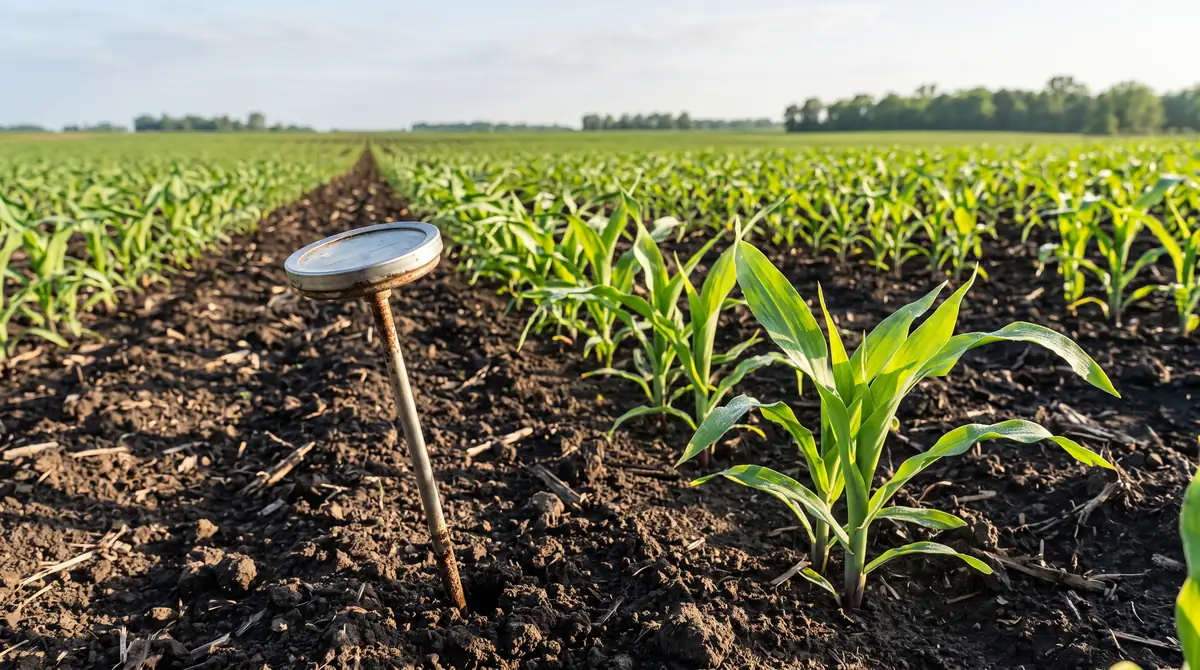
A probe thermometer at seed depth, read at the same time each day, gets you most of the way. Our guide to checking soil temperature before planting covers depth, timing and which readings to trust. If you want a continuous on-farm record instead of the nearest airport station, a farm weather station with a soil probe does the job.
Once the ear is filling, count backward to black layer. Purdue's grain fill stages give these remaining heat units for late April to early May plantings in Indiana (Brown, 1999 data):
| Kernel stage | GDD left to black layer (about) |
|---|---|
| R2 blister | 960 |
| R3 milk | 880 |
| R4 dough | 670 |
| R5 full dent | 337 to 360 |
| Half milkline | 200 |
This is the countdown that answers the August question: will this field make it before a killing frost? Compare the GDD left with what your location normally adds between now and its average first fall frost. The last frost date guide explains how those frost estimates work at the spring end of the season.
Pick one tool for the season total and stick with it, so your numbers stay comparable year to year:
Our free Farmer's Almanac Planner answers a narrower question: how much heat is the next week likely to add? Enter your location and it totals daily GDD from today forward using the National Weather Service forecast for your exact spot. Add that to your season-to-date total from one of the trackers above and you have a rough date for the next stage worth scouting.
Know its limits. The planner counts forward from today, not from your planting date, and the forecast data runs out after about 7 or 8 days. It also uses the simple base-50 average with no 86/50 caps, so it reads a little high in a heat wave and a little low on cold nights compared with true corn GDD. Use it for the week-ahead look, and keep the season total in a corn GDD tool.
Here is a worked example using Purdue's numbers. Say 535 GDD have built up since your corn emerged.
Later in the season, the math shifts. At 1,220 GDD since emergence, the crop is past V10 (10 x 82 = 820). Subtract 820 to get 400, divide by 50, and you get 8 more leaves: about V18.
Now walk out and confirm. Use the leaf collar method, the university standard: count leaves with a visible collar, the pale band where the leaf blade meets the sheath, starting with the short, rounded first leaf. Leaves still in the whorl without a visible collar do not count. Purdue's staging methods note explains that the "droopy leaf" method, which hail adjusters use, usually reads one leaf higher on young corn and two leaves higher by about knee-high. Know which method a label or chart assumes before you time a herbicide pass off it.
Stage 10 plants in a few spots across the field and take the most common number. After about V6 the lowest leaves can tear away as the stalk thickens, so split a stalk lengthwise and find the first elongated internode. The leaf attached at the node just above it is usually leaf 5, which keeps your count anchored.
If the plants run well behind the count, GDD is not wrong so much as incomplete. The model ignores drought, nutrient stress, compaction and hybrid quirks, and Purdue notes that severe stress slows collar appearance. A field that lags its GDD prediction by two or more leaves is telling you to look for a problem.
GDD for insects work the same way with different base temperatures and starting points. If that is your next question, our post on degree-day pest trap monitoring covers it.
A few minutes this winter makes next season's numbers trustworthy:
Count the heat to know when to look. Then go look.
Corn needs about 100 to 120 GDD from planting to emerge, then about 82 GDD per new leaf collar through V10 and about 50 GDD per leaf after that. That puts V6 near 600 GDD after planting. Silking and black layer depend on the hybrid: one University of Kentucky example for a 2,700 GDD hybrid lists silking at 1,400 and black layer at 2,700.
Use the 86/50 method. Take the day's high temperature, and if it is above 86°F, use 86. Take the low, and if it is below 50°F, use 50. Average those two numbers and subtract 50. A day with a high of 90 and a low of 72 gives (86 + 72) / 2 - 50 = 29 GDD. Add each day to a running total from planting.
Corn develops faster as it warms, but development speed stops rising above about 86°F, and it nearly stops below 50°F. Capping the high at 86 and raising the low to 50 keeps the count matched to how the plant actually responds. Without the caps, hot days overstate progress and cool nights understate it, so a season total can drift by a leaf stage or more.
It varies by seed company, and the tag often does not say. Purdue advises that if a hybrid's GDD to black layer is rated from emergence, add about 115 GDD to compare it with a from-planting total. A 2,600 GDD rating from emergence becomes about 2,715 from planting. Ask your seed rep which method their ratings use.
Yes. Purdue research found hybrids planted after about May 1 reach maturity with roughly 6.8 fewer GDD for each day of delay, through at least the second week of June. A 2,700 GDD hybrid planted May 31 would need just under 2,500 GDD. The data comes from Indiana trials, so treat it as a strong guide rather than an exact local figure.
Join our list for practical guides on farm tech, precision agriculture, and tools that work.