
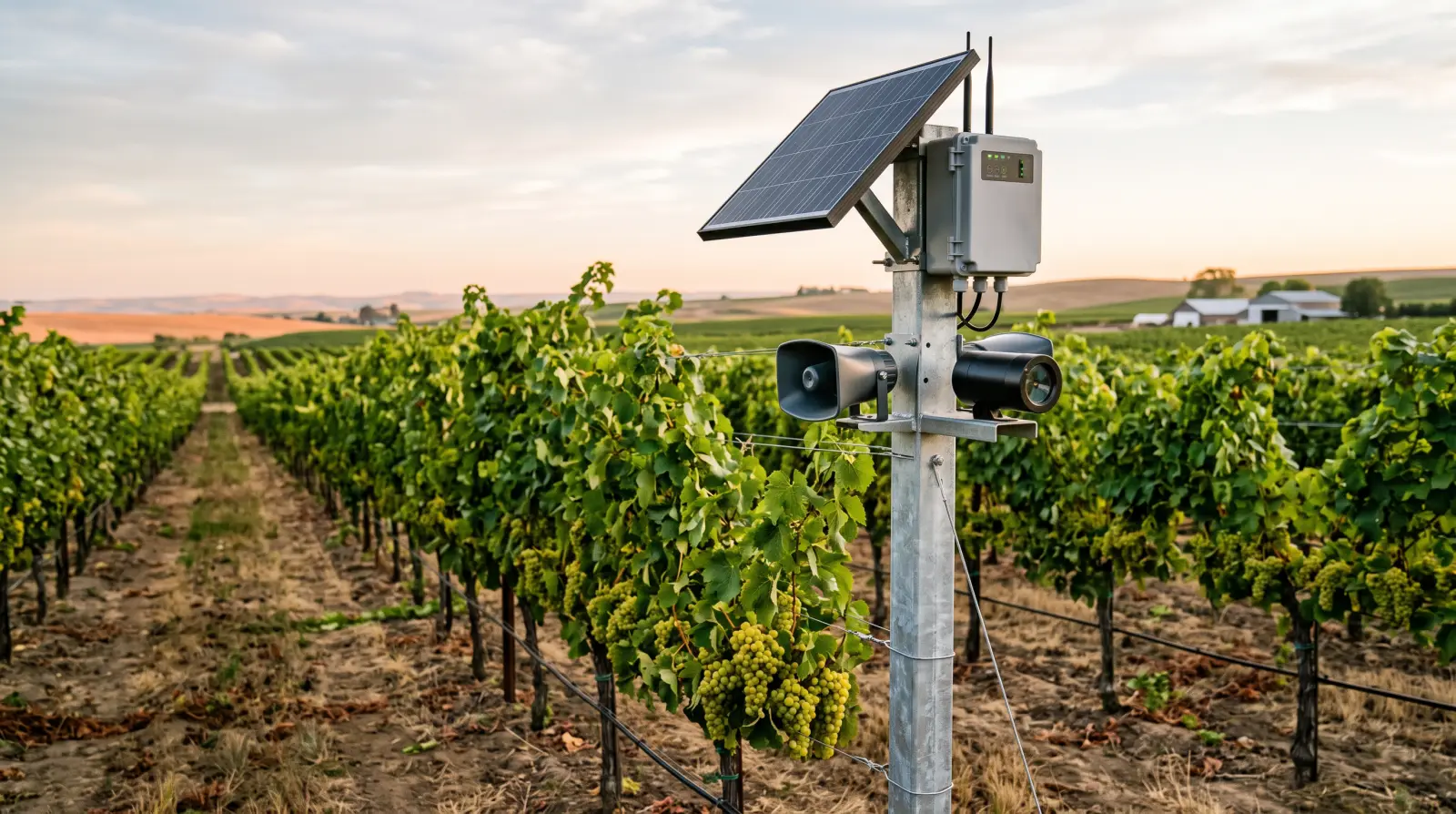
An automated bird deterrent works on a farm only if the animal cannot learn to ignore it. Moving green lasers, detect-and-respond systems, and patrol drones beat propane cannons and static balloons because motion and unpredictability are built in. The best-documented tool, the automated laser, is real but light-limited, and only netting stops damage with certainty.
Read that again, because it is the whole guide. The question a working grower actually asks is not "which gadget is coolest," it is "what do I put in the field, and will it still work in August?" And the answer to that turns on one idea that sorts every product on the market cleanly: birds and deer are not scared by loud or bright things. They are scared by things they cannot predict and cannot get used to. Once you hold that ruler up to the field, the winners and the losers separate fast.
So this is a behavior-first buyer's guide, not a product roundup. By the end you should know why your propane cannon quit working, what "automated" genuinely buys you, how honest the laser evidence really is, where drones stand today, and the price of the one option that never fails. Let's start with the enemy.
Because the animal figures them out. A pest bird or a whitetail is a fast learner, and a cannon that bangs on a timer, a scare-eye balloon that never moves, and a strip of reflective tape all send the same predictable signal every time. Give an animal a few days of that signal with no consequence attached, and it does the sensible thing. It stops reacting.
This is not a fringe opinion. Ontario's agriculture ministry states plainly that propane cannons are "only effective in the short-term or when used with other deterrents," and wildlife researchers report that birds "habituate to predictable nonlethal sounds." Niagara-region research reporting reached the same conclusion about bird bangers being the least effective long-term choice. The failure mode is baked into the tool. A device that repeats itself teaches the animal that the threat is empty.
That single fact, habituation, is the axis everything else rides on. It is also why the fix in the literature is always the same three words: diversify, randomize, reposition. Any deterrent, old or new, that ignores those words will fade. Any tool that has them built in has a fighting chance. That is the real dividing line between a cannon and a laser, and it matters more than any spec sheet.
Two upgrades, and they map directly onto the habituation problem.
The first is motion and randomness. A laser beam that sweeps across a field or a drone that flies a varied path never presents the same fixed picture twice. There is no steady, ignorable pattern for the animal to file away as harmless. Movement is the opposite of a timer.
The second upgrade is quieter and, over time, more important: detect-and-respond. The best automated systems pair a camera or radar with the deterrent so it fires only when a pest actually shows up. A 2024 peer-reviewed system paired deep-learning bird detection with an automatic laser rotation mechanism, so the laser activated only when a bird was present. That does two things at once. It denies the animal a constant background signal to tune out, and it saves power while cutting the nuisance to neighbors and non-target wildlife. The same computer-vision thread runs through modern AI crop scouting and see-and-spray weed detection, where the value is not the actuator but the decision to fire only when it counts.
Put simply: legacy tools broadcast constantly and hope. Automated tools move, vary, and increasingly wait until there is a real target. That is the upgrade you are paying for, and it is worth paying for only if the deployment respects it.
Yes, and the evidence is stronger than for anything else in this category, with one large asterisk you need to understand before you spend a dollar.
Start with the headline number. A peer-reviewed before-and-after study published in Scientific Reports in 2021 put an automated green laser on a 6-meter tower at a Dutch free-range farm. Wild-bird visits fell 98.2 percent overall, ducks and geese by 99.7 percent, and songbirds by 96.1 percent. The time birds spent in the treated area dropped more than 600-fold. The part that matters most for a farmer: over 28 straight days, the mallards showed no habituation. The signal kept working because a moving beam is not a repeating pattern.
The agricultural proof comes from the University of Rhode Island, where researchers ran a multi-year field trial of a "laser scarecrow" in sweet corn, a portable unit with a continuously moving green beam. In 2017, control plots averaged 48.4 damaged ears against 14.6 under the laser. In 2018, 23.8 percent of ears were damaged in control plots versus 13.7 percent under the laser. That is roughly a 60 to 70 percent cut in damage, on a real crop, over more than one season. It is the study that put laser scarecrows on the map, and it is why so many growers now build the open-source URI design themselves.
Now the asterisk, and it is the single most important sentence in this guide: a laser is a low-light tool. The beam is far more visible, and far more effective, at dawn, dusk, and under overcast skies. In bright direct sun the beam can wash out and lose its bite, especially on lower-power units. URI runs its demonstrations at twilight for exactly this reason. Some vendors claim their higher-power units work fine in full daylight, but that is a claim from the people selling the hardware, so treat it with the skepticism you would treat any sales sheet. Plan the laser around your low-light windows, dawn and dusk when many birds feed hardest anyway, and pair it with something else for midday. Anyone who tries a laser at noon, sees nothing, and gives up has been set up to fail by an overpromise.
They are, with siting discipline. Most agricultural bird lasers fall in the Class 3B range, roughly 5 to 499 milliwatts. A Class 3B beam can injure an unprotected eye on direct, sustained exposure, so this is not a toy, but it is also a well-understood, manageable risk. Reputable systems use a spread or expanded beam and run a programmed path to keep the beam moving and limit exposure. Your job as the operator is straightforward: aim away from roads, homes, aircraft paths, and people, and program the sweep so it never crosses them. Site it responsibly and it is a tool, not a hazard. This is a plan-it-once decision, not a reason to walk away.
They are promising and clearly better than static tools, but they are still early, and you should treat them that way. Drones out-move everything a cannon or scarecrow can do. Research shows birds are far more tolerant of stationary devices than of an object that actively chases them, and cooperative missions with more than one drone push large flocks better than a single unit can.
The deer work is where it gets interesting. A widely reported autonomous system uses drones emitting beeps, horns, and human-voice recordings, and the human voice turns out to be the strongest deterrent of the three, while the system logs feeding times and GPS locations. USDA-affiliated researchers have even tested spray-drones that combine hazing with an avian repellent, so the dispersal "sticks" rather than letting the flock drift back an hour later.
The honest limits are real. Battery endurance and coverage cap how much ground one drone protects. Piloting and monitoring take labor. Commercial farm use falls under FAA Part 107, the same rulebook covered in our guide to farm drone regulations, and the broader case for on-farm flight is in our drone technology in agriculture overview. And here is the through-line again: even a drone can be habituated to if you fly the same lazy pattern every day. The field data is still thin at large scale. Call drones emerging, not solved, and you will not get burned.
Less far than most growers assume, and hearing sets the limit. A 2024 Wildlife Society Bulletin study tied the effective range of auditory frightening devices to blackbird hearing and antipredator response, reinforcing that a single cannon does not blanket a big field. Sound falls off fast, and coverage is smaller than the noise suggests to a human standing at the property line.
That does not make acoustics useless. It makes them a layered-plan component, never a lone timer-driven bang. A sensor-triggered, randomized bio-acoustic system that plays varied distress and predator calls only when birds are detected, and gets repositioned through the season, still earns a place. A fixed cannon booming on a clock through August does not. The difference, once more, is whether the animal can predict it.
When the crop value demands certainty, because netting is the only method that stops damage 24 hours a day, quietly and legally. Every automated deterrent on this page is a risk reducer. Netting is a guarantee. Extension guidance is blunt about it: only netting stops bird damage and fruit loss around the clock. The trade-off is cost and labor, and at very large scale it becomes impractical, but for a high-value block it is the benchmark everything else is quietly competing against.
Here is the honest price so you can weigh gadget against net. In Northeast blueberries, lightweight single-use netting runs roughly 650 to 850 dollars per acre, mid-weight drape netting about 1,100 to 1,300, and heavy permanent canopy netting about 1,850 to 2,250, with installation adding another 2,000 to 3,500 dollars per acre. Those are dated, regional ranges, not a quote, but they frame the decision. If the block is blueberries, wine grapes, or a high tunnel where losses can run 10 to 50 percent, the net often pencils out. If it is a large field of sweet corn, a laser makes more sense. The most useful plan for many farms is exactly that split: net the berries, laser the field corn.
| Method | Resists habituation? | Best light or time | Best targets | Real limits | Rough cost signal |
|---|---|---|---|---|---|
| Automated moving laser | Strong (no habituation in trials) | Dawn, dusk, overcast; weak in bright sun | Most birds; waterfowl | Low-light tool; Class 3B siting; needs line of sight | Hundreds to low thousands per unit |
| AI detect-and-respond laser | Strongest (fires only on a target) | Same low-light bias | Same as laser, with power and nuisance savings | Newer; higher upfront; still light-limited | Higher upfront; commercial |
| Response or patrol drone | Good, but can habituate without varied tactics | Daylight (visual piloting) | Large flocks; deer (human-voice audio) | Battery, labor, FAA Part 107, early data | Higher capex plus ongoing labor |
| Sensor-triggered acoustics | Moderate (only if randomized and triggered) | Any | Birds over short range; deer | Short range; noise ordinances; habituation if predictable | Low to moderate |
| Fixed cannon, static balloon, tape | Weak (fast habituation) | Any | Short-term or new pressure only | Fails in weeks alone; noise complaints | Low |
| Exclusion netting | Total (physical barrier) | 24/7 | High-value blocks | Capital and labor; impractical at very large scale | ~650 to 2,250 per acre plus install |
Treat every cost figure as a dated, approximate signal, not a bid.
Stop thinking about buying a gadget and start thinking about designing a program. The growers who keep birds off their crop through the whole ripening window do five things.
Match the tool to the animal. Starlings in a vineyard, geese in a grain field, and deer on an orchard edge are different problems. A moving laser handles most birds well. Deer respond better to a human-voice drone than to generic noise. Do not buy a bird tool for a deer problem.
Match the tool to the crop's vulnerable window. Damage concentrates when the fruit or grain is ripening. That is when the program has to be sharpest, and it is worth having it running before the birds establish a feeding routine, because breaking a habit is far harder than preventing one.
Match the laser to the light. This bears repeating because it is where most laser disappointment comes from. Lean on it at dawn, dusk, and on overcast days, and cover midday with netting on the high-value block or a randomized acoustic layer.
Layer two or three methods and randomize them. No single tool is a silver bullet, and even the good ones fade if you deploy them lazily on one fixed pattern. Rotate positions, vary the timing, and let a detect-and-respond trigger do the randomizing for you where you can afford it. The same instinct that protects a ripening crop from frost with orchard frost protection tech applies here: layered defense beats a single point of failure.
Finally, measure. Count damaged ears or clusters in a treated block against an untreated strip, the way the URI researchers did. Numbers tell you whether the program is working or whether the birds have started to win, long before the harvest total does.
Do those five things and you have moved the ceiling on how long deterrence lasts before the animals adapt. That is the real, honest promise of automated deterrents. Not a guarantee, but a genuinely longer runway than a cannon ever gave you, backed by peer-reviewed evidence. And when the crop is valuable enough that you cannot accept any loss at all, you already know the answer. You net it.
We track ag-tech like this the way a working grower would, by what holds up in the field rather than what sells on a spec sheet. If that is useful to you, the free Manley Farms email list is where the next breakdown lands first.
They work if the animal cannot predict them. Moving lasers and detect-and-respond systems resist habituation because there is no fixed pattern to learn; a peer-reviewed laser trial recorded no habituation over 28 days. Fixed cannons and static balloons fail within weeks because they repeat the same signal. Motion, randomness, and sensor triggering are what separate the tools that last from the ones that fade.
In a multi-year University of Rhode Island sweet corn trial, an automated green laser cut damaged ears by roughly 60 to 70 percent, and a poultry-farm study recorded a 98.2 percent drop in wild-bird visits. The catch is light: lasers work best at dawn, dusk, and under overcast skies, and can wash out in bright midday sun, so plan them around low-light windows.
Most farm bird lasers are Class 3B, roughly 5 to 499 milliwatts, which can injure an unprotected eye on direct, sustained exposure. In practice they are safe when sited responsibly: use a spread beam, run a programmed sweep, and aim away from roads, homes, aircraft paths, and people. It is a plan-it-once siting decision, not a reason to avoid the tool.
Yes, and they out-move static tools, but the technology is still early. Drones can push large flocks, and for deer a human-voice recording deters better than generic noise. The limits are real: battery life caps coverage, piloting takes labor, commercial use falls under FAA Part 107, and animals can still habituate without varied tactics. Treat drones as emerging, not a turnkey solution.
Netting is the only method that stops damage 24/7, so it is worth it on high-value blocks like blueberries or wine grapes where you cannot accept any loss. Expect roughly 650 to 2,250 dollars per acre plus 2,000 to 3,500 for installation. For large field crops like sweet corn, a laser is usually the better economic fit. Many farms split it: net the berries, laser the corn.
Join our list for practical guides on farm tech, precision agriculture, and tools that work.