
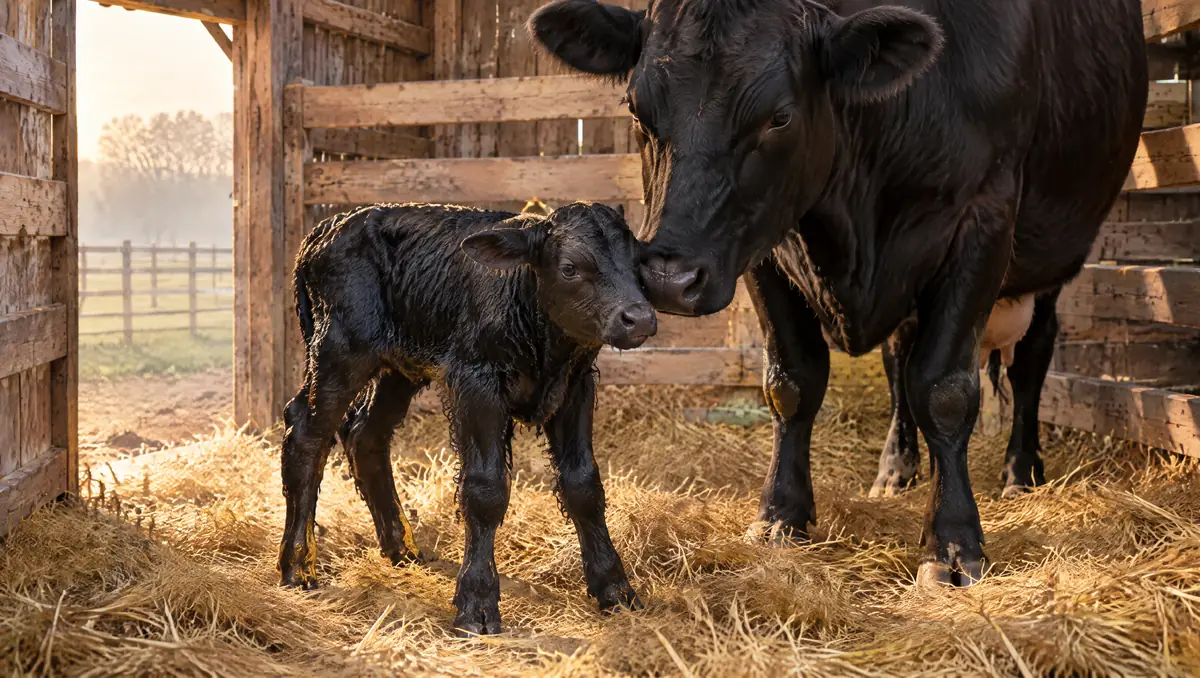
Good calving records cover seven things for every calf: dam ID, calf tag, birth date, sex, a calving ease score from 1 to 5, birth weight if you can measure it, and the outcome, live or dead, with a short note. Record them the same day, the same way, for every calf, including twins and dead calves.
That list isn't ours. It's what the calving books from NDSU, Missouri Extension and SDSU Extension share once you strip out the extras. SDSU puts the most important rule in one line: "Recording three traits consistently for all calves born is more beneficial than recording ten traits for only 50 percent of the calf crop."
A calving record is only worth what you can pull out of it at preg check, at fall culling and before you turn out bulls next year. So this guide gives you the field list, shows how to record each field the same way every time, and then shows the three reports those fields build. If a field doesn't feed a decision, it's optional.
Here's the core list, how to write each one, and what it's for later:
| Field | How to write it | What it feeds |
|---|---|---|
| Dam ID | The cow's tag number, never a nickname | Cow history, cull list |
| Calf ID | The tag you put in today | Weaning weights, replacement picks |
| Birth date | Exact, or marked "estimated" | 21-day calving distribution, weaning age |
| Sex | Heifer, bull or steer | Weaning comparisons, replacement count |
| Calving ease | BIF 1 to 5 score | Cull list, bull summary |
| Birth weight | Scale or hoof tape, or blank | Indicator only, backs up the ease score |
| Outcome and notes | Live, stillborn, died later, plus a cause | Calf crop percentage, cull list |
If you run more than one bull, add sire or bull group as an eighth field. An external AI sire name or "pasture 2 bulls" is fine. Without it you can't sort ease scores by bull, and that's one of the most useful things a calving book can tell you.
NDSU's printed calving book adds columns for cow body condition and udder/teat score. Treat those as a second tier. Fill them in when you can, but don't let them crowd out the core seven on a night when you're short on hands.
With ten cows in your first year, you probably do know every cow. By year three you won't remember which cow you pulled a calf from two springs ago. You won't know whether this year's late calvers are the same cows as last year's.
A dead calf with no record causes a second problem. At preg check that cow looks like she never calved, so your calf crop numbers are wrong and you might cull a cow for the wrong reason, or keep one you shouldn't.
SDSU sums up what the records show: which cows "have poor maternal instincts; which required assistance during labor; and which had stillbirths, abortions, or poor calf performance." That's your cull list, written in spring and ready to use in fall. If you're comparing software for the rest of the herd's records, our cattle management software guide covers the wider options.
Consistency matters more than detail. The same person scoring the same way every year beats a long form that three people fill in three different ways.
Tag the calf the day it's born, while it's easy to catch and the cow is still next to it. Write the tag number in the book, not "the speckled one." If you tattoo, use the year letter your breed association assigns. Associations don't all use the same letter for the same year, so check yours instead of copying a table off the internet.
A management tag at birth isn't official federal ID. Official tags (now visual plus electronic for covered interstate movement) mainly apply to sexually intact cattle 18 months and older, so check current rules with your state veterinarian before you buy tags. If you're already reading EID tags at the chute, our EID auto-drafting gate guide covers what that ID can do later.
This is the field the 21-day calving distribution report needs, so it's the one to protect. If you found the calf dry and nursing at the morning check and aren't sure whether it came in the evening or overnight, write your best date and mark it estimated. An estimated date is still useful. A blank isn't.
Heifer, bull or steer. If you band bull calves at birth, record the calf as a bull calf and log the banding as a separate event with a date, so you have a record of when it was done.
For sire, write the bull's tag or registration name, the AI sire, or the pasture group. "Unknown" is better than leaving it blank, because blank looks like you forgot.
Live, stillborn, died after birth, or unknown, plus a cause in a few words: "backwards, dead on arrival," "weak, didn't nurse, died day 2," "chilled." Every calf gets a line, even the dead ones. We cover the coding for losses, twins and fosters below.
A calving ease score rates how much help a birth needed, on a 1 to 5 scale. The Beef Improvement Federation (BIF) scale, as reproduced by the Beef Cattle Research Council, is:
| Score | Description |
|---|---|
| 1 | No difficulty, no assistance |
| 2 | Minor difficulty, some assistance |
| 3 | Major difficulty, usually mechanical assistance |
| 4 | Caesarean section or other surgery |
| 5 | Abnormal presentation |
Two BIF rules settle most arguments:
Score it the same day, and have the person who was there do it. A 2 for one person shouldn't be a 3 for someone else. If you're the only one calving, that's easy. If you trade nights with someone, agree ahead of time on what counts as "some assistance" versus "major."
You don't have to weigh every calf, but don't guess the weight by eye and write it down as if you'd weighed it.
The BIF guidelines are blunt about this. Birth weight is "only an indicator trait. In no situation is it an economically relevant trait." Visually estimated weights are "low accuracy, at best, and should not be submitted to breed associations, or used in selection decisions." For picking bulls, BIF points you to calving ease information instead.
That leaves three honest options:
Weigh or tape the calf within the first day, ideally at tagging. Write down the unit and which method you used, so a taped weight never gets mixed up with a scale weight. Weaning weights matter more for most cow-calf decisions. If you're thinking about weighing the whole herd, our guide to walk-over weighing systems covers that side.
These are worth writing down when you have the time. None of them should push the core seven off the page.
One field that doesn't belong here is docility. BIF scores docility at weaning or yearling age, not at birth. If a cow is fiercely protective or walked off from her calf, write that as a note on the cow.
Night checks are where most of these notes get written. If you're adding cameras or a thermal drone to cut down on walks to the pen, see our guides to remote livestock monitoring cameras and thermal drone calving checks. Cold snaps make a "chilled" note more common, and our wind chill and cold stress guide covers when newborns are at risk.
Write a line for every one of them. Skipping losses is the most common way calving records end up giving wrong numbers.
NDSU's calving book uses letter codes that are worth copying, even on paper:
For a twin, give each calf its own line under the same dam and the same birth date. For a graft, record the calf under its birth dam, then note which cow raised it. Otherwise the foster cow's weaning weight gets credited to the wrong cow.
The rule is simple: a dead calf still gets an ID line, a date, an ease score and a cause. Without it, the cow looks like she never calved, and your calving percentage looks better than it really is.
This is where the book pays off. Three reports cover most of the value, and you can build all three with a pencil and the core fields.
Twenty-one days is the length of an average heat cycle, so each 21-day period roughly matches one chance for a cow to settle. Missouri Extension explains how to count:
Then compare your percentages with the benchmarks. The two common ones differ slightly:
| Source | First 21 days | By day 42 | By day 63 |
|---|---|---|---|
| Missouri Extension "industry standard" | 65% | 88% (65 + 23) | 95% (5% after day 63) |
| CHAPS via SDSU, mature cows | 63% | 87% | 96% |
| CHAPS via SDSU, heifers | 76% | 88% | not listed |
SDSU suggests taking a hard look at the herd if fewer than 60% calve in the first 21 days and more than 25% calve in the second period. The money is in calf age. SDSU says one day of age can mean about 2.4 lb of weaning weight. A calf born in the third period is weaned weeks younger than one born in the first period.
Sort the book for any cow with:
None of those is an automatic cull. A heifer that needed a pull on a big bull calf isn't the same as a 6-year-old with a second dead calf. But the list tells you which cows to look at hard before you sell or rebreed.
Group calves by sire and look at average ease score, the number of 3s and above, and losses. If one bull's calves keep coming hard, that's worth knowing before next breeding season. That's also where calving ease EPDs come in, not birth weight alone.
Any of them works if you use it the same day, every day. A pocket book at the calving pen beats a spreadsheet you mean to update on Sunday. Whatever you pick, follow SDSU's advice and keep at least two copies, because books get lost, rained on and chewed.
We built Herd Records for the phone-at-the-pen version. It's free and works offline. The add-a-calf form has the core fields: birth date marked exact or estimated, tag, sex, an optional birth weight in lb or kg, an outcome of live, stillborn, died after birth or unknown, a 1 to 5 calving ease score, the sire, and notes. There's a button to add a twin to the same delivery. Afterward you can print a calving book, export a CSV and download a backup file.
Here's what it doesn't do. It has no 21-day distribution report, so do that count by hand or from the CSV. It has no fields for udder score, BCS or vigor, so put those in notes. Its ease scale is labeled as a local scale and doesn't submit to a breed registry. It stores your records in the browser on your device, with no cloud copy, so download a backup regularly and save it somewhere else. That's your second copy.
For a wider look at record tools across the whole operation, see our farm record keeping software guide.
Record seven things for every calf: the dam's tag number, the calf's tag, the birth date (marked estimated if you're not sure), sex, a 1 to 5 calving ease score, birth weight if you weighed or taped it, and whether the calf lived, with a short cause note if it didn't. Add the sire if you run more than one bull. Write it the same day.
A calving ease score rates how much help a birth needed. On the Beef Improvement Federation scale, 1 means no assistance, 2 is minor assistance, 3 is major difficulty usually needing mechanical help, 4 is a caesarean or other surgery, and 5 is an abnormal presentation. Score every calving the same day, including calves born dead, and have one person do the scoring when possible.
Score it a 1. The Beef Improvement Federation says a cow that calved between your regular checks can be assumed to have calved without assistance, even if nobody saw it. That keeps unobserved calvings from being left blank, which would make your ease records look incomplete. If you found the calf dead, it still gets a score, plus a note on the likely cause.
No. Birth weight is only an indicator trait, and the Beef Improvement Federation says calving ease information is more useful for picking bulls. If you do weigh, use a calf scale or a hoof tape within the first day and note which method you used. Don't guess a weight by eye and record it as a weight. A blank is more honest.
Split the season into 21-day periods. Start the first period 283 days after bull turn-in, or when the third calf is born. Count every full-term calf, alive or dead, in each period, and figure the percentage of the total. Count heifers separately. Extension benchmarks put about 63 to 65 percent of mature cows calving in the first 21 days.
Join our list for practical guides on farm tech, precision agriculture, and tools that work.