
Ask any cow-calf or backgrounding operation how often they actually put the herd across a scale, and the honest answer is usually "not as often as we should." There is a reason for that, and it has nothing to do with not caring about weight gain. Weighing cattle the conventional way is a half-day job with real costs attached. You muster the mob, push them down the lane to the yards, run each animal across the crush scale, record the number, and walk them back out. It takes labor, often more than one person, and it takes a chunk of a working day. Worse, every trip to the yards costs you liveweight shrink and a slug of stress, which is exactly the gain you were trying to measure in the first place. You spend the morning measuring weight by burning off some of the weight.
So most operations weigh a few times a year, at the moments that force the issue: weaning, sale, maybe a midpoint check if the calendar cooperates. Between those points you are managing one of the most important numbers in the business, average daily gain, by eyeball and by feel. You notice a stalled mob when it is obvious, which is usually weeks after it started.
Walk over weighing changes the basic shape of that problem. Instead of weighing being an event you schedule and dread, it becomes a passive data stream the cattle generate themselves, day after day, without anyone mustering anything. This is a working read on what walk over weighing actually is, the two very different ways to do it, how accurate it really is, what you do with the data once you have it, and whether it pays on a real operation. The goal here is to give you enough to make the call, not enough enthusiasm to make the sale.
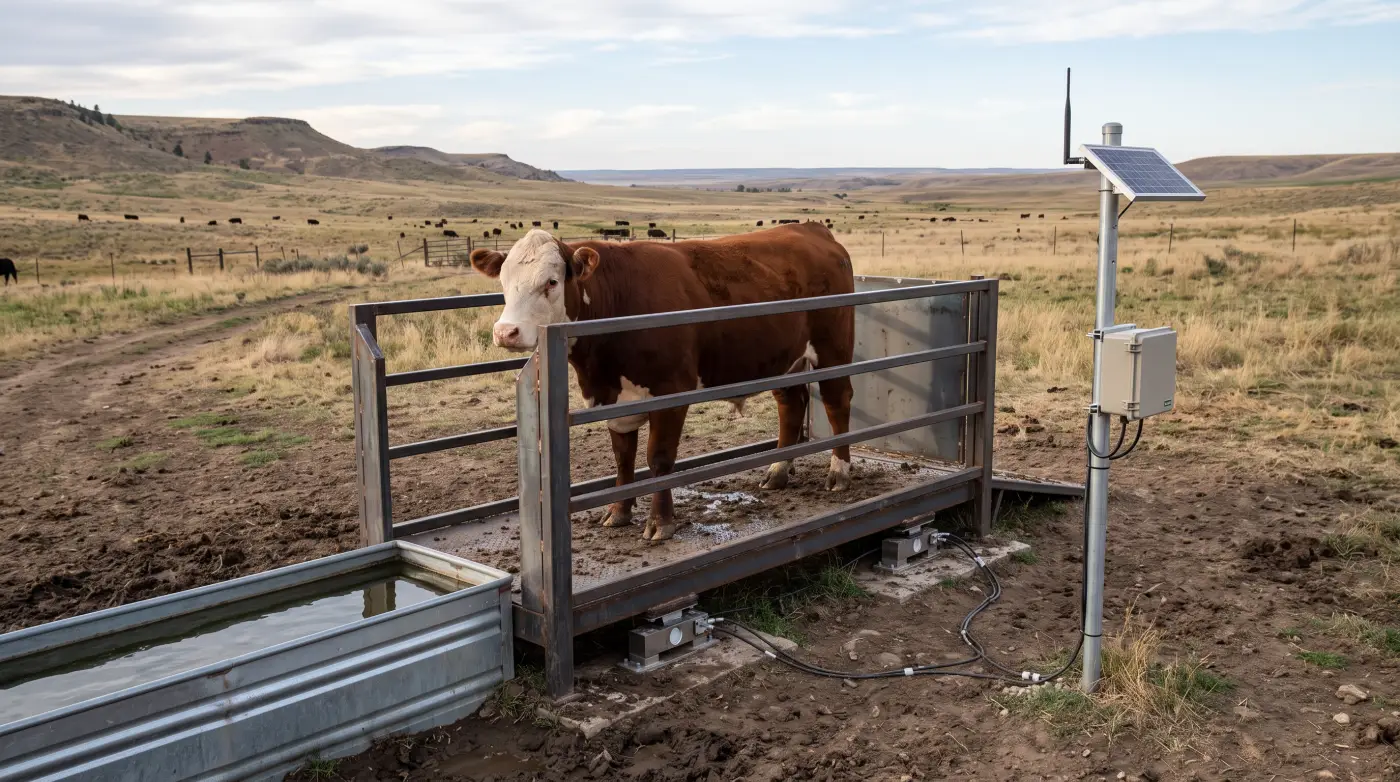
The idea is simple enough that it sounds too good when you first hear it. You put a weighing platform where the cattle already have to go, almost always the water point, sometimes a lick, mineral, or molasses station. The cattle walk across it or step onto it on their own, drawn by the water or the attractant. An EID (RFID) ear tag is scanned as the animal crosses, so the weight gets matched to that specific cow. The system captures the weight, applies an algorithm to smooth out gut fill, and pushes daily liveweight and average daily gain to an online dashboard you check from your phone or laptop.
No mustering. No yarding. No scheduled weigh day. The cattle weigh themselves on their own schedule, and you read the trend.
That is the loop in plain terms, and it is consistent across the major systems on the market: the Tru-Test and Datamars platforms, the Gallagher weighing and EID gear, and the Optiweigh in-paddock units. Where they differ, and it matters a great deal, is in how the animal actually gets weighed. That fork is the most important thing to understand before you spend a dollar.
The water point is also the reason this tech fits naturally onto a place that already thinks about where stock drink. If you have already invested in reliable livestock water systems or solar stock watering for pasture, you have already done the hard part of walk over weighing, which is getting every animal to reliably visit one spot.
There are two architectures, and conflating them is the single biggest mistake a buyer can make. They measure different things, fit different operations, and carry different trade-offs. Think of them as two tools for two jobs rather than a good one and a bad one.
The first design is a fixed platform the animal walks fully across, with all four feet bearing on the scale at some point. These are the Tru-Test, Datamars, and Gallagher systems, usually set in a single-file laneway leading to water or installed in a yard. Because the whole animal stands on the platform, the indicator captures true liveweight, the same quantity a crush scale measures. The Tru-Test dairy walk over weighing platform, for example, runs about 2.5 meters long with a 500 mm walking surface, a non-slip mat, and an integrated EID reader and antenna.
This is the design to pick when you care about accurate individual-animal data, the kind you would use for drafting decisions or marketing specific animals. The trade-off is infrastructure. You need a controlled walkway, power at the site, and the physical platform installed where the cattle funnel through. It is a more permanent setup.
The second design is the in-paddock unit, with Optiweigh the best-known example. It is a portable, solar-powered platform you drop in the paddock with a lick attractant on top. The animal puts only its front feet on the platform while it feeds, the unit reads the NLIS or EID tag and the partial weight, and an algorithm estimates full bodyweight from the front-feet reading. The unit runs on solar with cellular or satellite backhaul, and it moves with the mob.
That front-feet estimation sounds sketchy the first time you hear it, and it is fair to be skeptical. But it is the trade you make for very low infrastructure. You are not building a laneway or running power to a yard. You drop the unit in the paddock, and it follows the cattle. The cost is that you are estimating from a partial weight rather than measuring the whole animal, which makes this design best suited to mob-trend monitoring rather than precise individual numbers.
The clean way to choose: if you need every-animal individual data for drafting and marketing, lean toward the full platform. If you mainly want to know how the mob is tracking on gain, with minimal infrastructure and the freedom to move it around, the in-paddock unit is built for exactly that.
This is where the honest version of the story matters, because the accuracy answer depends entirely on which design you are talking about, and vendor pages tend to blur the two.
For full-platform systems, the strongest independent anchor comes from a peer-reviewed study of automated walk over weighing in lactating dairy cows, which found the weights landed within 5% of static scale weights in 96% of weighings. That is a genuinely good result for a system nobody has to operate, and because it is peer-reviewed rather than vendor-published, it carries weight.
For in-paddock front-feet systems, the numbers you will see quoted are mob-average claims, not individual-animal precision. Optiweigh and Meat & Livestock Australia trial material put the mob average within roughly 10 kg of a yard-weighed mob once enough animals have crossed, and MLA framing has cited walk over weighing tracking growth at around 98% accuracy at the mob level. Read those carefully: they are statements about the average of the whole mob, drawn from vendor and trial sources, not a promise that any single cow's reading on any single day is within 98% of truth.
Here is the line that ties it together and keeps you out of trouble. Walk over weighing is a trend instrument. A single day's individual reading is noisy. The rolling average over days is the actual product. Independent literature backs this up beyond the dairy study, including published work on automated walk over weighing tracking daily body mass in grazing steers and on predicting bodyweight and average daily gain from partial front-feet weight in growing beef cattle. The research exists, which is the cleanest rebuttal to "front-feet weighing cannot be real." Just do not port any one study's exact error figure onto your own herd and treat it as a guarantee.
Set your expectations before you set up the unit, because the first day's data will lie to you if you let it.
Optiweigh's own published guidance is useful here precisely because it cuts against over-promising, which makes it credible. A usable mob weight average comes in within 2 to 5 days, sometimes inside 24 hours. Average daily gain reporting starts after about 7 days, but 14 to 30 days is where it becomes genuinely reliable. Coverage runs roughly 20 to 50 animals per day, reaching 50 to 100 animals after 3 to 5 days, which is somewhere between a third and two-thirds of a typical mob.
The takeaway is the same as the accuracy section, just from a different angle. Give it days, not minutes. Not every animal volunteers every day, and the value shows up in the rolling average, not the first reading you anxiously refresh on the dashboard.
A weight number sitting in a dashboard does not pay for anything. What pays is the decision it lets you make sooner and with more confidence than your eye would have allowed.
The first use is hitting target or sale weight on evidence rather than guesswork. When you can see the mob average climbing toward your sale weight day by day, you market on data. You stop selling animals you could have carried another two weeks for real money, and you stop holding animals past the point of efficient gain.
The second use, and the one that earns its keep on a working place, is catching a stall or a drop in gain early. When the average daily gain line flattens or turns down, something changed: a feed shortfall, a water problem, parasites, illness, or a ration that simply is not working the way you assumed. Walk over weighing surfaces that days or weeks before it would show up at a yard weigh, which is days or weeks of feed and time you get back. MLA demonstration-site hosts reported exactly this, identifying more timely variations in weight gain and cutting the labor spent on weighing.
The third use is benchmarking. Move a mob to a new paddock or change a ration and the gain trend tells you within a couple of weeks whether the pasture or the feed is doing what you hoped. That is pasture and ration management run on numbers instead of impressions.
All of this assumes the weight data lands somewhere you will actually use it. The dashboard that comes with the system is the starting point, but the gain trend is far more useful when it lives alongside the rest of your herd records. If you are already running or shopping for cattle management software, the walk over weighing feed is one of the more valuable streams you can pipe into it. And once you trust the weight data, the logical next step for larger operations is acting on it automatically, which is where EID auto-drafting gates pick up the thread, sorting animals by weight without you standing at the gate.
The difference between a unit that earns its cost and one that gathers dust in a shed usually comes down to siting and a few practical details.
Put the platform where the cattle already have to go. The water point is the classic choice because thirst is the most reliable motivator on the place. A lick, mineral, or molasses attractant on or near the platform boosts voluntary crossings, which is the whole game with the in-paddock units. For laneway systems, a single-file approach to water funnels every animal across, which is how you get closer to full-mob coverage.
EID is mandatory for individual data. The platform weighs the animal, but the EID tag is what assigns that weight to this particular cow. No EID, mob average only. If you already run EID across the herd, you are most of the way there. The same tag-reading principle underpins a lot of the connected-herd tools, including GPS ear tags and virtual fencing on the monitoring side.
Connectivity is the detail people forget until the data does not show up. In-paddock units need cellular, often NB-IoT, or satellite backhaul to get the readings off the paddock. On a property with poor coverage at the back paddock, that is a real planning item, not an afterthought. Power is simpler: in-paddock units run on solar, while fixed platforms need power and an indicator at the site.
Finally, the gut-fill correction. The systems apply an algorithm to smooth out the daily swings caused by how much water and feed is in the animal at the moment it crosses. This is precisely why multiple crossings over several days beat one reading. A cow weighed right after a long drink reads heavier than the same cow weighed at dawn, and the algorithm plus the rolling average is what turns that noise back into signal.
There is no way around it: this is a real outlay, and you should budget honestly.
The model is upfront hardware plus an ongoing data subscription. In-paddock units are a several-thousand-dollar-and-up capital item with a recurring data fee. Fixed-platform setups, meaning load bars, an indicator, an EID reader, and the platform itself, also run into the thousands and climb depending on configuration. There is no version of this that is cheap, and you should be wary of anyone who tells you otherwise.
A straight word on pricing: public US dollar figures are thin. The in-paddock category is Australian-led and still emerging in North America, while Tru-Test, Datamars, and Gallagher load-bar and EID hardware is mainstream and widely sold in the US. Do not assume Australian list prices map to your local dealer. Budget for hardware plus subscription and get a real quote for your specific setup before you build the ROI case.
That ROI case is a genuine gut-check, and it comes down to three questions. How big is the herd? How often would you otherwise weigh, and what does each of those weigh days cost you in labor and shrink? And how much is it worth to catch a feed or health problem two weeks early? If you run an extensive grazing operation, weigh infrequently because it is a production in itself, and manage on gain, the math tends to work. If you can yard a small herd in twenty minutes any morning you like, the case is weaker, and there is no shame in deciding the tech is not for you yet.
A fair article names the catches, so here they are in one place.
Not every animal crosses every day. Voluntary weighing means voluntary, and shy animals or a poorly placed unit will skew your coverage. Front-feet estimation is partial by design, which is fine for mob trend and weaker for individual precision. Gut-fill noise is real, which is why you read days rather than single readings. Full-platform systems carry meaningful infrastructure requirements, a controlled walkway and power. And US adoption of the in-paddock concept is still emerging, sitting on top of mainstream load-bar and EID hardware rather than being a settled, everybody-does-it technology. The underlying tech is most proven in Australia and New Zealand, where extensive grazing, large mobs, and a strong EID mandate created the conditions for it, with formal producer demonstration trials behind it.
None of these are reasons not to buy. They are reasons to buy the right design for your operation and to set expectations accordingly.
Walk over weighing is a strong fit if you run extensive grazing or growing and backgrounding cattle and you care about the trend in gain. For that operation, turning weight from a stressful periodic event into a passive daily data stream is worth real money, in feed caught early, in animals marketed on evidence, and in weigh days you no longer run. Pick the full platform if you need accurate individual data for drafting and marketing. Pick the in-paddock front-feet unit if you want mob trend with minimal infrastructure and the freedom to move it around.
If you can yard your whole herd in twenty minutes and weigh whenever you feel like it, walk over weighing is probably not your next purchase, at least not yet.
Wherever you land, the principle behind it is the one worth carrying into every tech decision on the place: the best monitoring tools are the ones that work while you are doing something else. If you want more honest, no-hype breakdowns of farm technology that has to earn its cost, browse the rest of the Manley Farms blog or sign up for the email list so the next one lands in your inbox. We test the pitch against the field so you can spend your money on the tools that actually pay.
It depends on the design. A peer-reviewed dairy study found full-platform walk over weights landed within 5 percent of static scale weights in 96 percent of weighings. In-paddock front-feet units are a mob-average tool, typically within about 10 kilograms of a yard-weighed mob once enough animals cross. Treat any single day's individual reading as noisy and trust the rolling average instead.
Expect a usable mob average within 2 to 5 days, sometimes inside 24 hours. Average daily gain reporting starts around day 7 but becomes genuinely reliable between 14 and 30 days. Coverage runs roughly 20 to 50 animals a day, reaching 50 to 100 after 3 to 5 days, because not every animal volunteers to cross every day.
A full-platform system, such as Tru-Test or Gallagher, has the animal stand with all four feet on the scale, capturing true liveweight for accurate individual drafting decisions. An in-paddock unit like Optiweigh reads only the front feet while the animal licks an attractant and estimates full bodyweight, trading individual precision for portability and almost no infrastructure. Choose by whether you need individual or mob data.
For individual-animal data, yes. The platform captures the weight, but the EID or RFID ear tag is what assigns that weight to a specific cow. Without EID, you get a mob average only, which is still useful for tracking gain trends. If you already run EID across the herd for traceability, you have done most of the setup work already.
Join our list for practical guides on farm tech, precision agriculture, and tools that work.