
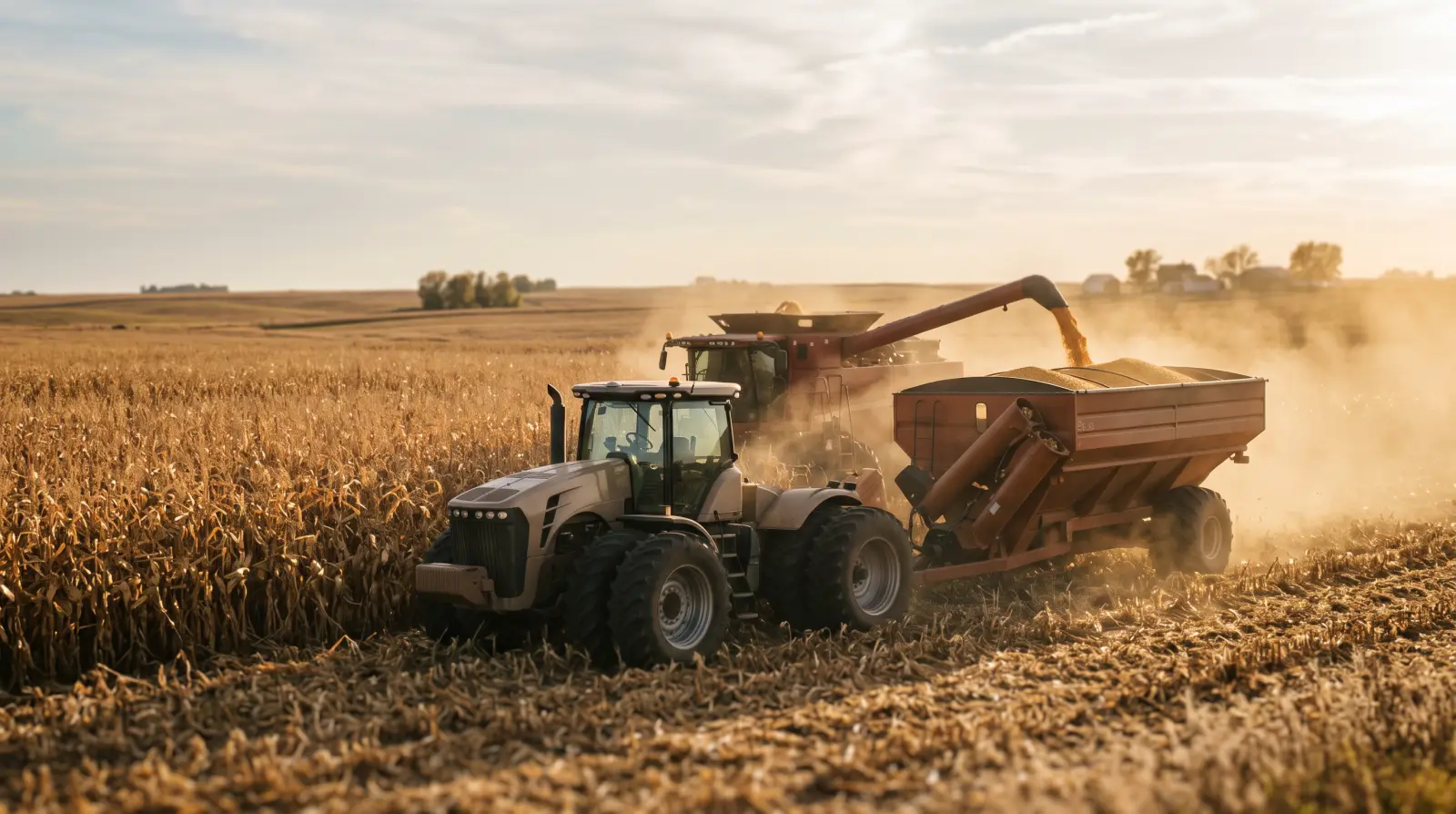
Every harvest comes down to one question: is the combine moving or is it sitting? A combine that stops to wait on a grain cart is burning the most expensive hour on the farm. And the job of keeping that cart under the auger - matching speed, holding the line, catching the grain on the go without spilling or driving on standing crop - is the hardest seat to fill on the whole crew. It is monotonous, it runs late into the night, and a tired operator on hour fourteen is exactly when you lose a cart-load on the ground.
That is the bottleneck the driverless grain cart was built to solve. Not planting, not tillage, not replacing your combine operator. One narrow, well-defined job: run the cart so a human does not have to. And here is what makes it worth your attention right now - this is the rare piece of farm autonomy that has actually crossed from trade-show demo to equipment you can buy and run this season. It works precisely because the job is so bounded.
This is the honest, working-farmer look at what an autonomous grain cart actually does today, which systems are real and shipping versus still in testing, what it costs to own and run, the strings attached, and the only math that tells you whether it belongs on your operation.
Kill the sci-fi image first. A driverless grain cart is not a robot that thinks for itself and roams the farm. It is a leader-follower system. The combine is the leader, run by a human the entire time. The cart - a tractor pulling an auger cart - is the follower, and it has been taught to do one thing very well.
Here is the sequence. The combine fills. The operator taps a tablet. The driverless tractor pulls the cart out, drives itself to the combine, matches its speed and path, and unloads on the go while both machines keep rolling. When the cart is full, it drives itself to a truck or a staging zone, dumps, and comes back for the next round. No second person in the cab. The combine operator stays in command the whole time - the cart comes when called and never gets ahead of the person actually running the harvest.
That is the entire job. It does not steer itself to the field on public roads, it does not decide when to harvest, and out of the box it does not till or plant. Understanding that narrowness is the whole point: it is shipping because nobody asked it to be a general-purpose farmhand. It was asked to fill one seat, and it fills it.
If you want the wider view of where farm autonomy is headed across every operation, that is a separate conversation - see our look at autonomous tractors and farm robotics. This piece stays in the harvest lane.
Two systems carry this category right now, and they share the same core idea: a human combine operator stays in charge while a driverless cart does the catching.
OutRun (PTx Trimble) - the one that is actually shipping. PTx Trimble is the precision-ag joint venture between AGCO and Trimble, and OutRun is its retrofit autonomy kit. That word - retrofit - matters. It is not a new tractor. It is a kit that bolts perception and control hardware onto a tractor you may already own, plus the steering and hydraulic control to make it drive itself. After an initial rollout across Nebraska, Iowa, Kansas, and Missouri, OutRun became commercially available across the U.S. for the 2025 harvest.
The catch is the compatibility list. As it stands, OutRun runs on John Deere 8R / 8000R tractors with IVT transmissions, model year 2014 or newer. Kits for Fendt 900 and 1000 series tractors, plus an OutRun tillage kit, are slated for July 2026. So the first real question is not "do I want this" - it is "do I own a tractor it works on." If you do not, the cost conversation gets a lot bigger.
Raven OMNiDRIVE - the other real system, slower to market. Raven (now under CNH, shown with New Holland equipment and demoed with dealers like Titan Machinery) built OMNiDRIVE around a tablet interface where the combine operator summons the driverless tractor and cart to unload on the go, keeping it synced to cut spillage and stay off unharvested crop. It has been heavily farmer-tested since around 2022, but its broad commercial rollout has lagged OutRun. If you are shopping today, treat OMNiDRIVE as demoed and farmer-proven, with commercial availability trailing - worth a call to a dealer to confirm current status before you count on it for this season.
There is a third name to note without overstating it: John Deere is developing its own system where the cart auto-syncs with the combine, matches speed, positions for the unload, and returns to the truck driverless. That one is in testing, not shipping. The lines blur a little, since OutRun retrofits onto Deere's own 8R tractors - but the clean takeaway is OutRun and OMNiDRIVE are the systems in the field, and Deere's in-house version is still on the way.
This is the question every reader actually has: what happens when a pickup pulls into the field, or a person walks out to the rig?
The sensing is layered. OutRun mounts its perception on the cab roof - Doppler radar and LiDAR plus AI cameras for seeing the field and what is in it. Positioning runs on PTx Trimble's Nav 900 GPS with RTK correction for the inch-level accuracy needed to hold a clean line next to the combine, and connectivity rides on Starlink.
The behavior is deliberately conservative. The system constantly monitors its surroundings. When it detects an object in its path, it slows down. If the object does not clear, it stops. It alerts the operator on an iPad or phone when it needs a human decision. For moving obstacles, it waits until the path is clear before continuing. The operating envelope is roughly up to 15 mph and field inclines up to about 15 degrees.
In plain terms: it is built to give up ground rather than push through. A driverless cart that stops and pings your phone is doing exactly what it should. That is the right instinct for a 30,000-pound rig moving through a field where people, trucks, and field edges are all in play. It is not a reason to get careless - you still set the field boundaries and keep people clear - but the obstacle logic is real and it errs toward stopping.
This whole capability is built on the guidance foundation you may already run. If you are still steering by hand, the natural first step is autosteer, not full autonomy - see auto-steer retrofits for older tractors and the RTK GPS guide for the accuracy layer underneath all of this.
Here is the number you came for, with an honest caveat attached.
Reported pricing for OutRun runs roughly $50,000 to $60,000 in one-time hardware, plus a fixed subscription of about $15,000 per year. That annual fee is not optional padding - it covers the RTK correction the receivers depend on, the Starlink satellite connection, and the AI compute and cloud costs that keep the system running. Notably, the company moved away from a usage-based model to a conventional fixed annual fee, which at least makes it a line item you can plan around.
Now the caveat, because it matters. That pricing comes from a detailed dealer and show-floor report, not an official published price sheet, and PTx Trimble still directs buyers to a dealer for an actual quote. So treat $50,000 to $60,000 plus $15,000 a year as reported figures as of mid-2026, useful for sizing the decision but not a quote. Prices and subscription terms move. Get a real number from your dealer before you build a budget around it.
And do not forget the line item that gets missed: the compatible tractor. If you do not already own a qualifying 8R, the true cost of entry is the kit plus the iron to put it on. The hardware is the headline, but connectivity and the annual fee are ongoing, and the tractor prerequisite can dwarf both.
This is where most autonomy articles wave their hands. Here is a straighter answer.
The recurring industry framing - and it holds up - is that the hardest case for this technology is not the mega-farm. The mega-farm can justify a full-time hand. The operation where a driverless cart pencils best is the roughly 1,000 to 4,000-acre farm that cannot justify a year-round extra employee but is genuinely short a body at harvest. That is the honest "is this me" filter, and it has two parts that both have to be true:
First, enough harvest acres to amortize $50,000 up front and $15,000 a year against the wage and the hassle of a seasonal cart operator. Second, a real struggle to seat a reliable seasonal driver in the first place. If you can easily hire a good cart operator every fall, the math is harder to make. If you spend every August dreading whether you will have a warm body in that seat - and whether they will still be sharp at midnight - the value shows up fast.
Treat that 1,000 to 4,000-acre band as a sizing heuristic, not a guarantee or a published ROI study. Below it, this is hard to pencil. Well above it, the saved wage is easier to justify. Run your own acres, your own labor reality, and your own dealer quote through it before you decide.
There is one piece of real-world experience worth sharing, and it reframes what you are actually buying. A producer in Mapleton, North Dakota, running OMNiDRIVE put it this way: "With the Raven OMNiDRIVE, I never missed the cart once. With the guy in there, we ended up spilling twice within a half hour."
That is one farmer's experience, not a statistic, and it should not be turned into a percentage. But it points at something the price sheet does not capture. The value is not only the wage you save. It is a cart that does not get tired, does not lose focus at 2 a.m. on hour fourteen, and does not miss the auger because it was reaching for a thermos. Spilled grain on the ground is money gone, and so is a combine idling while the cart wanders off line. A machine that holds the line every single pass is worth something real, even on top of the labor it replaces.
Be clear-eyed about what comes with a system like this.
There is an unresolved liability question. If a machine misreads a sensor, drives where it should not, and buries itself - or worse - whose fault is that? This is newer ground than the marketing admits, and it is worth raising with your dealer and your insurer before a kit ever touches your tractor.
There is the connectivity dependency, and it is not a footnote. OutRun rides on Starlink and RTK correction. If your fields sit in a dead zone or your correction signal is flaky, you need to know that before you spend a dollar - it is foundational to whether the system works on your ground, not a nice-to-have. If reliable field internet is a question mark for you, start with satellite internet for farms.
And there is the control and ownership question. With a subscription-driven, connected, sensor-heavy rig, you do not fully control or repair it the way you control a tractor you can wrench on yourself. That ties into the broader right-to-repair conversation and into who owns your farm data when your machines are streaming it to the cloud. None of this is a dealbreaker. All of it is worth understanding before you sign, not after.
Worth noting too: the cart still needs its weigh and logistics side handled - the autonomy moves the cart, it does not replace the scale and load-tracking work. If that side of your harvest is still manual, see our piece on grain cart weigh systems and logistics.
The driverless grain cart is the first farm robot you can actually buy, and it earns that status by doing one job - keeping the combine moving - extremely well, with a human still in command.
If you run enough harvest acres, already own a compatible tractor, struggle every fall to seat a reliable cart operator, and have solid field connectivity, this is worth a dealer call this season. If you are missing one of those - especially the compatible tractor or the connectivity - it is worth waiting one more season and watching the field develop. The things to watch: the Fendt and tillage kits arriving in July 2026, OMNiDRIVE's commercial rollout firming up, and where pricing settles as competition grows.
The technology is genuinely impressive. But the decision is not about how impressive it is. It is about your acres, your harvest labor, and a real quote from your dealer. Run those numbers honestly and you will know whether the second seat in your cart should stay empty next fall.
If you found this useful, it is one of a growing library of plain-spoken equipment and precision-ag guides we keep on the Manley Farms blog - built to help you make these calls with the numbers in front of you instead of the hype. Bookmark it before harvest planning starts.
OutRun is a retrofit, not a new tractor, and its compatibility list is narrow. As it stands it runs on John Deere 8R and 8000R tractors with IVT transmissions, model year 2014 or newer. Kits for Fendt 900 and 1000 series tractors, plus an OutRun tillage kit, are slated for July 2026. If you do not own a qualifying tractor, the iron becomes part of your true cost of entry.
Reported OutRun pricing runs roughly 50,000 to 60,000 dollars in one-time hardware plus a fixed subscription of about 15,000 dollars per year, which covers RTK correction, the Starlink connection, and cloud compute. Those are dealer-report figures as of mid-2026, not an official price sheet, so get a real quote. Add the cost of a compatible tractor if you do not already own one.
It runs layered sensing, Doppler radar and LiDAR plus AI cameras on the cab roof, and behaves conservatively. When it detects an object in its path it slows, and if the object does not clear it stops and pings the operator's iPad or phone for a decision. It waits for moving obstacles to clear before continuing. The operating envelope is roughly up to 15 mph on inclines under about 15 degrees.
The system pencils best on the roughly 1,000 to 4,000-acre operation that cannot justify a year-round extra employee but is genuinely short a body at harvest. Two things must both be true: enough harvest acres to amortize the hardware and annual fee, and real difficulty seating a reliable seasonal cart operator. Mega-farms can justify a full-time hand, and below the band it is hard to pencil.
Join our list for practical guides on farm tech, precision agriculture, and tools that work.