
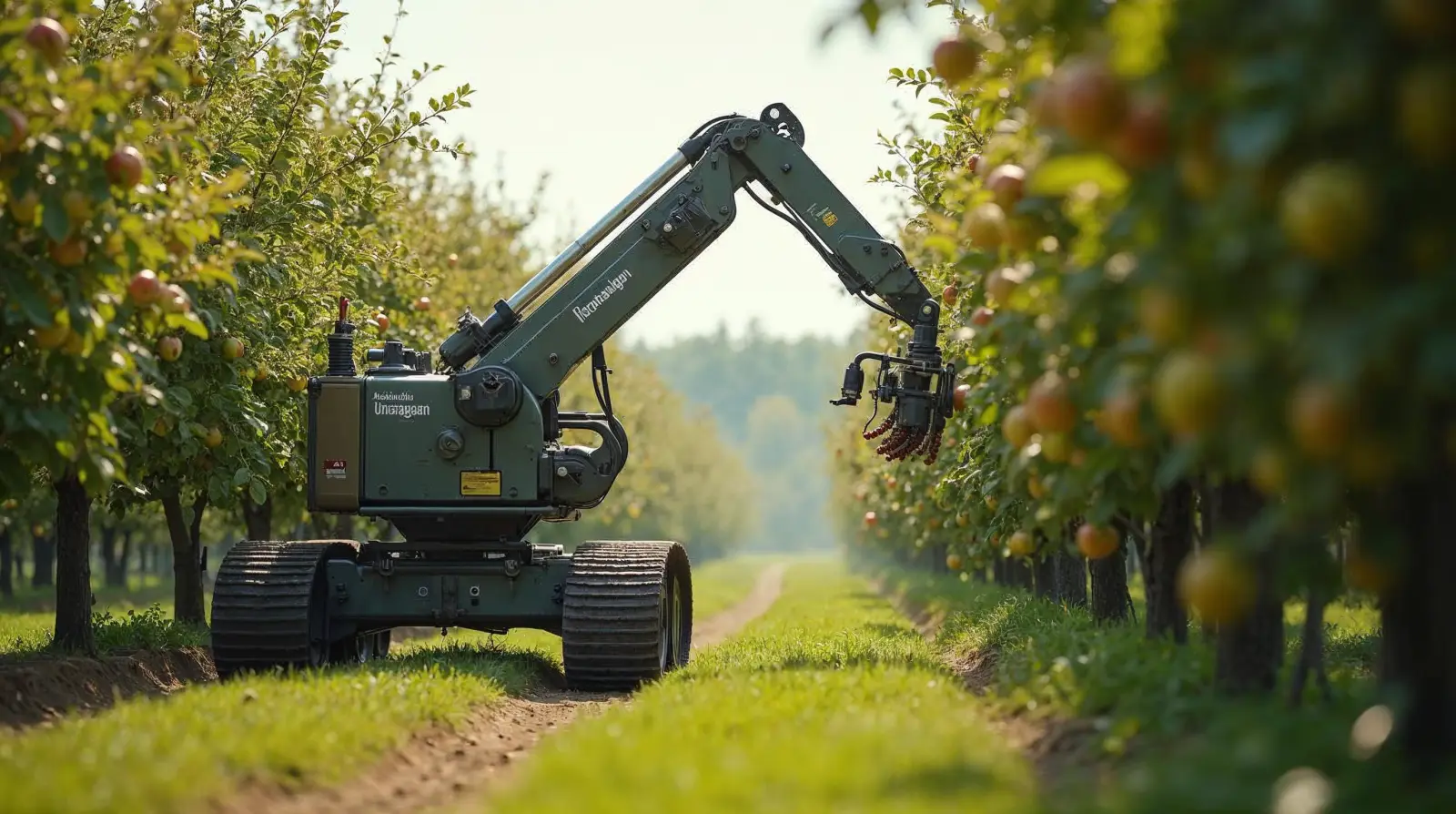
Robotic fruit harvesters are real but still frontier technology in 2026, not a product you can buy to pick a whole orchard. Machines from FFRobotics, Advanced Farm, and Tevel run in limited trials, still pick slower and bruise more than skilled crews, and several well-funded rivals have folded. Today's dependable win is a harvest-assist platform, not a robot.
Every fall the same two things are true at once. The labor bill climbs again, and a slick video crosses your feed of a machine picking apples by itself, arm after arm, no crew in sight. Then harvest arrives and the crew still shows up, because the robot in the video is not the robot you can rent. That gap between the promise and the pallet is the whole story of orchard picking automation right now, and it is worth understanding before you let a salesperson or a headline make the decision for you.
The honest picture is neither the fantasy nor the dismissal. Picking robots exist, they are being sold and trialed in real orchards, and the labor pressure funding them is not going away. They are also slow, expensive, and still learning not to bruise your fruit, and the ag-tech graveyard is full of companies that raised tens of millions and shipped nothing you could keep running. What follows is where that leaves a working grower, and what you can actually do about it this season.
The engine behind every picking robot is labor cost, not novelty. Fruit and vegetable producers can spend up to roughly 40% of production expenses on labor, and harvest is the sharpest spike of the year. Total U.S. farm labor expense reached about $53.5 billion in 2025, up around 3.6% from the year before, driven by wage increases and ongoing shortages. Apple growers have felt the squeeze from both ends at once, with grower prices down sharply over recent years while labor costs climbed roughly 60% over the last decade.
The guest-worker math is what makes an expensive machine pencil out on a spreadsheet. H-2A adverse effect wage rates for 2025 ran from roughly $14.83 an hour in the lowest states to nearly $20 an hour in California, and Washington State's rate climbed from $12.00 in 2013 to close to $19.82. Add mandatory housing, transportation, and compliance overhead and the true loaded cost of an H-2A worker is commonly put in the $25 to $30-plus range. That number is exactly the target a robot vendor points at.
Two cautions before you treat that as a one-way ramp. First, the shortage is real but episodic, not a permanent uniform emergency. In the 2025 Specialty Ag Labor Survey, 70% of growers reported securing adequate labor, up from 54% the prior year. Second, wage policy is genuinely in flux. A late-2025 Department of Labor rule moved to cut some H-2A rates after a decade of steep increases. Since a robot's entire return-on-investment case rests on the labor cost it displaces, and that cost just got less predictable, the honest read is that labor is high but volatile, not a guaranteed and growing tailwind.
Every picking robot does the same two jobs: it uses machine vision to find and grade ripe fruit, then a mechanical hand, the end-effector, to remove it. This is the same see-then-act pattern behind the vision systems we covered in AI crop scouting and see-and-spray weed detection. The hard part in an orchard is not seeing the apple. It is reaching it through leaves and branches and getting it off the tree without a bruise. Three approaches split the field.
There is a fourth category growers constantly lump in with robots, and keeping it separate is the most useful thing in this article. More on that below.
Here is the honest scorecard. Today's picking robots generally pick slower than a skilled human and damage more fruit. Reported strawberry comparisons put a skilled hand crew around 8 to 12 flats an hour against current robots at roughly 4 to 8. Those figures come from industry aggregators rather than peer-reviewed trials, so read them as illustrative ranges, not gospel. The direction, though, is solid: a robot trades away speed and gentleness in exchange for never tiring, never getting injured, and running close to 20 hours a day.
Fruit damage is the other gate, and the one that quietly kills the economics. A machine that bruises fruit makes culls, and culls are lost revenue on every pass. Vendors are still chasing the roughly 5% commercial-damage threshold that separates a viable tool from an expensive science project. Reach is the third limit. A robot only picks what it can see and touch, which is why the fruit it misses still needs a human follow-up pick.
Then there is the graveyard, and it is the single most important honesty in this piece. Abundant Robotics ran the world's first commercial robotic apple harvest in New Zealand with T&G Global in 2019, a genuine milestone. By June 2021 the company had shut down its fruit-harvesting business, unable to build enough market traction or raise follow-on funding through the pandemic. Its intellectual property later went to Wavemaker Labs. The highest-profile apple-picking robot in the world lasted about two years as a going concern.
Berry robots tell a parallel story of consolidation rather than open-market shipping. In March 2025, vertical-farming company Oishii acquired the key IP, assets, and engineering team of Tortuga AgTech, the Colorado strawberry and table-grape harvesting-robot startup that had raised around $55 million since 2016 and won a 2024 ag robot of the year award. Even award-winning berry technology did not become a machine you could buy for your field. It got absorbed into one company's controlled-environment operation. The lesson for a grower is blunt: signing up as an early adopter means buying a science project, not a combine.
The dependable purchase in 2026 is not a picking robot at all. It is a harvest-assist platform. These self-propelled machines keep your crew doing the picking but automate the drudgery: they position workers at the right height, run conveyors to move fruit to bins, and adjust speed to fruit density. They do not replace the crew. They make the crew faster, cut ladder time, and reduce the injuries that cost you people mid-harvest.
That distinction is the whole game. A harvest-assist platform still uses human hands. A harvesting robot tries to remove them. The platform is proven, commercially available, and pays back in throughput and safety today. The robot is a bet on a machine with little track record in your block. Do not let a vendor blur the two.
This is also the part of the orchard where automation has genuinely arrived elsewhere on the calendar. Spraying and mowing were automated well before picking, which tells you something about relative difficulty. If you want the automation that is real right now, look at autonomous orchard sprayers and autonomous mowers for orchards and pasture before you look at a picking arm. The same holds in the barn, where robotic milking systems have real adoption because the cow, unlike an apple in a canopy, comes to the machine.
Full automation lands first on high-value, high-labor crops grown on a flat plane, and this is a decision-relevant fact most coverage skips. Strawberries are picked around 40 times a season and harvest can run 50% to 60% of farm cost, which is exactly why berry robots drew the most money. Modern high-density apple plantings on a vertical trellis, a fruiting wall, give a robot a flat, predictable surface it can actually see and reach.
An old-style, large-canopy standard orchard is the opposite: fruit scattered in three dimensions behind leaves and limbs, which is close to the worst case for a robot arm. If you are replanting anyway, a 2-D fruiting wall does more than simplify pruning and spraying. It is the single biggest thing you can do today to keep a future robot on the table. The architecture you plant now sets the automation menu you will get to order from in ten years.
Treat any full-harvest robot claim like you would treat any big-ticket piece of iron with no track record, because that is what it is. A short buyer's discipline:
For almost every grower, the move is watch-and-wait on full picking robots and act now on everything around them. Evaluate a harvest-assist platform this season if labor and injuries are your bottleneck; it is the automation that actually pays today. If you are replanting, plant for a 2-D fruiting wall so the future stays open. Keep an eye on FFRobotics, Advanced Farm, and Tevel as their trials mature, but keep your harvest plan built on people until a machine has earned a place in your block.
The robot in the video is real. It is also a place where some of the smartest, best-funded companies in ag-tech went broke. Respect both facts and you will make a good decision. We track orchard and specialty-crop automation as it moves from trial to tool, so if you want the honest version rather than the vendor version, our orchard automation guides are a good place to start, and you can join the email list to get new breakdowns as this technology actually ships.
No. As of 2026 there is no picking robot you can buy and rely on to harvest a full orchard on its own. Machines from FFRobotics, Advanced Farm, and Tevel are in limited commercial trials, still pick slower and bruise more than skilled crews, and generally miss fruit a human must follow up on. The dependable purchase today is a harvest-assist platform, not a full robot.
Abundant Robotics ran the world's first commercial robotic apple harvest in New Zealand in 2019, then shut down its fruit-harvesting business in June 2021. The company could not build enough market traction or raise follow-on funding through the pandemic. Its technology later passed to Wavemaker Labs. It stands as the clearest warning that even a headline-making picking robot can vanish in about two years.
Slower, for now. Reported strawberry figures put a skilled hand crew around 8 to 12 flats per hour against current robots at roughly 4 to 8. Those ranges come from industry aggregators, not controlled trials, so treat them as directional. A robot's real edge is not speed. It is running close to 20 hours a day without tiring or getting injured.
A harvest-assist platform. It keeps your crew picking but positions workers at the right height, runs conveyors to bins, and adjusts to fruit density, raising throughput and cutting ladder injuries. It is proven and commercially available today, unlike full picking robots. Autonomous sprayers and mowers are also mature buys, since spraying and mowing were automated well before picking.
Yes, significantly. Robots pick best on a flat, planar canopy such as a high-density apple fruiting wall or a trellised berry system, where fruit is visible and reachable. A large-canopy standard orchard hides fruit in three dimensions and is far harder to automate. If you are replanting, choosing a 2-D fruiting wall is the biggest single step toward keeping future automation possible.
Join our list for practical guides on farm tech, precision agriculture, and tools that work.