
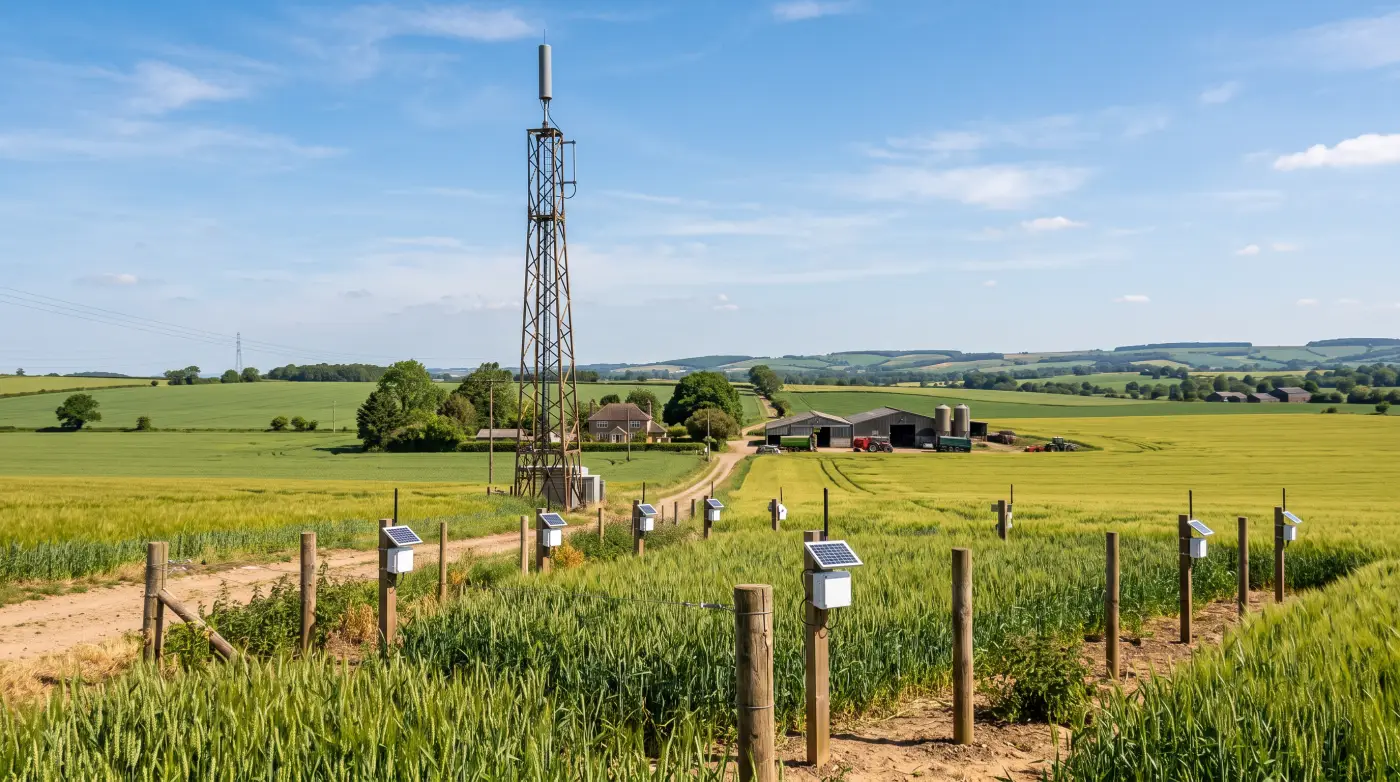
LoRaWAN is a long-range, low-power radio network that lets one antenna on your barn collect readings from dozens of cheap, battery-powered sensors spread across the farm - tank levels, gate states, soil moisture, bin temperature. It trades data for reach: a few bytes a few times an hour, sensors that run for years, and coverage measured in miles.
Every farm has a list of things you check by driving to them. The stock tank in the far pasture that might have frozen over or run dry. The gate down the lane you cannot see from the yard and are never quite sure is latched. The grain bin you lie awake worrying about on a warm, humid night in the fall. None of these needs much information. Each one just needs to tell you a single number or a single yes-or-no, and it needs to tell you from a long way off without you standing there.
The fix most people reach for is a fancier sensor. That is the wrong instinct. A better tank float does not help if you still have to drive out to read it. What you actually want is a network - something that lets a lot of cheap, dumb, long-lived sensors phone home to one place, so the tank, the gate, and the bin all report to your phone instead of your pickup.
That network is what LoRaWAN is. The name stands for Long Range Wide Area Network, and the whole design is built around one idea: move tiny amounts of data over long distances on almost no power. It is not fast, it does not carry much, and that is the point. It gives you reach and battery life, and it pays for both by sending only a handful of bytes at a time.
Here is the single most common mistake, and it will cost you money if you make it: LoRaWAN is not a sensor. It is not a product you bolt onto a tank. It is the radio network that ties a whole yard full of sensors back to one place. Keep three parts straight and the rest of this makes sense.
The end devices are the sensors out in the field. They are cheap, they run on a battery, and they are lazy on purpose. A sensor wakes up, sends one tiny packet - the tank is at 40 percent, the gate is open, the soil is dry - then goes back to sleep. Because the radio is switched off almost all the time, this is where the multi-year battery life comes from.
The gateway is one antenna, usually mounted up high on a barn, a pole, or a grain leg. It listens for every sensor within range and forwards their packets to the internet over ethernet, wifi, cellular, or increasingly satellite. A single gateway can hear dozens to hundreds of sensors. This is the piece that turns "a lot of sensors" into "one cheap network," and it is the part vendors quietly leave out of the sticker price.
The network server and app is the software that unscrambles those packets, keeps track of your devices, and pushes the readings to a dashboard or a text alert. It can be a free community network, a paid managed service, or your own server. This is the layer that turns a raw packet into a message that says the far tank is low.
A sensor salesman will happily sell you the first part and skip the middle one. Understand the gateway before you buy anything, because the gateway is the whole reason the math works.
Everything good and everything frustrating about LoRaWAN comes from one tradeoff. To reach for miles on a coin cell, the radio has to send very little, very slowly, very rarely.
In North America, LoRaWAN runs in the unlicensed US915 band, the slice of spectrum from 902 to 928 MHz, so there is no license or airtime fee to use it. The data rates in that band run from roughly 980 bits per second at the longest range up to around 22 kilobits per second at short range. Read those numbers again: that is bits, not megabits. You are sending a few bytes per message, a few times an hour. There is also a hard cap of 400 milliseconds that any one transmission can occupy a channel, which is the technical reason your sensors have to keep their messages short.
There is a lever in the middle called spreading factor. Turn it up and a message travels farther but takes longer to send and burns more battery. Turn it down and it is quick and cheap but does not reach as far. Range, battery, and airtime are all the same dial. You do not get to max out all three.
What this rules in is exactly the farm chore list: a level, a state, a temperature, a moisture reading. One small fact at a time. What it rules out is anything with real bandwidth. You cannot stream a camera over LoRaWAN. You cannot send a photo. You cannot get a reading every second. That is not a limitation someone will fix in the next version - it is physics, baked into the range and power you are buying. If you want eyes on the calving barn, that is a job for cellular signal boosters or Starlink, not this.
You will see "up to 10 to 15 kilometers" quoted everywhere. Treat that as a ceiling, not a promise. That figure is line-of-sight, meaning a clear path with nothing in the way and the antenna up high. Your farm is not line-of-sight. Timber, rolling ground, metal buildings, and a standing crop in July all eat range, and the taller the crop gets the worse it looks by August.
Realistic on-farm coverage through cover is usually in the low single-digit miles, and the biggest lever you control is antenna height. A gateway on the peak of a tall barn or partway up a grain leg will out-cover a better radio sitting low every time. Get it up high and get it in the clear.
The honest way to buy is to test before you commit. Put a cheap node in the pickup, mount the gateway where you think it will live, and drive the property. Watch where the packets stop coming in. An afternoon of that tells you more than any range spec on a box, and it tells you whether one gateway covers your ground or whether the back forty needs its own.
Vendors advertise three to ten years, and you will see "up to 10 years" on plenty of spec sheets. Multi-year battery life is real, but that top number is a ceiling under ideal conditions, not something you should bank on.
Three things drain the battery. How often the sensor talks - every fifteen minutes is far hungrier than four times a day. How far it has to reach - a high spreading factor to punch through timber costs airtime and power. And temperature - a battery on a gate post in a Midwest January does not perform like it did in the catalog. The defensible expectation is simple: a Class A sensor that reports infrequently will run for years on one battery. Ask more of it and plan to change batteries sooner.
That word Class A matters. LoRaWAN sensors come in classes that set their power draw. Class A, the low-power default, sends its message and then listens only briefly, twice, right after. This is where the years-long battery life lives, and it is what nearly every field sensor uses. The tradeoff is that you can only send a command back to the sensor in that short window right after it talks to you. Class C listens continuously, which lets you control it any time but burns power fast, so it is normally reserved for mains-powered gear like a valve actuator. A soil probe is Class A. A powered valve on the pivot might be Class C. Match the class to whether the thing has power.
Anything that boils down to a small reading sent occasionally, which on a working farm is a long list:
The through-line is that every one of these is a single small fact. Where all those facts land - a dashboard, an alert, a spreadsheet you can actually use - is a question of farm software and data integration, and it is worth deciding before you own a pile of sensors talking to nothing.
You have three honest ways to run the network layer. The Things Network is a free, open, community network - a fine place to start, but its coverage and uptime are best-effort, so do not assume it reaches your ground. Helium is a decentralized network where hotspot hosts earn crypto and coverage is crowd-sourced, which means it is there until it is not. A private or managed network is your own gateway pointed at a paid or self-hosted server, which costs more and gives you control and reliability in return.
For a farm that needs its own dependable coverage, the practical answer is almost always to own your gateway and point it at either The Things Network or a managed server. Do not build your operation on the hope that a stranger's hotspot down the road stays online. This is the same lesson as the rest of rural connectivity: control the piece you depend on.
On security, LoRaWAN encrypts its payloads end to end with AES-128, the same class of encryption banks use. Your tank levels and gate states are not broadcast in the clear for a neighbor to read off the air. That is genuine reassurance, but it is not magic - the keys still have to be managed properly, so keep your device credentials as carefully as you would any password.
Prices move by brand, region, and where you buy, so treat every figure here as a rough guide and get a real quote before you spend. A basic outdoor starter gateway runs around $100, with professional cellular-backhaul units costing more. Individual sensors land roughly in the $30 to $100 range depending on what they measure. The important shape of the cost is this: the gateway is a one-time expense you pay once and then amortize across every sensor you ever add. Buy it for two sensors and it looks expensive. Spread it across fifteen and it disappears into the noise.
Which points straight at the honest "do not buy this" cases. If you have one or two sensors, skip LoRaWAN. A single cellular or NB-IoT node with its own SIM card is simpler - there is no gateway to buy, mount, power, and maintain. If you need any real bandwidth - video, images, anything you want to watch live - LoRaWAN cannot do it and never will. Cameras are a cellular or satellite job, full stop, and there is no shame in running remote livestock cameras on a completely separate connection.
LoRaWAN wins in exactly one shape: many low-data sensors spread across ground that one gateway can cover. So before you buy anything, do two things. Count your sensors - list every tank, gate, bin, probe, and barrel you would actually want to watch, and be honest about whether that list is three things or thirty. Then map your coverage - figure out how far apart those points sit and whether one well-placed antenna can hear them all. Our free Field Boundary and Input Calculator is a quick way to draw your ground and measure the distances between the far corners before you shop for a gateway. If the sensor count is high and the distances fit under one antenna, LoRaWAN is built for you. If not, a couple of cellular nodes will serve you better and cheaper.
If you want the plain-English breakdowns as we publish them, the farm-tech notes we send out are free to join, and there is no pitch attached. The goal here is the same as the network itself: put the useful signal where you can actually use it.
LoRaWAN is a long-range, low-power radio network that connects many cheap, battery-powered sensors to a single gateway antenna on your farm. Each sensor sends a tiny reading - a tank level, a gate state, soil moisture - a few times an hour, and the gateway forwards those readings to your phone or a dashboard over the internet. It is built for lots of small signals over long distances, not for streaming.
The advertised range of 10 to 15 kilometers is a line-of-sight ceiling with the antenna up high and nothing in the way. On a real farm with timber, hills, buildings, and standing crops, expect coverage in the low single-digit miles. Antenna height is your biggest lever, so mount the gateway as high and clear as you can, and drive the property with a test node before you commit.
It depends on how many sensors you have. For one or two sensors, a cellular or NB-IoT node with its own SIM is simpler and cheaper because there is no gateway to buy and maintain. LoRaWAN wins when you have many low-data sensors spread across ground that a single gateway can cover, since the one-time gateway cost then spreads across every sensor you add.
A Class A sensor that reports infrequently will typically run for years on a single battery, and vendors quote figures from three up to ten years. Treat the high numbers as ideal-condition ceilings. Battery life shrinks the more often the sensor transmits, the farther it has to reach, and the colder it gets, so plan around "multi-year," not a guaranteed decade.
No. LoRaWAN moves only a few bytes at a time by design, which is what gives it long range and years of battery life. It physically cannot carry video, images, or live streams, and that will not change with a newer model. For cameras, use a cellular or satellite connection instead and keep it separate from your LoRaWAN sensor network.
Join our list for practical guides on farm tech, precision agriculture, and tools that work.